In summary:
- Focus on high-contrast, simple items like black and white cards to match your newborn’s developing vision.
- Prioritize “passive” toys (e.g., wooden blocks) over “active” electronic toys to build concentration.
- Drastically limit time in “containers” like bouncers and swings to encourage natural motor skill development.
- Design a “Yes Space” where your baby has total freedom of movement without constant intervention.
- Combat visual clutter by rotating a small number of toys and using neutral decor to create a calm, focused atmosphere.
The urge to prepare for a new baby often translates into an overwhelming accumulation of things. The nursery becomes a landscape of pastel-colored plastics, musical swings, and baskets overflowing with toys. Well-meaning advice tells you to buy “educational” items and to create a “stimulating” space, but this often leads to a visually chaotic environment that overstimulates the infant and overwhelms the parent. You end up with a room full of plastic junk that promises development but delivers distraction.
The common approach is to fill the space with as much as possible, believing more choice equals more learning. We’re told to get the bouncer that plays Mozart, the mobile with flashing lights, and a toy for every conceivable scenario. But what if the key to fostering deep, meaningful development isn’t about adding more, but about intentionally taking away? What if the most powerful environment is one of curated simplicity, designed not to entertain, but to empower?
This is the core of the Montessori philosophy for infants. It’s not about a specific brand of wooden toys or an aesthetic. It’s a form of environmental engineering that respects the child’s innate developmental drives. It’s about understanding the ‘why’ behind every object you introduce into their world. This guide will walk you through the foundational principles for creating a space that honors your baby’s need for movement, concentration, and order, transforming their room from a place of passive entertainment into a laboratory for active learning.
This article provides a structured approach to applying these principles. We will explore the science behind visual stimulation, the crucial difference between toys that build focus and those that break it, and the practical steps to declutter both physically and visually for a truly supportive infant environment.
Summary: A Minimalist’s Guide to the Montessori Infant Environment (0-6 Months)
- Why Black and White Cards Stimulate Brain Growth Better Than Pastels?
- How to Set Up a “Yes Space” That Encourages Crawling safely?
- Passive Toys vs Active Toys: Which Ones Actually Build Concentration?
- The “Container” Mistake That Delays Walking Milestones
- When to Rotate Toys: The Sign That Your Baby Is Bored with the Selection?
- Pikler Triangle vs Foam Blocks: Which Investment Lasts Longer for Active Play?
- How to Purge 50% of Your Toys Without Causing a Meltdown?
- The Visual Clutter Mistake That Kills Creativity Instantly
Why Black and White Cards Stimulate Brain Growth Better Than Pastels?
A newborn’s world is blurry. Their visual system is one of the last sensory faculties to fully mature, and at birth, they see primarily in shades of grey. Research on infant vision shows that newborns have approximately 20/400 visual acuity, meaning they can only clearly focus on objects 8-12 inches away. The rods and cones in their retina responsible for color perception are not yet fully developed. This is why soft pastels, which dominate the traditional baby market, are virtually invisible to them.
High-contrast images, specifically black and white, provide the strongest possible visual signal to a baby’s developing brain. These stark patterns fire signals from the retina to the brain, stimulating neural connections and encouraging cognitive growth. This isn’t just about “keeping them busy”; it’s about providing the precise input needed for their eyes and brain to learn to work together. It’s a direct response to a developmental imperative: the infant’s innate drive to make sense of the visual world.
As their vision matures, you can use these tools to encourage specific skills. Following the cards helps develop eye-tracking, and placing them strategically during tummy time can motivate head and neck strength. The process is a gradual one:
- 0-4 weeks: Hold static cards 8-12 inches from the baby’s face during quiet, alert periods.
- 4-8 weeks: Slowly move the cards horizontally to encourage their eyes to track the movement.
- 8-12 weeks: Place cards near their tummy time area to motivate head-turning.
- 3-6 months: Introduce more complex patterns and begin rotating cards at different angles as their binocular vision develops.
By choosing high-contrast visuals, you are not just decorating; you are providing essential tools for brain construction. Parents often report their baby’s eyes “lighting up” when presented with these cards, a clear sign of engagement and focused attention that a muted, pastel environment simply cannot provide.
How to Set Up a “Yes Space” That Encourages Crawling safely?
The concept of a “Yes Space” is central to the Montessori infant environment. It is an area where everything within the baby’s reach is safe for them to touch, mouth, and explore. The goal is to eliminate the need for the parent to constantly say “no” or redirect the child, thereby fostering independence and uninterrupted concentration. This space is the physical embodiment of movement freedom, a direct antidote to the restrictive nature of playpens and “containers.”
Setting up a “Yes Space” is an act of environmental engineering. It begins with safety: cover all electrical outlets, secure all furniture to the walls, and remove any small objects, choking hazards, or unstable items. The ideal foundation is a firm, comfortable mat on the floor, but it shouldn’t be a sensory dead zone. Incorporating different textures, such as a low-pile wool rug next to a smooth wooden floor, provides rich sensory input that is crucial for brain development.
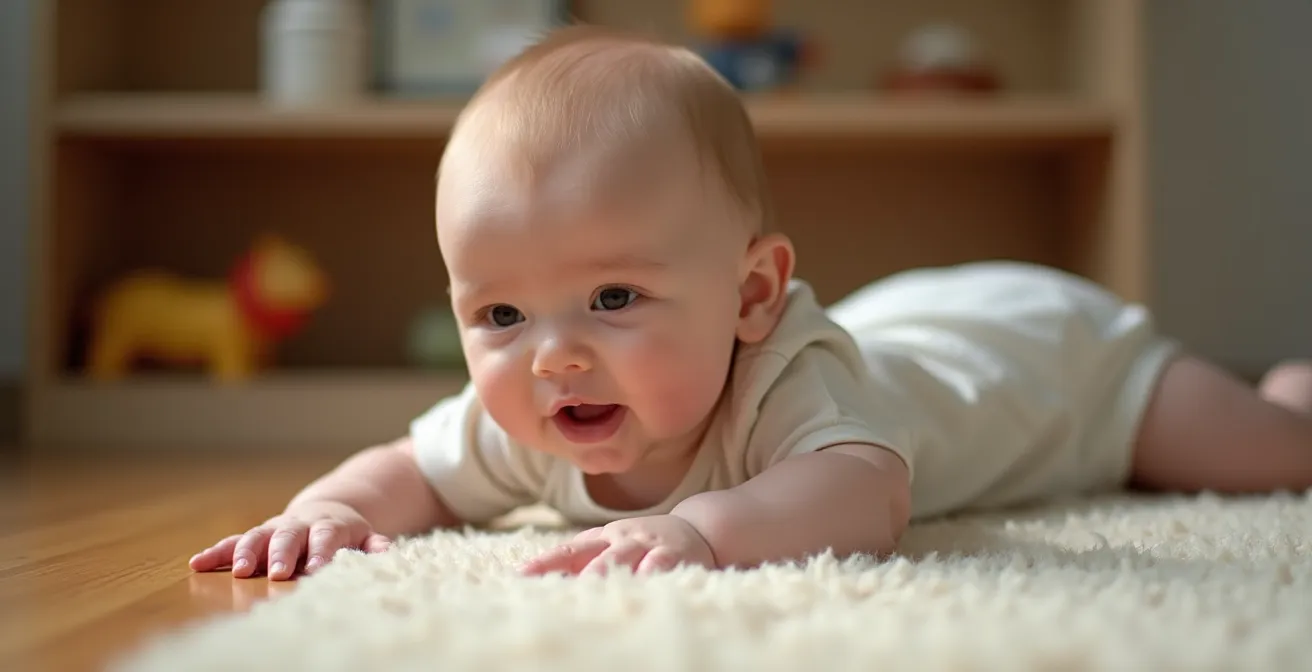
As seen in the space above, the environment invites exploration. It is prepared for the child’s developmental needs, not for adult convenience. A low shelf with just two or three carefully chosen toys encourages movement with a purpose. A mirror secured to the wall at floor level provides fascinating feedback and encourages lifting the head during tummy time. The entire area is designed to support the developmental imperative of movement, allowing the infant to begin the foundational work of pushing up, rolling, and eventually crawling without restriction.
This space sends a powerful message of trust to the infant. It says, “This world is for you. You are capable. You are free to explore.” By preparing the environment in this intentional way, you are not just baby-proofing a room; you are laying the groundwork for physical confidence and a deep-seated sense of security and autonomy.
Passive Toys vs Active Toys: Which Ones Actually Build Concentration?
The things he sees are not just remembered; they form a part of his soul.
– Maria Montessori, Montessori for Babies: A Complete Beginner’s Guide
In a Montessori context, toys are considered “work” for the child, and their purpose is to aid in development. A critical distinction is made between “passive” and “active” toys. An active toy is one that does something to entertain the child—it has batteries, lights up, or plays music at the push of a button. The child is a passive recipient of the toy’s entertainment. A passive toy, by contrast, does nothing on its own. It requires the child to be the active one, to manipulate it, explore its properties, and discover its potential.
Electronic toys create a high cognitive load. They bombard the infant’s developing brain with external stimuli (lights, sounds, pre-programmed actions), which can be overwhelming and lead to short attention spans. The feedback is external and predictable. In contrast, a simple wooden rattle or a set of interlocking discs has a low cognitive load. The child’s brain is free to focus on the task at hand: feeling the texture, understanding the weight, discovering the sound it makes when shaken, or figuring out how to transfer it from one hand to the other. The feedback is internal, driven by the child’s own discovery of cause and effect.
This difference is fundamental to building concentration. An active toy trains the brain to expect entertainment, while a passive toy trains the brain to create its own engagement. This table from an analysis of Montessori materials clarifies the developmental impact:
| Aspect | Passive Toys | Active Toys |
|---|---|---|
| Cognitive Load | Low extraneous load – child’s brain focuses on manipulation | High extraneous load – lights/sounds overwhelm processing |
| Developmental Progression | Grows with child (grasp → transfer → connect) | Single function, quickly outgrown |
| Feedback Loop | Internal – child discovers cause & effect | External – toy responds predictably |
| Concentration Building | Extended focus through self-directed exploration | Brief attention, passive entertainment |
| Examples | Wooden rattles, interlocking discs, grasping beads | Electronic mobiles, musical toys, light-up buttons |
Choosing passive toys is an act of trust in the child’s innate ability to learn and explore. It is about providing tools, not distractions, and creating the mental space necessary for deep, focused work to occur. This is how a child builds the foundational skill of concentration, one of the greatest gifts of a Montessori education.
The ‘Container’ Mistake That Delays Walking Milestones
The modern baby market is saturated with “containers”: bouncers, walkers, jumpers, swings, and activity centers. They are marketed as convenient for parents and entertaining for babies. However, from a developmental perspective, these devices represent a significant obstacle to motor skill acquisition. They restrict natural movement, place the baby in unnatural positions, and can actively delay major milestones like sitting, crawling, and walking. True movement freedom happens on the floor, not in a plastic seat.
When an infant is placed in a container, their core muscles are not engaged. They are held in a fixed position that prevents them from practicing the subtle shifts in weight, the strengthening of their back and neck, and the coordination of limbs required for independent mobility. Studies on infant mobility show that infants who are allowed unrestricted movement on the floor tend to develop gross motor skills 15-20% faster than their “contained” peers. The floor is the baby’s natural gymnasium.
Of course, there are moments when a parent needs a safe place for their baby for a few minutes. The key is intentionality and moderation. The goal is not to eliminate containers entirely but to demote them from a primary living space to a very short-term tool. A disciplined approach is necessary to protect the crucial window for motor development.
Your Action Plan: Auditing “Container” Usage
- Inventory: List all “containers” in your home (bouncers, swings, walkers, activity centers) to understand what you’re working with.
- Time Tracking: For one full day, track the total time your infant spends in any container. Is it under the recommended 60-minute maximum?
- Ratio Check: For every 15 minutes of necessary container time, ensure it is immediately followed by at least 30 minutes of unstructured, free floor time.
- Alternative Audit: Identify situations where you typically use a container. Could babywearing or a pre-prepared safe floor space be a viable alternative?
- Environment Scan: Does every main living area in your home have a designated, safe, and inviting “yes space” on the floor to make it the default option?
By consciously minimizing container use and maximizing floor time, you are giving your child the greatest advantage in developing physical confidence, coordination, and strength. You are respecting their developmental imperative to move and explore their world on their own terms.
When to Rotate Toys: The Sign That Your Baby Is Bored with the Selection?
Toy rotation is a cornerstone of the Montessori home, but it’s often misunderstood. The goal isn’t to constantly surprise the child with novelty or to adhere to a rigid schedule. The purpose is to create an orderly, uncluttered environment and to present materials that are perfectly matched to the child’s current developmental stage. The decision to rotate should be guided by observational cues from the child, not by a date on the calendar.
An infant’s “boredom” is actually a sign of mastery or developmental mismatch. When a child has fully explored a toy with their current abilities, they will naturally lose interest. The toy no longer presents a challenge or a point of discovery. This is the signal that it’s time to put the toy away for a while and perhaps introduce something new that meets their emerging skills. Conversely, if a toy is consistently ignored, it may be too advanced for their current stage.
So, what are the specific signs to look for? Watch for these observable behaviors that indicate a toy has run its course for now:
- The baby consistently ignores the toy for three or more consecutive days, even when it’s easily accessible.
- Interaction time drops significantly; they may pick it up but move on in under 30 seconds.
- Exploratory behavior ceases. They no longer mouth it, turn it over, or examine it from different angles.
- They use the toy in the same, repetitive way without any new variation or discovery.
- When presented with a choice, they show a clear and consistent preference for other items.
The Re-Introduction Cycle Success
The power of rotation is in re-introduction. Parents implementing a 3-4 week rotation cycle often see remarkable results. In one case, a wooden grasping bead toy was consistently ignored by a 5-month-old and was stored away. When the exact same toy was reintroduced at 6 months, it engaged the baby for over 15 minutes. The baby was now able to transfer it from hand to hand and explore the sound it made—skills they hadn’t possessed just a few weeks earlier. This demonstrates how rotation isn’t about novelty; it’s about matching toys to emerging developmental skills.
By becoming a careful observer, you transform toy management from a chore into a responsive dialogue with your child. You provide them with the “just right” challenge that fosters deep concentration and a love of learning.
Pikler Triangle vs Foam Blocks: Which Investment Lasts Longer for Active Play?
As your infant becomes mobile, investing in larger pieces for active play becomes a consideration. Two popular options in the Montessori and respectful parenting communities are the Pikler Triangle and large foam play blocks. While both support gross motor development, they serve different functions and offer different long-term value. The choice is less about which is “better” and more about which aligns with your long-term vision for environmental engineering.
The Pikler is an unparalleled investment in gross motor skills, proprioception, and crucially, a child’s ability to assess their own physical risks.
– Montessori Physical Development Expert, Montessori Equipment Guide
The Pikler Triangle is a specific piece of equipment designed by Dr. Emmi Pikler to encourage self-directed motor development. It is a fixed structure that allows a child to explore climbing at their own pace. Its primary function is to help a child develop strength, coordination, and proprioception (the sense of their body in space). Its genius lies in its static nature; the child must adapt and learn on the structure. Foam blocks, on the other hand, are open-ended building materials. They are soft, safe for tumbling, and can be configured in endless ways, encouraging creativity and problem-solving.
When considering longevity, both have a surprisingly long lifespan, but their use evolves dramatically over time. A comparative analysis from sources on Montessori room design shows how each item adapts:
| Age Range | Pikler Triangle Use | Foam Blocks Use |
|---|---|---|
| 6-8 months | Pull-up support for standing | Safe falling/cushioning zone |
| 8-12 months | Cruising along rungs | First stacking attempts |
| 1-2 years | Climbing practice | Building simple towers |
| 2-3 years | Confidence climbing | Creating enclosures/forts |
| 3-5 years | Fort base, imaginative play structure | Complex architectural creations |
| Investment Value | $150-300 for 5+ years use | $100-200 for 5+ years use |
The Pikler is a targeted investment in physical risk assessment and gross motor skills. The foam blocks are a broader investment in creative construction and imaginative play. For an infant environment, the Pikler offers immediate use for pulling up, while foam blocks offer a safe landing zone. Ultimately, many families find that they are not mutually exclusive but complementary tools that serve different, yet equally important, developmental needs over many years.
How to Purge 50% of Your Toys Without Causing a Meltdown?
As a child grows, their collection of toys tends to expand exponentially. The result is often toy overwhelm, where too many choices lead to scattered attention and superficial play. Purging toys is not about deprivation; it’s about curating a more focused, engaging, and peaceful environment. The key is to approach it as a thoughtful process of observation and collaboration, not a sudden clearing-out. The “Three Box Method” is a gentle and effective strategy for this.
The process starts with a week of pure observation. Without interfering, simply watch and take note: which toys are consistently used? Which ones are touched once and discarded? And which ones are never touched at all? This data is your guide. Once you have a clear picture, you can set up three boxes: “Keep,” “Memory,” and “Share/Donate.” For a pre-verbal infant, the parent will do the sorting based on observation. For a toddler, you can involve them in the process.
The steps are simple and methodical:
- Week 1: Observe & Document. Keep a simple log of which toys are actively and deeply engaged with.
- Week 2: Sort into Three Boxes. Based on your observations, sort the toys. The “Keep” box contains the current favorites. The “Memory” box is for 2-3 truly special items you want to save. The “Share” box is for everything else.
- Store or Share. Put the “Share” box aside for donation. Store the “Keep” box, and place only 5-8 of those items on the shelf. The rest are ready for rotation.
- Celebrate the Space. Acknowledge the calm and order of the new setup. Notice how your child engages more deeply with the fewer items available.
- Implement “One In, One Out.” Moving forward, maintain the balance. When a new toy comes in, an old one is put into the rotation box or donated.
Twin Family Toy Reduction Success
One family with twins found their home overrun with duplicate toys and clutter. By implementing the observation-first approach and the three-box method, they successfully reduced their total toy count by 60%. The counterintuitive result was not less play, but more. The twins’ engagement with the remaining toys increased dramatically, with longer periods of focused, independent play. The key to their success was a week of objective observation before making a single change, ensuring the toys that remained were the ones that truly served a developmental purpose.
This methodical approach transforms decluttering from a stressful event into a positive act of environmental engineering, creating a space that supports concentration and respects the child’s developmental needs.
Key Takeaways
- An infant’s environment is not for decoration; it’s a critical tool for brain development, requiring intentional design.
- Prioritize movement freedom by maximizing floor time and minimizing the use of restrictive “containers” like bouncers.
- Choose simple, “passive” toys that require the child’s action over electronic “active” toys to build deep concentration.
The Visual Clutter Mistake That Kills Creativity Instantly
The Montessori philosophy places a profound emphasis on order, and for good reason. A calm, orderly, and predictable environment provides the external security a child needs to do their internal work of development and learning. Visual clutter—too many toys, busy patterns, loud colors, and disorganized spaces—acts as a constant, low-level distraction for a developing brain. It increases the cognitive load, making it difficult for an infant to focus, engage deeply with materials, or enter a state of creative play.
An orderly, predictable environment provides a sense of security and calm, which is the necessary mental state for creative and imaginative play to flourish.
– AMI Montessori Educator, The American Montessori Society
This is especially critical in the early years. Neuroscience research confirms that a staggering 90% of brain development occurs before the age of five. The environment in these first years is not just a backdrop; it is an active ingredient in brain architecture. A cluttered space pulls the child’s attention in a dozen different directions at once, preventing the sustained focus needed to build neural pathways. A visually calm space, by contrast, allows the child to select a single piece of work and give it their full attention.
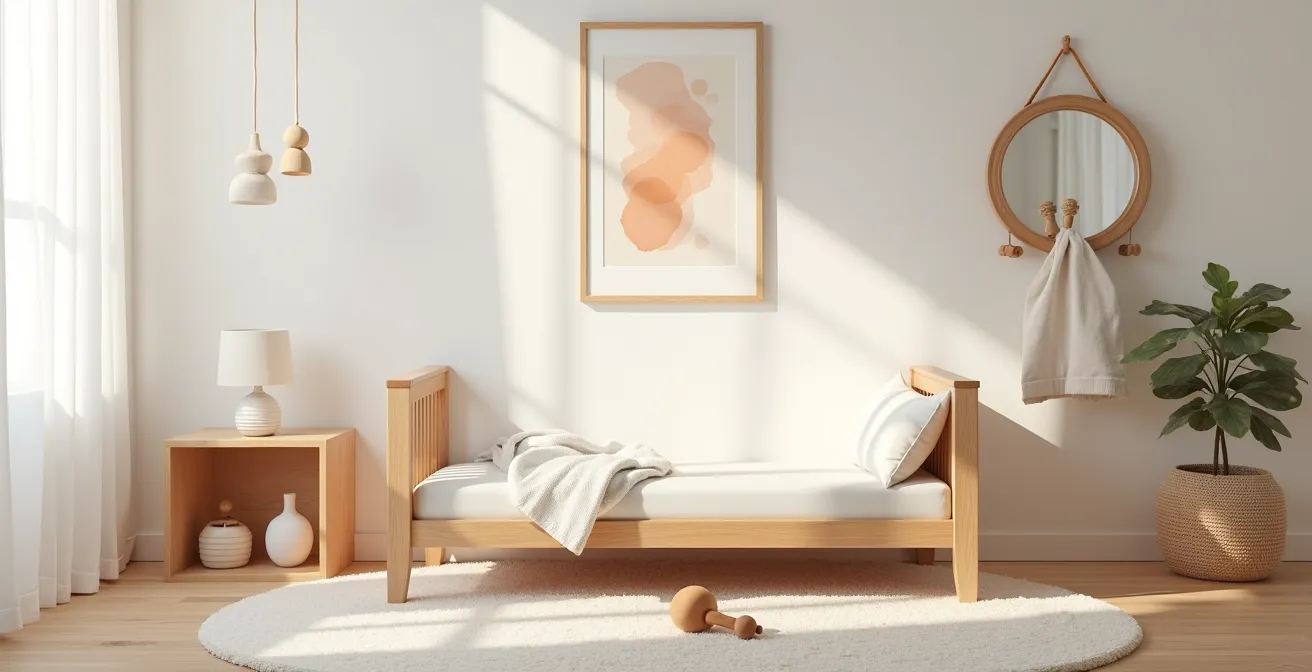
Creating visual calm is an exercise in minimalism and intention. It’s about making deliberate choices to remove the non-essential and allow the essential to shine. The goal is to create a peaceful canvas that highlights the few beautiful, purposeful materials you have chosen for your child. Here are practical steps to achieve this:
- Neutral Palette: Paint walls in soft, neutral tones (whites, warm greys, sage greens) that don’t compete for attention.
- Minimalist Art: Limit wall art to one or two simple, beautiful pieces, and hang them at the child’s eye level, not the adult’s.
- Natural Materials: Choose furniture and storage in natural wood tones or simple white to create a cohesive, calm look.
- Concealed Storage: Store the majority of toys out of sight in solid-colored baskets or behind closed cabinet doors.
- Curated Shelves: Display a maximum of 3-5 toys or activities on low, open shelves. This invites choice without overwhelming.
- Solid Textiles: Use bedding, rugs, and curtains in solid colors or with very simple, non-busy patterns.
By systematically reducing visual noise, you are not creating a sterile or boring room. You are engaging in thoughtful environmental engineering to create the optimal conditions for concentration, creativity, and peace to flourish.
Now that you understand the principles of visual calm, movement freedom, and intentional material selection, the next logical step is to begin observing your own space through your child’s eyes. Start with one small area and apply these ideas to see the immediate impact on their play.