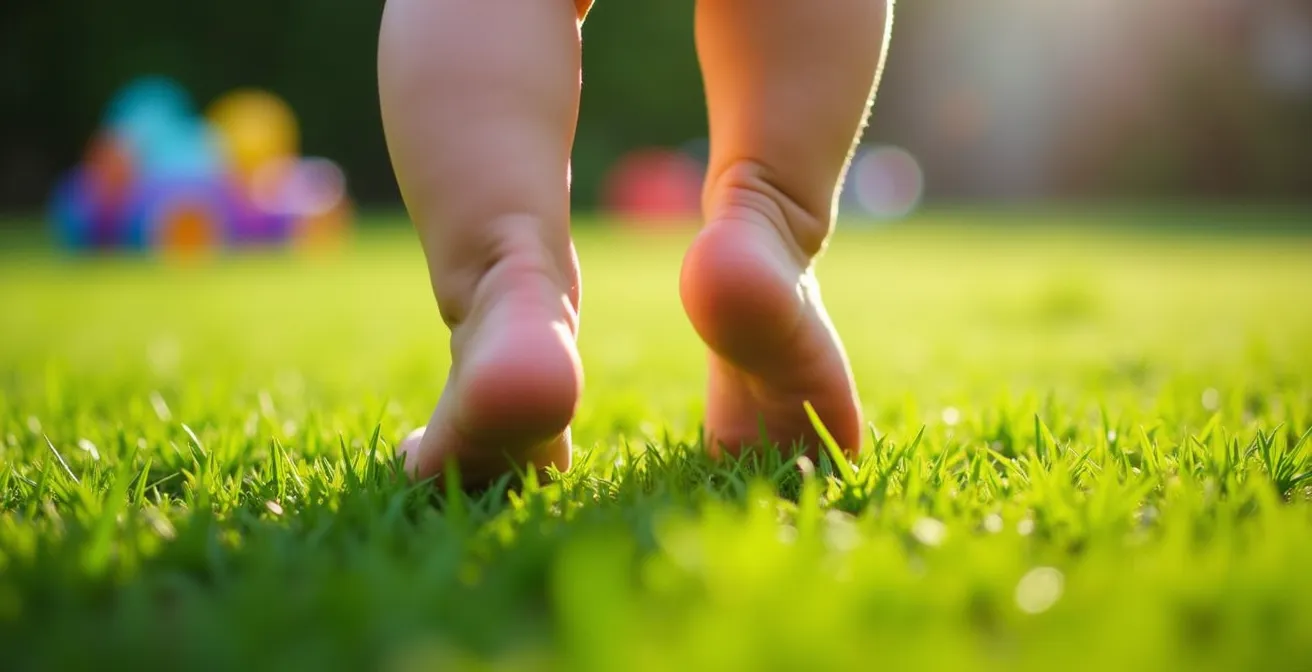
The healthiest choice for a child learning to walk is to be barefoot as much as possible; conventional shoes often hinder natural foot development.
- Rigid, hard-soled shoes restrict movement and mute the essential sensory feedback a child’s brain needs to learn balance and coordination.
- Features often marketed as benefits, like “ankle support” and “arch support,” can actually weaken the foot by preventing its intrinsic muscles from developing properly.
Recommendation: Prioritize barefoot time indoors and use only lightweight, flexible, soft-soled shoes for protection when outdoors.
As a parent, watching your child take their first wobbly steps is a milestone filled with excitement and a host of new questions. Chief among them is the footwear dilemma: what are the best shoes for a learning walker? The market is a confusing landscape of shoes promising “orthopedic support,” “stabilizing technology,” and “perfect arch development.” You are led to believe that a sturdy, supportive shoe is a prerequisite for healthy walking. As a pediatric podiatrist, my advice cuts through this marketing noise with a simple, evidence-based truth: the best “shoe” for your child is no shoe at all.
This may seem counter-intuitive. We associate shoes with protection and support. However, a toddler’s foot is not a miniature adult foot. It is a complex sensory organ and a marvel of biomechanical engineering designed to develop through direct interaction with its environment. The constant sensory feedback from the ground—the texture, the temperature, the unevenness—is critical information for the brain, teaching it to balance, coordinate, and move with confidence. Most conventional baby shoes, especially those with rigid soles and high ankle support, act like sensory deprivation chambers for the feet, muting this vital feedback loop and potentially altering their natural gait.
This article will guide you through the science of early foot development from a podiatrist’s perspective. We will dismantle the most common myths surrounding baby shoes, explain why “problems” like flat feet are perfectly normal, and provide you with the practical knowledge to make choices that truly support, rather than hinder, your child’s gross motor skill journey. We’ll cover everything from how to measure their feet correctly at home to designing an environment that encourages strong, healthy development from the ground up.
To navigate this crucial topic, we will explore the key biomechanical and developmental aspects of your child’s first steps. This summary provides a clear roadmap of the evidence-based insights you will gain.
Summary: A Podiatrist’s View on Early Footwear
- Why Flat Feet Are Normal and Healthy for Toddlers Under 3?
- How to Measure Your Child’s Foot at Home Without a Brannock Device?
- Hard Sole vs Soft Sole: Which Prevents Tripping for New Walkers?
- The “Room to Grow” Mistake That Causes Blisters and Falls
- How to Create “Walking Obstacles” with Cushions to Strengthen Ankles?
- How to Use Uneven Terrain to Improve Your Child’s Balance Naturally?
- Why Your Joints Hurt and Your Mood Drops in the Third Trimester?
- Designing a “Yes Environment” to Accelerate Gross Motor Skills Safely
Why Flat Feet Are Normal and Healthy for Toddlers Under 3?
One of the first things parents notice when their toddler starts standing is the apparent absence of an arch. Their feet look perfectly flat, leading to a common concern: is my child’s foot developing incorrectly? As a podiatrist, I can reassure you this is not only normal but also a healthy and necessary stage of development. Babies are born with a thick pad of fat in the area where the arch will eventually form. This fat pad provides natural cushioning and protection, and it effectively hides the developing bone structure underneath.
The development of the foot’s arch is not something a child is born with; it is a process that occurs over several years. The bones, ligaments, and intrinsic muscles of the foot strengthen and take shape as your child begins to stand, walk, and run. This mechanical stress is precisely what stimulates the arch to form. According to the American Academy of Pediatrics, in most children, the medial arch naturally develops between 6 and 10 years of age. Attempting to “correct” a toddler’s normal flat foot with rigid, arch-supporting shoes is not only unnecessary but can be counterproductive. It prevents the foot’s muscles from doing the work they need to do to grow strong on their own.
Studies confirm that what you’re seeing is a universal developmental phase. The arches in a child’s feet typically begin to appear and develop naturally as they become more active, usually between the ages of 2 and 6. Until then, that flat-footed appearance is a sign of a healthy, typical toddler foot. Rather than worrying about a lack of an arch, the focus should be on encouraging activities that promote natural foot strength, primarily by allowing as much barefoot time as possible.
How to Measure Your Child’s Foot at Home Without a Brannock Device?
Once you’ve determined a shoe is necessary for outdoor protection, getting the right size is critical. A poorly fitting shoe can cause blisters, ingrown toenails, and falls. While a Brannock device in a shoe store is the gold standard, you can get a very accurate measurement at home with a few simple items. The key is to measure while your child is standing, with their full weight on their feet, as feet spread and lengthen under pressure. For the most accurate sizing, it’s best to measure in the late afternoon or evening, when feet are naturally at their most swollen.
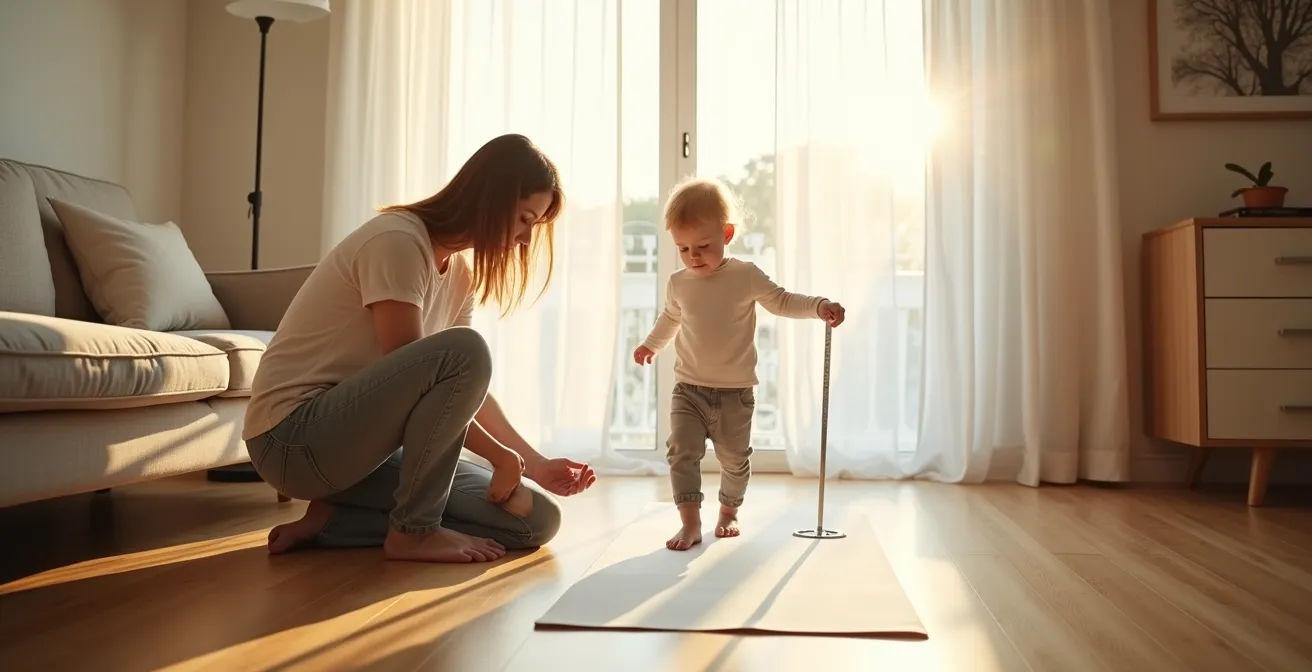
The illustration above captures the ideal setup for this process: a calm environment where the child can stand naturally. Following a consistent method ensures you account for both length and width, giving you the data needed to choose a shoe that fits like a second skin rather than a restrictive box. This simple routine can save you from the guesswork and common fitting errors that plague many parents.
Your Action Plan: Measuring Toddler Feet Accurately
- Prepare the Station: Have your child stand barefoot on a sheet of paper placed firmly against a wall. Ensure their heels are touching the wall.
- Trace the Outline: While they are standing straight, carefully trace the outline of both feet with a pen or marker held vertically. It’s common for feet to be slightly different sizes.
- Measure the Length: Use a ruler to measure the distance from the back of the heel to the tip of the longest toe for both tracings. Use the measurement from the larger foot.
- Assess the Width: Gently wrap a soft measuring tape or a ribbon around the widest part of the foot tracing (usually the ball of the foot) to get a width measurement.
- Add Growing Room: Add about 1 to 1.5 cm (or about half an inch) to the length measurement. This provides the ideal “room to grow” without the shoe being dangerously large.
Hard Sole vs Soft Sole: Which Prevents Tripping for New Walkers?
A pervasive myth in children’s footwear is that a hard, rigid sole offers superior protection and support, thereby preventing falls. The biomechanical reality is the exact opposite. For a new walker, a heavy, stiff shoe is like strapping a small plank to their foot. It forces an unnatural, clunky gait, inhibits balance, and is a leading cause of tripping. The foot needs to be able to bend and flex naturally, and the toes need to grip the ground to maintain stability. A hard sole prevents all of this.
Soft, flexible soles are vastly superior for early walkers because they mimic the freedom of being barefoot. They allow the foot to move as nature intended, providing just enough protection from sharp objects or rough surfaces outdoors without compromising function. A lightweight, soft-soled shoe enables the foot to send crucial proprioceptive signals to the brain, enhancing the child’s awareness of their body in space and accelerating their ability to balance. The Freshly Picked Research Team articulated this perfectly:
Hard soles shoes can actually make it more difficult for your child to learn to walk because of how heavy they are. Lightweight soft soles, however, are much less likely to inhibit your child’s ability to walk. Soft soles are unique because they allow your child to extend their toes and grip the floor as if they were walking barefoot.
– Freshly Picked Research Team, Why Soft Sole Baby Moccasins are Better for Growing Feet
When selecting a shoe, perform this simple test: can you bend the shoe in half with one hand? Can you twist it easily? If not, it’s too rigid for a developing foot. The goal is protection, not restriction. A soft sole achieves this balance, allowing for healthy development while keeping your child safe on their outdoor adventures.
The “Room to Grow” Mistake That Causes Blisters and Falls
It’s an understandable temptation. Knowing that children’s feet can grow half a size every 2 to 4 months, buying shoes a size or two too big seems like a savvy financial decision. However, this “room to grow” strategy is one of the most common and detrimental mistakes a parent can make. A shoe that is too large forces the foot to slide around inside, causing friction that leads to painful blisters. To compensate for the looseness, a child may clench their toes to grip the shoe, leading to foot strain and an unnatural walking pattern.
More importantly, an oversized shoe is a significant safety hazard. It creates extra length at the front that the child isn’t accustomed to, causing them to trip and fall frequently. This not only poses a risk of injury but can also erode a new walker’s confidence. Biomechanically, the impact is substantial. Studies on gait kinematics reveal the hidden costs of poorly fitting footwear. Research has shown that children in shoes—particularly ill-fitting ones—exhibit altered movement patterns. According to an analysis from ACE Physical Therapy, a child in bulky shoes takes longer strides and displaces their center of mass more than when barefoot, which could explain why they expend more energy while walking.
The proper fit allows for about a thumb’s width (approximately 1-1.5 cm) of space between the end of the longest toe and the front of the shoe. This provides adequate room for growth and movement without compromising stability. You should be able to pinch a small amount of material at the widest part of the foot. Resist the urge to “buy big.” Investing in properly fitting shoes, even if they need to be replaced more often, is an investment in your child’s safety and healthy motor development.
How to Create “Walking Obstacles” with Cushions to Strengthen Ankles?
Instead of relying on a shoe to provide “ankle support,” you can actively help your child develop strong, stable ankles through play. Creating a simple obstacle course indoors with cushions, pillows, and blankets is a fantastic way to challenge their balance and strengthen the tiny stabilizing muscles in their feet and ankles. These soft, unstable surfaces force the foot to adapt, engage, and work harder to maintain balance, acting as a form of intrinsic muscle development. This is far more effective than an external brace, like a high-top shoe, which acts as a crutch and prevents those muscles from getting stronger.
The process should be fun and progressive. Start simply with a single firm cushion on the floor. Encourage your child to step on and off it, first with your help and then independently. As they gain confidence, you can create a “path” of several cushions with different textures and levels of firmness. Walking across this path requires constant micro-adjustments in the feet and ankles, building strength and improving their proprioceptive awareness. The goal is to create a safe yet challenging environment that promotes natural development.
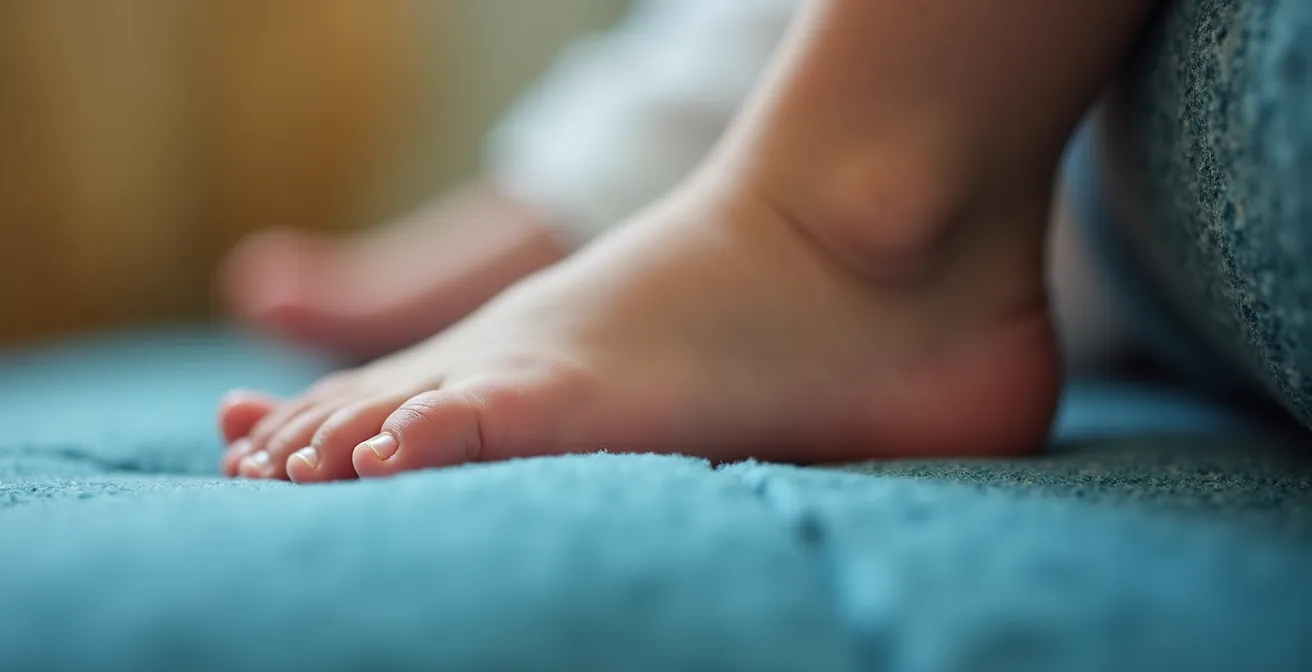
As seen in the image, the foot’s interaction with an unstable surface is complex and dynamic. The toes spread and grip, the arch engages, and the ankle works to stabilize the entire body. This is the kind of active, sensory-rich experience that builds a strong foundation for a lifetime of confident movement. Always supervise this activity and ensure the surrounding area is clear of hard furniture to allow for safe tumbles.
How to Use Uneven Terrain to Improve Your Child’s Balance Naturally?
The same principle of strengthening through instability applies even more powerfully outdoors. While flat, predictable surfaces like pavement and hardwood floors are easy to navigate, they offer limited sensory information and little challenge to the developing foot. In contrast, natural, uneven terrain—like grass, sand, dirt paths, or a collection of smooth stones—is a developmental superfood for your child’s feet and brain. Every step on an unpredictable surface sends a flood of rich sensory data to the brain, refining balance and coordination.
Pediatric occupational therapist Angela Hanscom, author of *Balanced and Barefoot*, is a strong advocate for this practice. She explains that walking barefoot outdoors provides “natural messages” to the feet as they encounter different textures and inclines. This variance in sensory input and physical resistance helps integrate reflexes in the foot and is crucial for forming strong arches. Letting a child navigate a grassy hill or a sandy patch at the park is one of the best things you can do for their gait development and proprioceptive awareness. This natural training provides a robust foundation for fluid, confident movement that a flat, sterile environment simply cannot replicate.
The benefits are not just anecdotal; they are supported by scientific research. For instance, a 2018 study comparing regularly barefoot and shod children found that barefoot activity significantly improves balance and jumping skills. The children who were habitually barefoot demonstrated better performance in balance beam walking and standing long jump tests. This underscores the idea that the foot is designed to interact with a variable world, and shielding it from this variability with shoes can inhibit its full potential.
Why Your Joints Hurt and Your Mood Drops in the Third Trimester?
At first glance, this question seems wildly out of place in an article about toddler foot development. What does a symptom of late-stage pregnancy have to do with a child learning to walk? I’ve included this seemingly random title to make a crucial point through analogy: what appears to be a “problem” is often a normal, temporary, and functional part of a developmental process.
During the third trimester, a pregnant person’s body produces the hormone relaxin, which loosens ligaments and joints to prepare the pelvis for childbirth. A side effect of this essential process can be joint pain, instability, and a wobbly gait. This isn’t a pathology to be “fixed”; it’s a necessary physiological adaptation. No one would suggest putting a pregnant person in a rigid, full-body cast to “support” their joints. We understand it’s a phase with a purpose.
We must apply the same logic to a child’s development. A toddler’s flat feet, wobbly first steps, and bowed legs are the pediatric equivalent of third-trimester joint pain. They are temporary, functional stages of a body that is rapidly adapting and growing. The fat pad on the foot is their temporary cushion. The unsteady gait is their brain learning a new, incredibly complex skill. Attempting to “correct” these normal phases with rigid shoes and artificial arch supports is as misguided as trying to “fix” pregnancy with a brace. It interferes with a natural process that knows exactly what it’s doing.
Key Takeaways
- A toddler’s “flat feet” are normal and healthy, protected by a fat pad that disappears as the arch develops naturally up to age 10.
- Soft, flexible soles are superior to hard soles as they mimic barefoot walking, allowing for natural movement and sensory feedback crucial for balance.
- Buying shoes too large for “room to grow” is dangerous; it causes an unnatural gait, blisters, and significantly increases the risk of tripping and falling.
Designing a “Yes Environment” to Accelerate Gross Motor Skills Safely
Ultimately, the goal is to create what experts call a “Yes Environment”—a space where your child’s natural drive to move, explore, and learn is met with opportunity and safety, not restriction. In the context of foot development, this means creating an environment that defaults to being barefoot. For the vast majority of their time indoors, shoes are unnecessary. A safe, baby-proofed home is the perfect gymnasium for their feet to get stronger.
A “Yes Environment” for motor skills is one rich in sensory experiences. It includes a variety of textures underfoot, like rugs, wooden floors, and the soft, unstable cushion courses we discussed. It’s a space where climbing on the sofa (with supervision) is encouraged and where movement isn’t confined. By removing both physical hazards and unnecessary restrictions like shoes, you empower your child to follow their developmental instincts. They will build strength, coordination, and confidence at their own pace, guided by the constant feedback loop between their feet and their brain. As research from Naboso Technology highlights, this has profound implications:
A child who often walks barefoot will naturally develop stronger, more flexible feet – it’s like strength training for their feet. When exposed to different surfaces and stimuli, sensory nerves within the foot send valuable feedback to the brain, thus enhancing your child’s proprioceptive awareness, posture, and coordination.
– Naboso Technology Research Team, Why Children Should Be Barefoot Until Age Four
So, the next time you’re tempted to put shoes on your toddler indoors, pause and ask if it’s for protection or for habit. By embracing the barefoot philosophy and creating a “Yes Environment,” you are giving your child’s feet the freedom they need to build the strong, capable foundation they will stand on for the rest of their lives.
Your role is not to force development with artificial supports but to facilitate it by providing a safe, stimulating environment. Trust in the remarkable design of the human body and give your child’s feet the freedom to do what they were made to do.