In summary:
- Stop forcing traditional sports and instead reframe movement as playful, goal-oriented “missions” like backyard ninja courses or geocaching adventures.
- Focus on the hidden science of play: simple jumping builds critical bone density, and sleep unlocks growth hormones essential for development.
- Change your language from “burning calories” to “building power” to foster a positive body image and a lifelong love for movement.
- Design a “Yes Environment” at home where safe physical exploration is encouraged, naturally building your child’s balance and coordination.
You’ve seen the eye-roll. You’ve heard the sigh. The moment you suggest kicking a ball or joining a team, your child shuts down. For parents of kids who just don’t jive with traditional sports, it can feel like a losing battle against a sedentary lifestyle. The common advice is to “find a sport they like” or simply “make it fun,” but that often misses the point entirely. These kids don’t just dislike one sport; they often have an aversion to the entire concept of structured, competitive “exercise.”
This resistance isn’t about laziness. It’s frequently rooted in a fear of failure, social anxiety, or a simple lack of connection to the activity. The pressure to perform in soccer, baseball, or basketball can be overwhelming. But what if the solution wasn’t to find a better sport, but to abandon the idea of “sport” altogether? What if the real key to unlocking a lifetime of healthy movement lies in a radical mindset shift? Instead of focusing on exercise, we need to focus on play, purpose, and the incredible science behind simple, joyful movement.
This guide moves beyond the team sports paradigm. We’ll explore how to transform physical activity from a chore into a series of exciting missions. We will uncover the critical link between jumping and bone growth, the power of sleep in physical development, and how to use your own backyard as a training ground. Most importantly, you will learn how the words you use can either build a child’s physical confidence or inadvertently create body image issues. Get ready to discover a new, inclusive, and energetic approach to movement.
To help you navigate these powerful strategies, this article is structured to build from the foundational science of movement to creative, real-world applications. Explore the sections below to find the inspiration you need to get your child moving and thriving.
Summary: A New Playbook for Encouraging Active Kids
- Why Impact Activities like Jumping Are Critical Before Puberty?
- How to Use Geocaching to Trick Your Kids into Hiking 5 Kilometers?
- Martial Arts vs Swimming: Which Builds Better Self-Discipline?
- The “Exercise to Burn Calories” Mistake That Triggers Body Image Issues
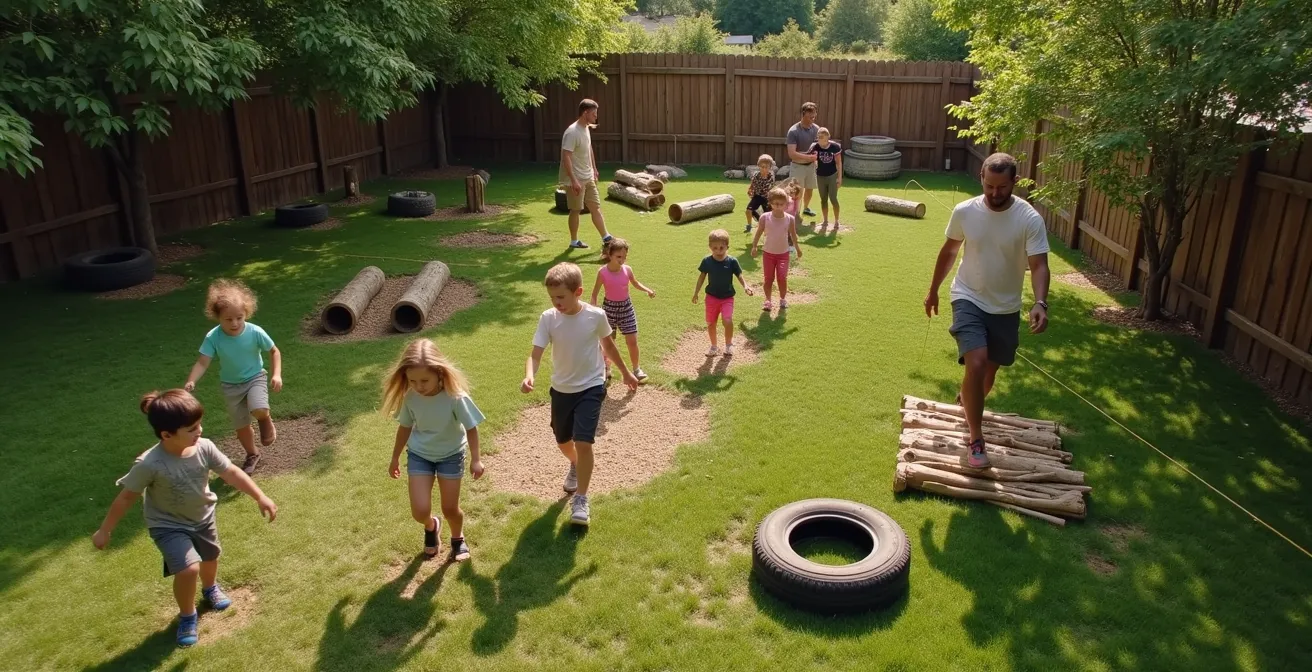
- How to Create a “Family Ninja Warrior” Course in the Backyard?
- Why 70% of Growth Hormone Is Released During Deep Sleep?
- How to Use Uneven Terrain to Improve Your Child’s Balance Naturally?
- Designing a “Yes Environment” to Accelerate Gross Motor Skills Safely
Why Impact Activities like Jumping Are Critical Before Puberty?
Before a child ever steps onto a field, their body is building the foundation for a lifetime of strength. One of the most powerful, yet often overlooked, ways to do this is through simple, high-impact activities like jumping. It’s not just about burning off energy; it’s a critical biological signal. During the pre-pubertal years, the skeleton is uniquely responsive to these forces. Each time your child jumps, hops, or skips, they are sending a direct message to their bones to become denser and stronger. This period is a limited-time window to maximize peak bone mass, which is a major factor in preventing osteoporosis later in life.
The science is compelling. A systematic review published in PeerJ found that high-impact jumping exercises with ground reaction forces of 3.5 to 8.8 times body weight significantly increase bone mineral content in children. This isn’t about intense, structured training. This can be achieved through play: hopscotch, jumping rope, or stomping in puddles. Furthermore, this type of activity directly stimulates physical growth. A 2025 clinical trial published in BMC Sports Science found that a 24-week jumping exercise program increased height gain in participants by stimulating bone development and optimizing growth hormone pathways.
So how do you encourage this vital activity without it feeling like a chore? Gamify it. Create a “Stomp the Yard” dance-off, set up a mini-trampoline “Quake Challenge” to make stuffed animals fly, or design an adventure-based hopscotch course. The goal is to make impact joyful and instinctive, not a prescribed exercise. Think less about reps and more about laughter. These playful moments are quietly building a resilient, powerful skeleton.
How to Use Geocaching to Trick Your Kids into Hiking 5 Kilometers?
One of the biggest hurdles for parents of “non-athletic” kids is the sheer resistance to activities like hiking. The suggestion is often met with groans about being bored or tired. The secret weapon to overcome this is to reframe the entire experience. Stop calling it a hike; start calling it a treasure hunt. This is the genius of geocaching, a real-world outdoor adventure that uses a GPS-enabled device (like your smartphone) to find hidden containers called “geocaches.”
Instead of focusing on the physical effort, a child’s attention is completely absorbed by the “movement mission”: deciphering clues, navigating with a map, and the thrilling anticipation of discovery. Suddenly, a 5-kilometer trail isn’t a long walk; it’s a journey through a mysterious forest to find a hidden prize. According to Dr. Catherine Ohmstead from Dilworth Pediatrics, geocaching brilliantly bridges a child’s love for technology with the benefits of nature. She notes that children who were once resistant to the outdoors become enthusiastic adventurers, developing spatial reasoning and problem-solving skills while completely forgetting they are exercising.
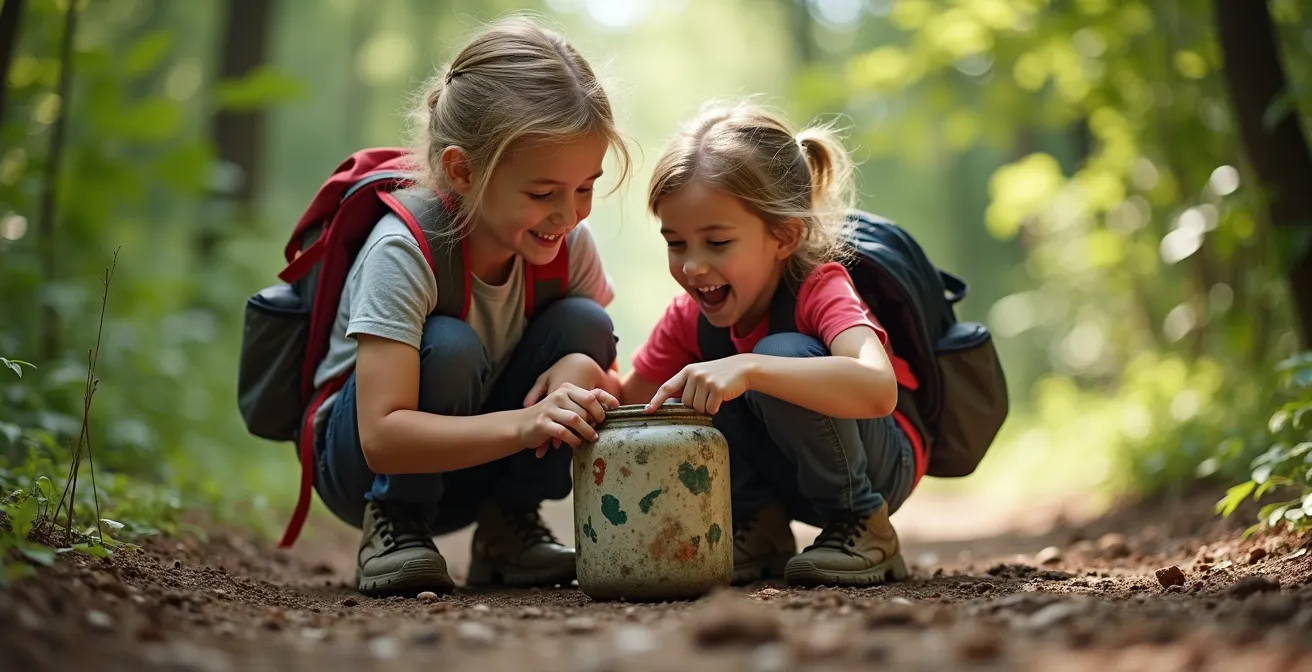
The beauty of this activity is its scalability. You can start with a short, simple cache in a local park and gradually work your way up to more challenging finds in rugged terrain. The focus is always on the goal, not the grind. Your child isn’t just walking; they are an explorer, a detective, and an adventurer. This shift in perspective is everything. It teaches them that their bodies are capable of carrying them on exciting journeys, building both physical endurance and a deep sense of accomplishment that no organized sport could ever replicate.
Martial Arts vs Swimming: Which Builds Better Self-Discipline?
When parents look for alternatives to team sports, swimming and martial arts often top the list. Both are fantastic for physical fitness, but they cultivate very different *types* of self-discipline. Understanding this difference is key to choosing the right fit for your child’s specific personality and needs. It’s not about which is “better” overall, but which is the better tool for the job you want to accomplish.
Swimming, at its core, builds internal discipline and a mindset of consistency. The environment is rhythmic and sensory-calming. A child learns to regulate their own breath, pace themselves over long distances, and focus inward to push through fatigue. The primary struggle is against oneself and the clock. This makes it an excellent choice for children who may be anxious or overstimulated in chaotic environments, teaching them a form of meditative repetition and endurance.
Martial arts, on the other hand, build external discipline and emotional regulation. The dojo is a structured environment that demands respect for authority (the Sensei) and an awareness of one’s body in relation to others. A child learns to control their impulses, react calmly under pressure, and manage their emotions during sparring or kata. This is ideal for impulsive children who need to develop better self-control and for timid children who need to build confidence and situational awareness. A recent comparative analysis highlights these distinctions clearly.
| Aspect | Swimming | Martial Arts | Best For |
|---|---|---|---|
| Type of Focus | Internal, rhythmic concentration | External awareness and reaction | Swimming: anxious kids needing calm Martial Arts: impulsive kids needing control |
| Discipline Style | Consistency over long durations | Respect for authority (Sensei) | Swimming: building endurance mindset Martial Arts: learning structured hierarchy |
| Physical Control | Breath control and pacing | Body control in space | Swimming: cardiovascular discipline Martial Arts: spatial awareness |
| Mental Benefits | Meditative repetition | Stress reduction | Swimming: stress reduction Martial Arts: confidence building |
| Skill Transfer | Homework completion through pacing | Sibling conflict management | Both: different life applications |
Ultimately, the choice depends on your goal. Are you looking to build your child’s mental endurance and ability to self-regulate in a calm setting? Swimming is a powerful tool. Are you aiming to develop their confidence, respect, and ability to manage external pressures? Martial arts offers a clear path. Both build discipline, but they forge it in very different fires.
The “Exercise to Burn Calories” Mistake That Triggers Body Image Issues
As parents, our intention is pure: we want our kids to be healthy. But the language we use to encourage movement can have a powerful, and sometimes damaging, impact. One of the most common mistakes is framing physical activity as a tool to “burn calories,” “lose weight,” or “fix” a body. This approach, however well-meaning, inadvertently teaches children that their bodies are a problem to be solved and that exercise is a punishment for eating. This can lay the groundwork for a lifetime of body image issues and a negative relationship with both food and movement.
The goal should never be to burn calories; it should be to celebrate what the body can do. This is the essence of building true physical literacy. Instead of talking about weight, talk about strength. Instead of discussing calories, discuss energy. The shift is subtle but profound. It reframes movement as a joyful exploration of one’s own capabilities, not a transaction to offset food intake. The CDC emphasizes that for children aged 6-17, the focus of their recommended 60 minutes of physical activity daily should be on fun and building competence, not on metrics tied to body size.
Adopting this “capability language” transforms the conversation. A hike isn’t about burning off pizza; it’s about building strong legs to climb to the waterfall. A session on the monkey bars isn’t about “getting in shape”; it’s about developing the power to swing to the next bar. By focusing on functional, exciting goals, you connect physical activity to a sense of achievement and adventure. You’re not just getting your child to move; you’re building their self-esteem from the inside out and protecting them from the toxic culture of dieting and body-shaming.
Action Plan: Your Positive Movement Language Swap
- Instead of “burn calories,” say “build power” or “gain energy.”
- Replace “lose weight” with “get stronger for climbing” or “improve your jump.”
- Swap “get in shape” for “prepare for our next adventure.”
- Change “work out” to “play actively” or “movement time.”
- Replace “exercise routine” with “daily movement adventure.”
- Instead of body measurements, celebrate functional milestones: “Wow, you held that plank for 20 seconds!” or “You climbed to the very top!”
How to Create a “Family Ninja Warrior” Course in the Backyard?
What if you could bring the excitement of a hit TV show right into your backyard? Creating a “Family Ninja Warrior” course is one of the most effective ways to get sedentary kids engaged because it taps directly into the power of imagination and a goal-oriented challenge. This isn’t “exercise”; this is a mission. The objective is clear, the obstacles are fun, and the sense of accomplishment from completing the course is immense. It’s the ultimate “movement mission.”
The key to success is creativity, not cost. You don’t need expensive equipment. Your backyard is already full of potential. A 2×4 plank on the grass becomes a balance beam. Pool noodles can be arched into hurdles. A rope tied to a sturdy tree branch is a swing. Use pillows for “hot lava” stepping stones, or a simple cargo net for a climbing challenge. Elite Sports Clubs reports that families who create these kinds of themed obstacle courses see an incredible 80% more engagement from non-athletic children compared to just telling them to go outside and play. The secret is incorporating a story—are they spies on a secret mission, or adventurers escaping a jungle?
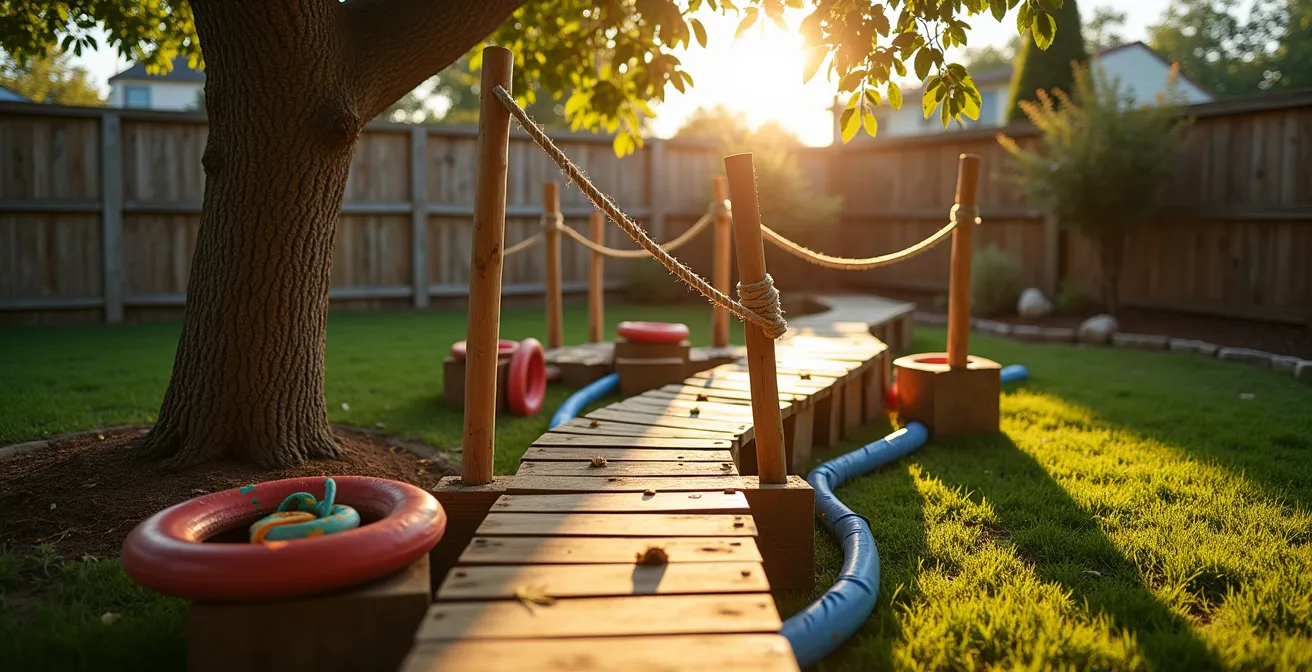
Make sure the course includes a variety of movements to build all-around physical literacy. Include stations that require:
- Balancing: Walking on a plank or a chalk line.
- Crawling: Going under a blanket draped over two chairs (a “tunnel”).
- Jumping: Hopping between designated spots or over small obstacles.
- Strength: Incorporating “bear walks” or “crab walks” between stations.
The best part is that you can adjust the difficulty on the fly, ensuring both a 5-year-old and a 12-year-old can feel challenged and successful. It becomes a collaborative family activity, full of laughter and cheering, that works every muscle group while kids are simply having a blast.
Why 70% of Growth Hormone Is Released During Deep Sleep?
The active, playful hours of the day are only half of the equation for a child’s healthy physical development. The other, equally crucial part, happens when they are fast asleep. It is widely understood that a significant majority of the body’s daily supply of Human Growth Hormone (HGH)—often cited as up to 70%—is released during the deep, restorative stages of sleep. This hormone is the master architect of childhood, responsible for building bone, repairing muscle, and fueling overall growth.
Think of it this way: the physical activity of the day is the “order” you place for a stronger, more capable body. Deep sleep is the “delivery” phase where the construction crews get to work. If sleep is consistently interrupted or insufficient, the delivery never fully arrives. The muscles don’t repair as efficiently, the bones don’t receive the full signal to grow, and the energy for the next day’s adventures is depleted. This is why a child who has had a full night of quality sleep often wakes up feeling stronger, more coordinated, and more energetic.
Therefore, optimizing sleep is not just about avoiding crankiness; it’s a non-negotiable part of any strategy to encourage physical activity. To protect this vital growth-and-repair cycle, a consistent sleep hygiene routine is essential.
- Schedule the last major physical play 2-3 hours before bedtime to let energizing cortisol levels fall.
- Implement a “screen-free” hour before bed, as the blue light from devices can suppress the production of melatonin and disrupt deep sleep cycles.
- Offer a magnesium-rich snack like a banana with almond butter to help relax muscles.
- Keep the bedroom cool, ideally between 65-68°F (18-20°C), as a lower body temperature facilitates entry into deep sleep.
- Create a simple “movement recap” where your child shares their favorite physical achievement of the day, positively reinforcing their activity before they drift off.
How to Use Uneven Terrain to Improve Your Child’s Balance Naturally?
We often think of balance as something you either have or you don’t. In reality, it’s a skill that can be trained, and one of the best gyms for it is nature itself. Flat, predictable surfaces like pavement and manicured lawns do very little to challenge and improve our proprioceptive system—the body’s internal sense of its position in space. To truly awaken this system, you need to introduce variety and unpredictability. You need uneven terrain.
Walking on a forest trail, scrambling over rocks, or even just running across a sandy beach forces a child’s feet, ankles, and brain to make thousands of tiny, instantaneous micro-adjustments. This is “proprioceptive awakening” in action. Findings from the Future Stars Adventure Camp are telling: they documented that children who spent just a few hours a week on varied terrain showed a remarkable 40% improvement in balance tests compared to peers who stuck to flat surfaces. They weren’t “practicing balance”; they were simply playing in a more stimulating environment.
This natural training builds a smarter, more responsive body. As Children’s Health and Fitness Specialist Len Saunders explains, it creates a robust foundation for all other physical skills. He notes:
Each step on an uneven surface sends thousands of signals to the brain, effectively ‘waking up’ the feet and creating faster, more automatic balance adjustments.
– Len Saunders, Children’s Health, Fitness and Wellness Specialist
You don’t need to live near a mountain to apply this principle. Seek out a park with a grassy hill, a playground with climbing structures, or even create your own “uneven terrain” at home with pillows and cushions. The goal is to move beyond the flat world and give your child’s brain the rich sensory input it needs to master the art of balance naturally.
Key Takeaways
- The secret to engaging a “non-athletic” child is to shift the goal from “exercise” to exciting “movement missions” that focus on adventure and accomplishment.
- Language matters profoundly. Celebrate what your child’s body can do (“You’re getting so powerful!”) rather than focusing on aesthetics (“burning calories”) to build lasting confidence.
- Your home and local environment are your greatest tools. By creating a “Yes Environment” and seeking out varied terrain, you can naturally develop your child’s motor skills through play.
Designing a “Yes Environment” to Accelerate Gross Motor Skills Safely
How many times a day do you find yourself saying “No”? “Don’t climb on that,” “Get down from there,” “No jumping on the sofa.” While these warnings come from a place of love and safety, a home filled with constant restrictions can inadvertently stifle a child’s natural impulse to move, explore, and test their physical limits. The alternative is to consciously design a “Yes Environment”—a space where the answer is implicitly “yes” because the environment itself is set up for safe exploration.
This doesn’t mean letting chaos reign. It means creating designated zones and using simple tools to channel that explosive energy productively. It’s about proactively providing opportunities for movement instead of reactively shutting them down. Research even shows that children who grow up in these permissive movement environments develop better risk-assessment skills. They learn their own limits through controlled experience, making them more cautious and competent movers in the long run.
Creating a “Yes Environment” can be done even in a small apartment. The goal is to provide safe outlets for climbing, swinging, and balancing.
- Install a doorway swing or bar for a fantastic vestibular system workout.
- Use colorful painter’s tape on the floor to create intricate patterns for jumping, hopping, and balancing games.
- Designate one piece of sturdy furniture as “climbing-safe” and establish clear boundaries around it.
- Create a “movement corner” with tumbling mats where rough-and-tumble play is always allowed.
- Establish “yes times” where building a massive cushion fort and leaping onto it is not only allowed but encouraged.
By creating a home that invites movement, you’re doing more than just preventing broken lamps. You are sending a powerful message that your child’s physical nature is something to be celebrated, not suppressed. You are building their gross motor skills, their confidence, and their ability to assess risk, all within the safety of your own walls.
Frequently Asked Questions about Encouraging Movement
How do I know the difference between acceptable risk and real danger?
Acceptable risks involve controlled challenges where a fall would result in minor bumps (climbing low structures, balancing on stable surfaces). Real dangers involve height beyond the child’s own height, unstable structures, or proximity to sharp or hard edges. The key is allowing them to experience small tumbles in a safe context.
Won’t a ‘Yes Environment’ make my child reckless?
On the contrary, research shows children in permissive movement environments actually develop better risk assessment skills. They learn their own limits through experience rather than constant warnings, leading to more cautious and competent behavior overall because they understand their capabilities.
What if I live in a small apartment?
Even small spaces can accommodate movement. Think vertically: use wall-mounted climbing holds. Use hallways for crab walks and bear walks. Create obstacle courses that go under beds and around furniture. Rotating the layout of a room slightly can create an entirely new landscape for movement challenges.