
Many parents worry about a simple checklist of autism signs. The truth is, understanding the neurological reasons behind milestones like the social smile or pointing is far more powerful. This guide moves beyond lists, explaining the ‘why’ of social development to help you distinguish between a quiet personality and a genuine delay, and equips you to have a productive conversation with your pediatrician.
As a parent, you are the world’s foremost expert on your child. You notice the subtle shifts in their mood, the new sounds they make, and the way they look at you—or don’t. When a baby doesn’t readily make eye contact or offer that coveted social smile, a seed of worry can be planted. The internet offers endless checklists of red flags, often turning this worry into a cycle of anxiety and constant, stressful monitoring. You are told to look for delayed speech or a lack of response to their name, but these lists rarely explain the full picture.
The common advice is to “wait and see” or simply “talk to your doctor,” which can feel dismissive when your parental intuition is sounding an alarm. But what if the key wasn’t in ticking boxes, but in understanding the developmental story unfolding before you? What if you could learn to see these early interactions not as a pass/fail test, but as clues to how your child’s unique brain is wiring itself for social connection? This guide is designed to give you that deeper understanding.
We will move beyond the superficial signs to explore the neurological significance of early social milestones. By focusing on the ‘why’ behind social-emotional reciprocity, you will gain an observational toolkit that transforms anxiety into informed action. We will differentiate typical introversion from developmental delays, decode crucial gestures, and outline exactly when and how to advocate for a professional evaluation, ensuring you can be your child’s most effective and confident advocate.
For those who prefer a condensed format, the following video from the Kennedy Krieger Institute provides an excellent visual overview of the key early signs discussed in this guide. It serves as a perfect complement to the detailed explanations that follow.
This article provides a structured path to understanding these complex topics. The following summary outlines the key areas we will explore, from the earliest social cues in infancy to the cognitive markers in toddlerhood, helping you build a complete picture of your child’s development.
Summary: A Guide to Early Social and Cognitive Markers
- Why the “Social Smile” at 6 Weeks Is a Major Neurological Event?
- How to Use “Parentese” to Trigger Social Engagement in Quiet Babies?
- Introversion vs Social Delay: Is Your Toddler Just Observant or Disconnected?
- The Pointing Gesture You Must Not Ignore at 12 Months
- When to Push for an ADOS Evaluation: The Window for Early Intervention?
- Why Lack of Facial Interaction Is More Stressful Than Physical Separation?
- ADHD or Energetic Toddler: Which Behaviors Actually Require Clinical Evaluation?
- Recognizing Cognitive Delays: When to Worry About Your Toddler’s Progress?
Why the “Social Smile” at 6 Weeks Is a Major Neurological Event?
A baby’s first smile is a celebrated milestone, but the social smile that emerges around six to eight weeks is far more than just a cute reflex. It is one of the first, most powerful indicators of social-emotional reciprocity. This isn’t just a happy expression; it is a purposeful, responsive action. When your baby sees your face, processes it as a source of comfort and engagement, and then coordinates their own facial muscles to smile back, they are demonstrating a profound neurological leap. This simple act signifies that their brain is beginning to understand the fundamental give-and-take of human connection.
This process involves the mirroring of emotion. Research shows that neurotypical individuals automatically mimic the facial expressions of others, a process that facilitates empathy and emotional contagion. When your baby smiles in response to your smile, they are participating in this foundational social dance. The absence or significant delay of a social smile suggests that this critical feedback loop may not be developing as expected. It’s not about a single missed smile, but a consistent lack of responsive facial engagement. This is why we, as pediatricians, view it not just as a milestone, but as a key piece of data about a child’s early neurological wiring for social interaction.
Understanding this turns you from a milestone-tracker into an informed observer. You are no longer just waiting for a smile; you are looking for a response, a sign that your engagement is being received and returned. This is the very beginning of a conversation that will last a lifetime, and the social smile is the first word.
How to Use “Parentese” to Trigger Social Engagement in Quiet Babies?
When a baby is quiet or seems disengaged, our instinct can be to either increase the volume or withdraw. However, a specific type of speech known as “Parentese” can be a powerful tool to break through and invite interaction. Unlike “baby talk,” which is simply nonsensical cooing, Parentese uses real words and correct grammar but is delivered with a higher pitch, slower tempo, and exaggerated vowels. This melodic, sing-song quality is acoustically designed to capture and hold an infant’s attention. It’s a multi-sensory invitation to connect.
The visual below captures the essence of this technique. Notice the exaggerated mouth shape, a physical characteristic of Parentese that provides a strong visual cue for an infant learning to read faces and connect sounds with expressions. It’s an act of making language both heard and seen.

To use Parentese effectively, it’s not just about what you say, but how you create an environment for connection. It’s about pairing your voice with sustained, gentle eye contact and perhaps a soft touch. You are creating a low-pressure, high-reward opportunity for your baby to tune in. Don’t look for a dramatic reaction; instead, watch for micro-engagements. A slight turn of the head, a brief flicker of eye contact, or a subtle softening of their body are all signs that your invitation has been received. Repeating the specific tones and phrases that get a small reaction helps your baby’s brain build a positive association between your voice and social pleasure.
- Use exaggerated vowels and higher pitch during routine activities like diaper changes to cut through auditory noise.
- Pair Parentese with sustained eye contact for at least 3-5 seconds.
- Add gentle touch while speaking to create a multi-sensory invitation.
- Watch for micro-engagements: slight head turns, brief eye contact, or body softening.
- Repeat successful Parentese patterns during feeding and play routines.
Introversion vs Social Delay: Is Your Toddler Just Observant or Disconnected?
As toddlers develop their own personalities, it’s common for parents to wonder if their child’s quiet nature is a sign of introversion or something more concerning. An introverted child is not anti-social; they are simply social in a different way. The key is to distinguish between a child who is observing and processing from a child who is consistently disconnected from the social world around them. As developmental specialist Dr. Cynthia Martin of the Child Mind Institute notes, “The ‘Social Battery’ concept helps parents understand that introverted toddlers may engage intensely for short periods and then need to ‘recharge’, whereas a social delay is more consistent across all situations.”
This “social battery” concept is a useful framework. The introverted toddler may watch a group of children intently from the sidelines, processing the dynamics before deciding whether to join. Later, in the privacy of their home, you might see them mimicking the play they observed. Their energy for social interaction is finite. In contrast, a child with a social delay often appears disconnected regardless of the environment. Their gaze may be blank or unfocused, and their energy levels don’t typically change after social encounters because they weren’t truly engaged in the first place.
The following table, based on information from guidelines provided by pediatric experts, can help you identify these crucial differences in behavior patterns. It’s a tool for observation, not diagnosis.
| Behavior Type | Introverted Child | Social Delay Indicators |
|---|---|---|
| Observation Pattern | Watches others intently, mimics later in private | Stares blankly, doesn’t register social activity |
| Energy Pattern | Engages intensely for short periods then needs recharge | Consistent disconnection across all situations |
| Peer Interaction | Prefers one quiet peer over groups | No difference between individual or group settings |
| Response to Name | Responds but may delay if focused | Frequently doesn’t respond even after multiple attempts |
The Pointing Gesture You Must Not Ignore at 12 Months
Around their first birthday, most children begin to point. This gesture seems simple, but it represents a massive cognitive leap: the birth of joint attention. Joint attention is the ability to share a focus on an object with another person. It’s a three-point skill connecting the child, another person, and an object of interest. This “triangle” of attention is a cornerstone of social learning and communication. When a child points to a dog across the street and then looks back at you to make sure you see it too, they are not just identifying a dog; they are saying, “Are you sharing this experience with me?”
The illustration below helps conceptualize this triangular relationship. The child, parent, and object form three points of a shared experience, a connection that is actively built and checked by the child’s gaze.
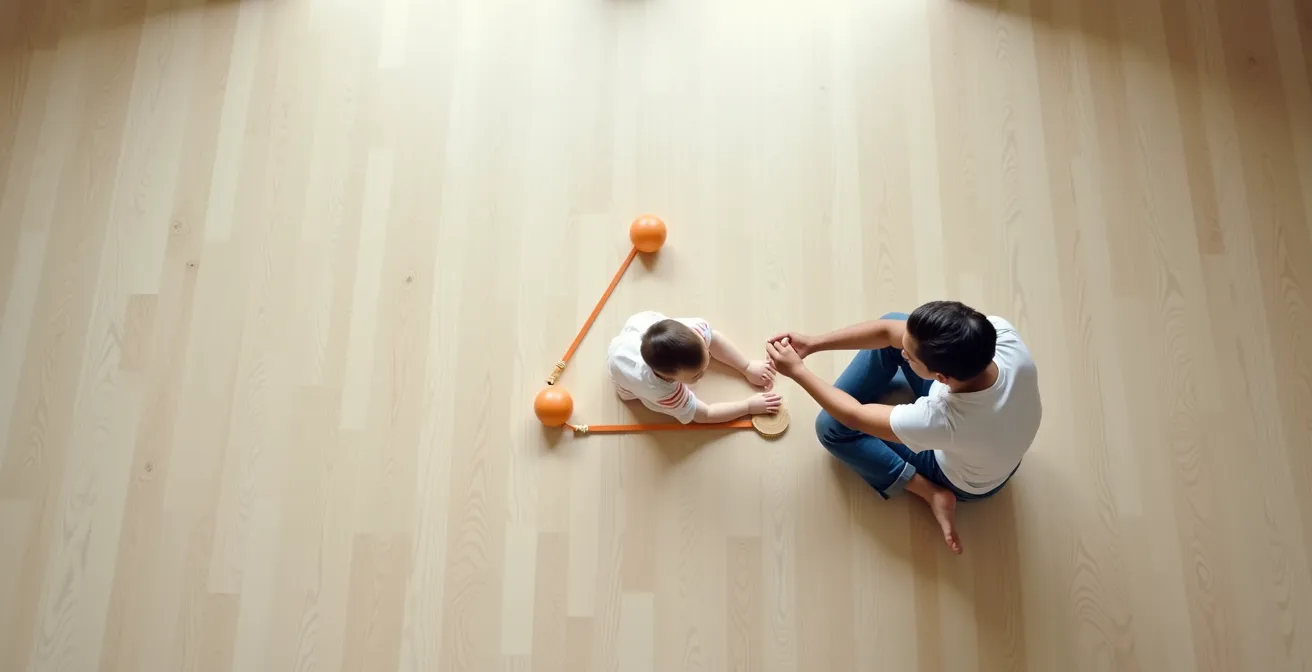
Crucially, there are two types of pointing, and the difference is significant. The first is “proto-imperative” pointing—pointing to request something. A child points to a cookie on the counter because they want it. This is an instrumental act. The second, more sophisticated type is “proto-declarative” pointing—pointing to share interest or comment on something. This is purely social. A child who points to a plane in the sky is inviting you into their world. A consistent lack of proto-declarative pointing by 18 months is a significant red flag, as research indicates that delays in joint attention skills are a core feature of Autism Spectrum Disorder. Often, a child on the spectrum may take a parent’s hand and lead them to an object, using the parent’s hand as a tool, without making the crucial eye contact that confirms a shared experience.
When to Push for an ADOS Evaluation: The Window for Early Intervention?
If you have observed a consistent pattern of the concerns discussed in this guide, the next step is a professional evaluation. The “gold standard” for diagnosing autism is the Autism Diagnostic Observation Schedule, or ADOS-2. This is not a written test but a series of semi-structured, play-based activities designed to elicit social and communication behaviors. It is a highly reliable tool; studies show the ADOS-2 assessment shows approximately 94% sensitivity and 80% specificity in correctly identifying autism.
The window for early intervention is critical. While a diagnosis can feel frightening, it is primarily a key that unlocks access to essential, brain-shaping therapies. The earlier a child begins targeted intervention, the better the long-term outcomes. Therefore, if your pediatrician suggests a “wait and see” approach despite your detailed concerns, it is appropriate and necessary to advocate for a referral to a developmental pediatrician or a psychologist who can administer an ADOS-2. You are not being an “anxious parent”; you are being a proactive one.
To have a productive conversation, you must present your concerns as data, not just feelings. Coming prepared with specific, documented examples is the most effective way to be heard. This is your observational toolkit in action.
Your Action Plan: Building a Case File for Evaluation
- Document Behaviors: Keep a journal noting specific behaviors with date, time, and context (e.g., “March 5, 10 AM: At the playground, did not respond to his name called 5 times. Was staring at the spinning merry-go-round.”).
- Record Videos: Take short (1-2 minute) video clips of concerning behaviors during daily routines. A video of a child not engaging or using repetitive motions is more powerful than a description.
- Note Missed Milestones: List specific developmental milestones that have been missed or are significantly delayed, referencing a standard developmental chart.
- Gather Caregiver Observations: Ask other caregivers (grandparents, daycare providers) for their specific, written observations. Multiple perspectives strengthen your case.
- Prepare a Summary: Write a one-page summary of your primary concerns, bullet-pointing the most significant and consistent behaviors. This gives your pediatrician a clear, concise overview.
Why Lack of Facial Interaction Is More Stressful Than Physical Separation?
For an infant, a parent’s face is the center of their universe. It is a source of food, comfort, and, most importantly, information. The need for responsive facial interaction is a deep, biological imperative. As researchers McIntoch et al. highlight in their work published in the Journal of Neuroscience, “Automatic mimicry of facial expressions facilitates social interaction, supporting interpersonal rapport, emotional contagion, and emotion recognition.” When a parent’s face is expressive and responsive, it creates a predictable, safe, and engaging world. But what happens when that feedback loop is broken?
The “Still Face Paradigm” is a famous psychological experiment that powerfully demonstrates this. In the experiment, a mother engages playfully with her baby, who responds with smiles and coos. Then, the mother is instructed to turn away and turn back with a neutral, unresponsive “still face.” Within moments, the baby’s behavior dramatically changes. They try to re-engage the mother with smiles and gestures. When that fails, they become visibly distressed, turning away, crying, and showing classic signs of stress.
This experiment reveals a profound truth: for an infant, an unresponsive face is more dysregulating than a parent’s physical absence. A parent leaving the room is a solvable problem—they will eventually return. An emotionally unavailable face, however, creates a chaotic and unpredictable environment that the infant cannot make sense of. This triggers a primal stress response, flooding their system with the hormone cortisol. This isn’t just psychological discomfort; it’s a physiological crisis. It proves that the biological need for facial feedback is as critical to an infant’s well-being as physical presence.
ADHD or Energetic Toddler: Which Behaviors Actually Require Clinical Evaluation?
All toddlers are bundles of energy. They are impulsive, have short attention spans, and are prone to meltdowns. So how can a parent distinguish between typical, high-energy toddler behavior and the early signs of Attention-Deficit/Hyperactivity Disorder (ADHD)? The key difference lies in the pervasiveness and function of the behavior. A typical toddler can be wild and unfocused in a boring situation (like a grocery store) but can often hyper-focus on an activity they love, like building with blocks. For a child with ADHD, the inability to regulate attention and impulses is often present across all activities, even preferred ones.
Furthermore, the diagnostic picture is complex because symptoms of ADHD and autism can overlap, particularly around hyperactivity and inattention. This can sometimes lead to misinterpretation during screening. In fact, studies found that without a concurrent ASD diagnosis, 21% of children with ADHD may score in the autism range on some observational scales. This highlights the need for a comprehensive evaluation by a specialist who can differentiate between the two.
As a parent, look for patterns that go beyond simple energy. Is the impulsivity dangerous, like darting into the street without any sense of risk? Are tantrums not just age-appropriate meltdowns but explosive, long-lasting rages triggered by minor frustrations? The following chart, with data adapted from pediatric health resources like Prospera Healthcare, offers a guide to help separate high energy from clinical red flags.
| Context | Typical Energetic Toddler | ADHD Red Flags |
|---|---|---|
| Activity Level | High energy in boring situations, can focus on preferred activities | Unable to focus even during self-chosen activities |
| Impulsivity | Occasional poor choices, learns from consequences | Dangerous impulsivity like darting into streets, inability to wait |
| Tantrums | Age-appropriate meltdowns, recoverable with comfort | Explosive, long-lasting tantrums triggered by minor frustrations |
| Sleep Patterns | May resist bedtime but eventually settles | Chronic sleep difficulties, needs hours to fall asleep |
Key Takeaways
- The social smile and pointing are not just cute milestones; they are critical neurological events signaling a child’s capacity for social reciprocity and joint attention.
- A consistent lack of responsive facial interaction can be more physiologically stressful for an infant than physical separation, triggering a cortisol response.
- Distinguishing between introversion, high energy, and genuine developmental delays requires observing behavior patterns across different contexts, not just isolated incidents.
Recognizing Cognitive Delays: When to Worry About Your Toddler’s Progress?
Beyond social and emotional milestones, cognitive development is another crucial area to observe. This refers to how a child thinks, learns, and solves problems. A delay in this area can sometimes be a sign of a broader developmental issue, including autism. One of the most important cognitive skills to emerge in toddlerhood is pretend play. By 18-24 months, a child should start to engage in symbolic play—making a block “talk” on the phone or pretending to feed a doll. This ability to use an object to represent something else is a massive cognitive leap. Its absence can be a significant red flag.
Another key area is problem-solving. When faced with a frustrating task, like fitting a shape into a sorter, a typically developing toddler will try multiple solutions before giving up. A child with a cognitive delay may give up almost immediately or resort to melting down, showing a low tolerance for frustration and a lack of flexible thinking. The ability to follow simple commands is also a telling indicator. By age two, a child should be able to follow a two-step command that is not part of a routine, such as “Go to your room and get your shoes.”
The following are specific cognitive red flags to watch for, based on guidelines from experts at the Child Mind Institute:
- No pretend play by 18-24 months (e.g., not making a toy car ‘talk’ or feeding dolls).
- Gives up immediately when frustrated instead of trying multiple solutions to a problem.
- Cannot follow simple, non-routine, two-step commands by age 2.
- Shows no interest in cause-and-effect toys (like pop-up toys) by 12 months.
- Lacks a basic understanding of object permanence beyond the typical age.
Recognizing these signs early is paramount. Shockingly, most children in the U.S. are diagnosed with autism around 4 years old, meaning years of critical early intervention are often lost. Your informed observation can change that trajectory for your child.
Your role as a parent is not to diagnose your child, but to be their best observer and advocate. By understanding the ‘why’ behind these developmental markers, you move from a place of fear to a position of empowerment. You now have a framework to gather specific, meaningful data that will lead to a productive partnership with your child’s healthcare providers. Trust your intuition, document your observations, and never hesitate to push for the answers your child deserves.