In summary:
- Your baby’s brain forms over a million new neural connections every second; your interactions are the primary architect of this growth.
- Contingent responses to your baby’s babbles build language circuits more effectively than any passive screen time.
- Simple, open-ended toys like blocks teach complex physics and logic, while electronic toys often limit neural exploration.
- A baby’s short attention span is not a disorder but a healthy, adaptive feature of a developing prefrontal cortex.
- Using “Parentese” (baby talk) is scientifically proven to capture infant attention and accelerate social and language development.
As a new parent, you are flooded with the desire to give your child the best possible start. This often translates into a quiet, persistent anxiety: are you doing enough to make sure they’re “smart”? The market preys on this fear, offering a dizzying array of “educational” toys, apps, and programs. The common advice is to talk, read, and play, but these directives feel vague, leaving you to wonder if you’re doing it “right.” You may worry about their attention span or feel pressure to start academic-style learning far too early.
But what if the key wasn’t in adding more scheduled activities, but in understanding the profound neural impact of the simple interactions you already have? What if you could see your daily play not as a series of tasks, but as the act of being a neural architect? The science of early brain development reveals that the first year is a period of explosive construction. During this time, your baby’s brain is not a passive vessel to be filled with facts, but a dynamic network being sculpted by experience.
This article will take you inside that process. We will move beyond the platitudes and explore the specific cognitive mechanisms at work during play. We’ll examine why your response to a babble is more powerful than a TV show, how simple blocks can teach physics better than a flashing button, and why your baby’s flitting attention is actually a sign of healthy brain function. By understanding the *why* behind the play, you can transform your everyday interactions into powerful moments of synapse formation, building a resilient and intelligent brain from the ground up.
This guide provides a science-backed framework for understanding how your baby’s brain learns from the world. Below is a summary of the key areas we will explore to help you become a confident and effective “neural architect” for your child.
Summary: A Scientist’s Guide to Early Brain Development
- Why Your Response to Babbling Builds Language Circuits Faster Than TV?
- How to Teach “Milk” and “More” to Reduce Frustration Before Speech?
- Buttons vs Blocks: Which Toys Teach Physics and Logic Better?
- The Expectation Error That Makes Parents Think Their Child Has ADHD?
- When to Start Reading Aloud: Why Day One Matters for Vocabulary?
- Why Black and White Cards Stimulate Brain Growth Better Than Pastels?
- How to Teach Cause-and-Effect Using Household Items Instead of Tablets?
- How to Use “Parentese” to Trigger Social Engagement in Quiet Babies?
Why Your Response to Babbling Builds Language Circuits Faster Than TV?
The seemingly random coos and babbles of an infant are not just noise; they are the first tendrils of language reaching out into the world. Your reaction to these sounds is one of the most powerful catalysts for brain development. This interactive loop is known to cognitive scientists as a contingent response. When a baby babbles and a caregiver immediately responds with eye contact, a smile, and words, the baby’s brain makes a critical connection: “My voice has an effect on the world.” This is fundamentally different from the passive experience of watching a screen, which provides input but no true interaction.
Groundbreaking research highlights the speed and power of this process. A study using magnetoencephalography (MEG) to monitor infant brain activity found that when adults played and talked socially with 5-month-olds, brain activity surged in regions responsible for attention. This neural activity directly predicted enhanced language development later on. In essence, your social response acts as a spotlight, telling the baby’s brain, “Pay attention! This is important.” This serve-and-return interaction builds the foundational circuits for social communication and language acquisition.
The brain learns to anticipate this social reward system with remarkable speed. In fact, research from Cornell University shows that within just 10 minutes of interaction, babies form strong expectations for these contingent responses. When the response is delayed or absent, their brain activity reflects surprise and a recalibration of expectations. This demonstrates that from a very early age, infants are not passive listeners but active participants, using your feedback to build their mental model of communication.
How to Teach “Milk” and “More” to Reduce Frustration Before Speech?
One of the great sources of frustration for both babies and parents in the first year is the communication gap. A baby has clear needs and wants but lacks the developed vocal cords and motor control to form words. This can lead to crying and tantrums born of sheer inability to be understood. Baby sign language offers a powerful neurological bridge across this gap, allowing infants to communicate specific needs like “milk,” “more,” or “all done” months before they can speak.
This isn’t just about reducing tears; it’s about building a crucial sense of agency and trust. When a baby can make a simple gesture and see it result in a desired outcome, their brain reinforces the same powerful loop of cause and effect we saw with babbling. It validates their intent and empowers them as an active communicator. According to University of Kansas researchers, when sign training is applied consistently, signing can effectively replace crying as a primary communication method.
To begin, focus on a few high-value signs. The sign for “milk,” for example, involves opening and closing a fist, as if milking a cow. Consistency is the key. Use the sign every single time you offer milk, saying the word aloud simultaneously. This multi-sensory approach—visual sign, spoken word, and the reward of the milk itself—creates a strong, layered neural association. While every child is different, most babies begin to sign back after two to eight weeks of consistent exposure.

As shown in the image, your guidance can be gentle and encouraging. You are not forcing a movement but demonstrating a connection between a physical action and a concept. This process doesn’t just teach vocabulary; it teaches the symbolic nature of language itself—that an abstract gesture or sound can represent a real-world object or desire. This is a profound cognitive leap for a developing brain.
Buttons vs Blocks: Which Toys Teach Physics and Logic Better?
In the quest for “educational” toys, parents are often drawn to electronic gadgets with buttons that promise to teach letters, numbers, or colors. From a neural perspective, however, these toys often promote a very narrow type of learning. When a baby presses a button, a predictable sound or light occurs. This teaches a simple, one-to-one correspondence but little else. This is convergent thinking: there is only one right answer, one expected outcome. The neural pathways being built are limited and repetitive.
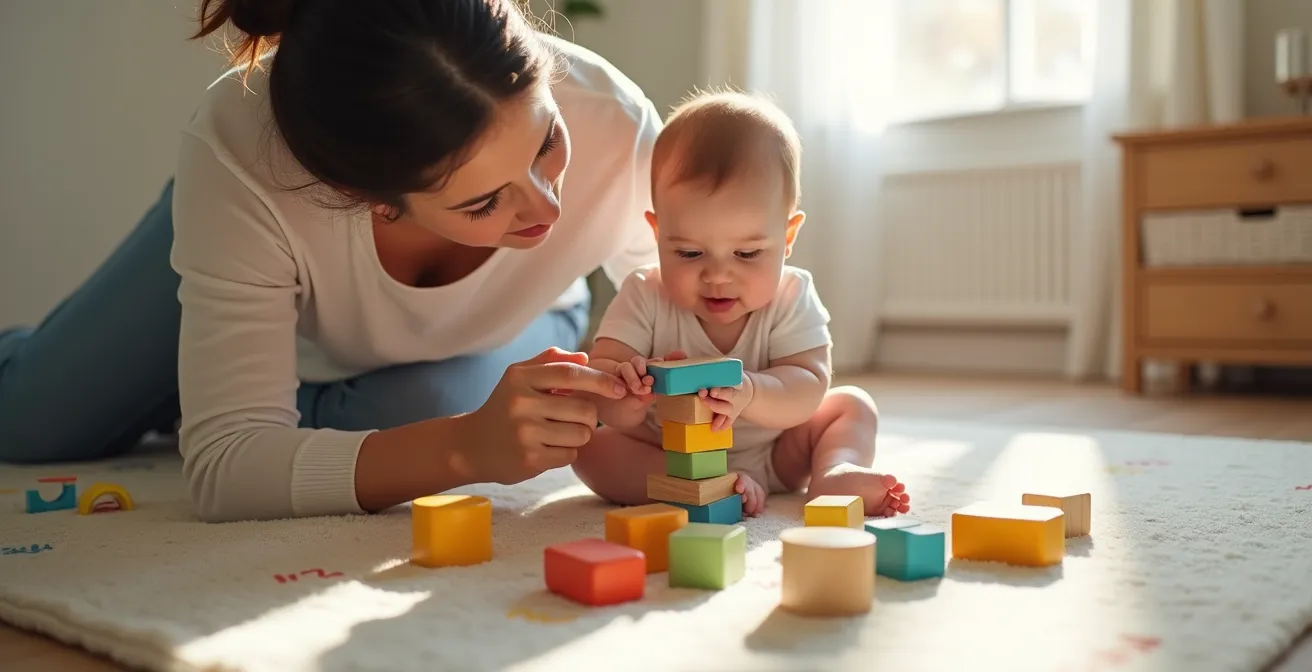
In stark contrast, a simple set of wooden blocks offers a universe of learning. Blocks encourage divergent thinking, where there are infinite possibilities and no single “correct” way to play. When a baby stacks blocks, they are conducting an intuitive physics experiment. They learn about gravity when the tower falls, about balance as they adjust a wobbly structure, and about structural integrity as they try to build a bridge. Each interaction provides rich, multi-modal sensory feedback: the weight of the block, its texture, the sound it makes when it clacks against another or topples to the floor.
This type of hands-on, manipulative play is rocket fuel for synapse formation. Research shows that as babies engage with objects like blocks, neurons fire and form connections at a staggering rate, fostering hand-eye coordination and fine motor skills that are the precursors to writing. The “failure” of a tower falling is a more valuable lesson than the “success” of a button press, as it provides new information that the brain must use to adapt its strategy for the next attempt.
This table illustrates the fundamental differences in the cognitive lessons taught by these two types of toys. An analysis of play patterns reveals why open-ended toys are superior for building complex neural architecture.
| Aspect | Building Blocks | Button Toys |
|---|---|---|
| Thinking Type | Divergent (infinite possibilities) | Convergent (single outcome) |
| Sensory Feedback | Multi-modal (weight, texture, sound, temperature) | Uni-modal (predictable sound/light) |
| Failure Learning | Tower falls = gravity/balance lessons | No meaningful failure state |
| Neural Exploration | Promotes extensive exploration | Limited neural pathways |
| Problem-Solving | Multiple solutions possible | One correct action only |
The Expectation Error That Makes Parents Think Their Child Has ADHD?
A common source of anxiety for parents is a baby’s seemingly short attention span. They may watch their infant pick up a toy, drop it seconds later, look at the cat, then focus on a dust mote in a sunbeam, all within a minute. In our adult world, conditioned for sustained focus, this can look like a problem. Some parents even begin to worry about attention disorders like ADHD. This, however, is a fundamental misunderstanding of the infant brain’s healthy, default operating system.
An infant’s brain is not designed for the “top-down,” goal-oriented focus of an adult. It operates on what scientists call stimulus-driven attention. This flitting from one object to another is an evolutionary survival mechanism. The baby’s job is to scan and absorb as much information about their environment as possible. Their prefrontal cortex, the brain region responsible for impulse control and sustained attention, is still highly immature. Expecting them to focus on one activity for an extended period is like expecting them to run a marathon before they can crawl.
Research from Harvard’s Center on the Developing Child confirms that this rapid shifting of attention is the normal, healthy state for a developing brain. What we perceive as distraction is actually data collection on a massive scale. This period of development is characterized by an explosion of neural connections; during the first three years, a baby has up to twice as many synapses as an adult. The brain is building a vast, interconnected web, and only later will it “prune” the connections that are used less frequently to become more efficient.
When to Start Reading Aloud: Why Day One Matters for Vocabulary?
The advice to “read to your baby” is ubiquitous, but the profound neurological reasons for starting from day one are often overlooked. It’s not about teaching a newborn to read; it’s about building the very architecture of their brain. In the first few years of life, Harvard research demonstrates that more than 1 million new neural connections are formed every second. Reading aloud provides the critical raw material for the language centers of this rapidly growing network.
When you read to an infant, you are bathing their brain in a rich soup of sounds (phonemes), rhythms, and sentence structures. Even if they don’t understand the meaning, their auditory cortex is hard at work, mapping these sounds and distinguishing the patterns of their native language. This exposure builds a vast “sound library” that will be essential when they begin to speak. A baby who has heard thousands of different words has a much richer and more complex neural foundation for language than one who has not.
This early relational experience is at the heart of brain development. As Dr. Jack Shonkoff of the Harvard T.H. Chan School of Public Health states, “The early years are important because the experiences young children have and the relationships they have with the important people in their lives literally shape the development of their brain.” Reading aloud is a perfect “serve and return” interaction. The baby coos, you pause and respond. They look at a picture, and you name it. This back-and-forth strengthens both the emotional bond and the neural circuits for learning.
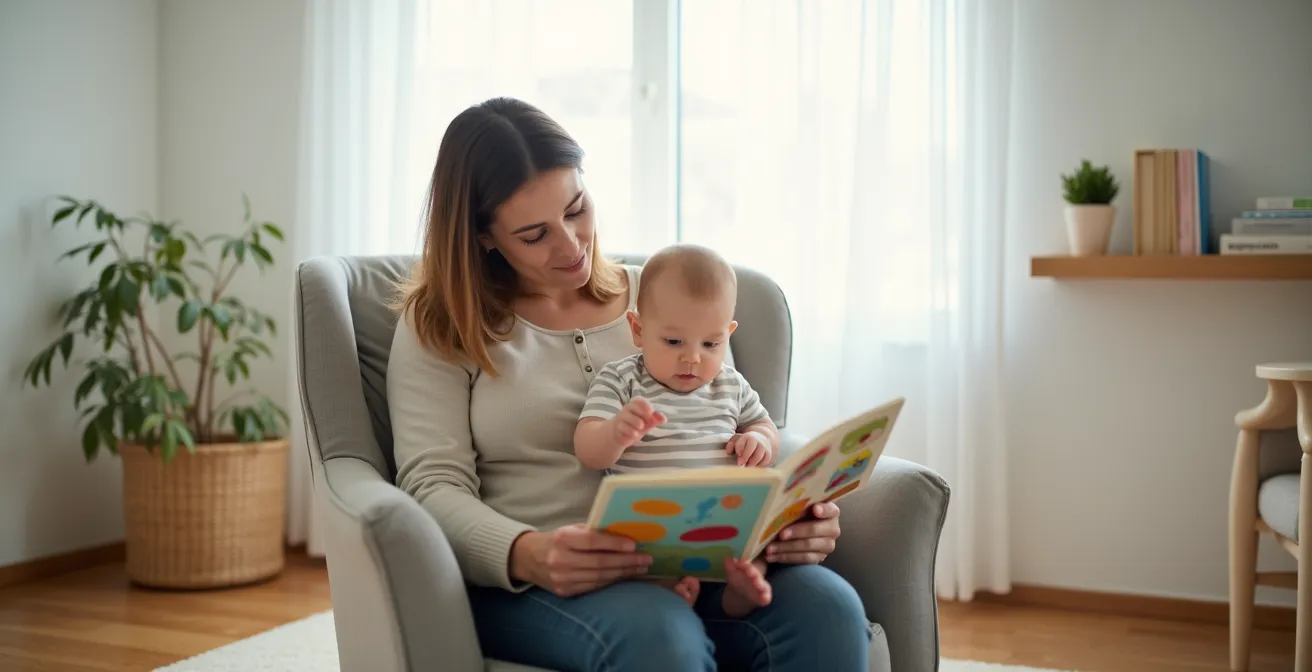
The act of snuggling together with a book, as seen here, combines physical comfort with cognitive stimulation, creating the ideal state for learning. The goal isn’t to finish the book, but to enjoy the shared experience. If your baby is more interested in chewing on the corner of the book, that’s a valid sensory exploration, too. The key is the positive association between you, books, and language.
Why Black and White Cards Stimulate Brain Growth Better Than Pastels?
A newborn’s world is blurry and muted. While parents often decorate nurseries in soft pastels, a baby’s visual system is not yet equipped to perceive these subtle shades. From a neurological standpoint, high-contrast black and white patterns are far more effective at stimulating brain growth. This is due to the developmental state of the eye’s photoreceptor cells at birth.
The human retina contains two types of photoreceptors: rods and cones. Rods detect light and dark (contrast), while cones detect color. In a newborn, the rod cells are functional, but the cone cells are still immature. This means that a low-contrast image, like a pale yellow duck on a white wall, can appear as an indistinct, confusing blur. The infant brain struggles to process this visual “noise.”
Conversely, a simple black and white image—like a checkerboard or a series of stripes—provides a strong, clean, unambiguous signal. This high-contrast information powerfully stimulates the optic nerve, which in turn sends a clear message to the brain’s visual cortex. This stimulation helps myelinate the nerve pathways, making them faster and more efficient. It is the visual equivalent of weightlifting for a developing brain, strengthening the entire visual processing system. The infant’s brain, which developmental research indicates reaches about 80% of its adult volume by age three, thrives on these clear, digestible inputs.
How to Teach Cause-and-Effect Using Household Items Instead of Tablets?
One of the most fundamental concepts a brain must learn is cause and effect: “If I do X, then Y will happen.” This is the basis of all logical reasoning and problem-solving. While a tablet can teach a simplistic version of this (touch the screen, a video plays), the real world offers a much richer, more variable, and therefore more instructive classroom. Your home is a perfect laboratory for your baby to conduct these critical experiments.
The goal is to allow your baby to become a tiny scientist, forming and testing hypotheses. When they repeatedly drop a wooden spoon from their high chair, they are not just being mischievous; they are investigating gravity, acceleration, and sound production. They are asking, “Does it always fall? Does it make the same sound on the rug as it does on the tile? What happens if I drop a soft toy instead?” Each variation provides a new data point for their developing model of the physical world.
This hands-on exploration builds a far more robust and flexible understanding of cause and effect than the rigid, predictable rules of a digital app. It involves multiple senses and requires the brain to integrate complex, real-time feedback. Instead of investing in expensive electronic toys, you can create powerful learning opportunities with items you already own.
Your Home Laboratory: A Checklist for Cause-and-Effect Discovery
- Gravity & Sound: Provide wooden spoons, plastic cups, or soft toys for your baby to drop from their high chair tray to explore gravity and the different sounds objects make on impact.
- Force & Acoustics: Offer a few pots and pans with different utensils (a wooden spoon, a metal whisk, a plastic spatula) to let them discover how varying force and materials create different sounds.
- Volume & Flow: During bath time, provide simple plastic containers or cups of different sizes for them to pour water between, teaching the foundational concepts of volume and fluid dynamics.
- Structure & Balance: Give them a stack of lightweight, non-breakable items like plastic food containers or large, empty yogurt cups to practice stacking and knocking down, learning intuitive lessons about stability.
- Object Permanence: Use a soft blanket to play a simple game of hiding a favorite toy. The act of them pulling the blanket away to reveal the toy reinforces the critical cognitive leap that objects continue to exist even when not visible.
Key Takeaways
- Your role is not to “teach” but to create a rich environment for discovery and to be a responsive partner in your baby’s exploration.
- The brain learns best from active, hands-on, multi-sensory experiences, not from passive consumption of digital media.
- Understanding the ‘why’ behind your baby’s behaviors—like a short attention span or dropping things repeatedly—transforms frustration into a fascinating window into their cognitive development.
How to Use “Parentese” to Trigger Social Engagement in Quiet Babies?
Many parents instinctively adopt a special way of speaking to their babies, often called “baby talk” or, more scientifically, “Parentese.” It’s characterized by a higher pitch, a slower tempo, and exaggerated, sing-song vowel sounds. While some may feel self-conscious using it, research overwhelmingly shows that Parentese is not just cute; it is a neurologically optimized tool for capturing a baby’s attention and boosting language development.
From an acoustic standpoint, the features of Parentese are perfectly tuned to the infant auditory system. The higher pitch makes the voice stand out from background noise, and the slower pace gives the baby’s brain more time to process the sounds. The hyperarticulation of vowels (e.g., drawing out the “ee” in “sweetie”) makes the fundamental building blocks of language clearer and more distinct. It’s like turning up the contrast on the spoken word, making it easier for the brain to decode.
Most importantly, Parentese is inherently interactive. Its natural “call and response” rhythm, with built-in pauses, acts as an explicit, non-verbal invitation for the baby to vocalize in return. This back-and-forth teaches the fundamental turn-taking pattern of all human conversation. This social feedback loop, according to research on prelinguistic vocal learning, is highly effective at triggering social engagement, even in quieter babies. It activates the social engagement system through the vagus nerve, creating a feeling of safety and connection that encourages interaction.
Embrace your role as your baby’s first and most important neural architect. By understanding the science behind your play, responding to their cues, and choosing interactions that promote discovery, you are giving them the greatest gift: a strong, connected, and resilient brain ready to learn for a lifetime.