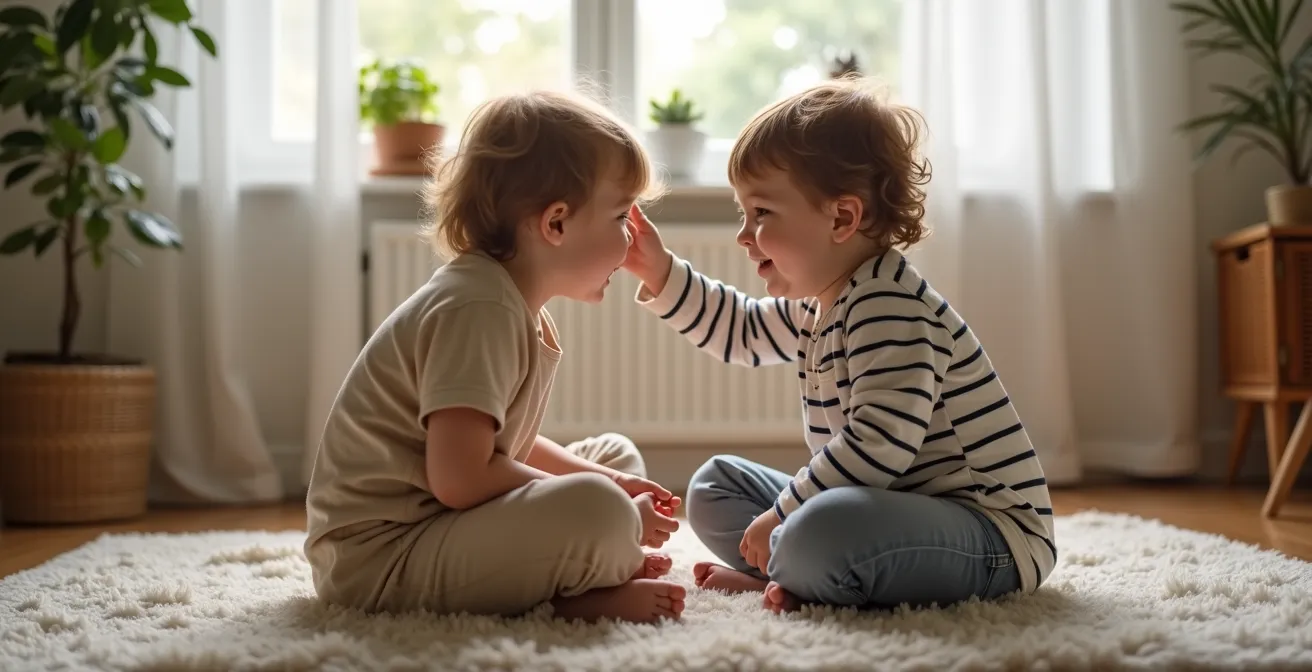
The key to preventing childhood anxiety isn’t being a perfect parent, but mastering the art of “repair” after inevitable moments of disconnection.
- Emotional unavailability (like distraction by a phone) is often more stressful for a baby than physical absence.
- Meaningful apologies, even to toddlers, are a powerful tool for rebuilding trust and demonstrating relational resilience.
Recommendation: Focus on attunement and reconnection, not on avoiding mistakes. This is what truly builds a secure attachment that lasts a lifetime.
As a parent, your deepest desire is to see your child grow into a happy, confident, and resilient adult. You read the books, follow the experts, and strive to do everything “right.” Yet, a nagging fear persists: “Am I messing this up?” This concern often centers on a powerful, yet misunderstood, concept: attachment. The way you connect with your child from the very beginning doesn’t just shape their childhood; it lays the neurological groundwork for their future mental health, particularly their vulnerability to anxiety disorders.
Many parenting guides offer simple, checklist-style advice: “be responsive,” “offer comfort,” “spend quality time.” While well-intentioned, this advice misses the profound truth of attachment. It’s not a series of actions to perform, but a dynamic, relational dance. It’s about the moment-to-moment experience of being seen, heard, and felt by another. It’s about the messy, imperfect, and beautiful process of co-regulating nervous systems, of rupture and, most importantly, repair. This isn’t about achieving parental perfection; it’s about understanding the profound impact of your presence—and your absence.
But what if the key to building a truly secure attachment lies not in what you *do*, but in how you *are*? What if emotional attunement is more critical than the specific method you use? This guide moves beyond the surface-level tips to explore the deep, neurobiological “why” behind secure attachment. We will examine the critical role of facial interaction, the power of a genuine apology to a toddler, the subtle signs that distinguish confidence from clinginess, and how to navigate common parenting challenges with the goal of fostering long-term emotional well-being.
This article provides a deep dive into the core principles of attachment theory, offering not just advice, but the understanding you need to parent with confidence and connection. The following sections break down key developmental moments and relational challenges to guide you on this journey.
Contents: A Relational Guide to Building a Secure Attachment with Your Child
- Why Lack of Facial Interaction Is More Stressful Than Physical Separation?
- How to Apologize to a Toddler After You Yell to Restore Security?
- Secure Base vs Clinginess: Is Your Child Confident or Anxious?
- The “Cry It Out” Misunderstanding That Can damage Trust if Done Wrong
- When separation Anxiety Peaks: Why 9 Months Is the Worst Time for a Vacation?
- Why You Cannot Spoil a Baby Under 6 Months by Holding Them Too Much?
- Why the “Social Smile” at 6 Weeks Is a Major Neurological Event?
- How to Handle Criticism of Gentle Parenting from Grandparents?
Why Lack of Facial Interaction Is More Stressful Than Physical Separation?
For an infant, a parent’s face is their entire world. It’s the first map they learn to read, the source of safety, and the mirror in which they discover themselves. We often assume that physical separation is the greatest source of stress for a young child, but developmental psychology reveals something far more potent: emotional unavailability. A parent who is physically present but emotionally absent—distracted, expressionless, or focused on a screen—can trigger a profound stress response in an infant, one that is often more disorganizing than if they had simply left the room.
This phenomenon was powerfully demonstrated in Dr. Edward Tronick’s landmark “Still Face Experiment.” In this study, a mother engages playfully with her baby, who responds with joy and connection. Then, the mother is instructed to turn away and turn back with a neutral, unresponsive “still face.” The baby’s reaction is immediate and heartbreaking. They try everything to win back their mother’s engagement—smiling, pointing, cooing, and even screeching. When their bids for connection fail, they become profoundly distressed. Tronick’s work showed that after just 3 minutes of an expressionless face, infants lose postural control, turn away in a state of sad disengagement, and may even collapse. This isn’t just a fleeting mood; it’s a physiological crisis.
The neurobiological reason for this is rooted in our earliest social instincts. Research from developmental psychology shows that as early as 40 minutes after birth, infants demonstrate social cognition by mimicking their parents’ facial expressions. This “serve and return” interaction is the fundamental building block of brain architecture. When a parent is emotionally checked out, the “return” is missing, leaving the infant’s nervous system in a state of alarm. In our modern world, this is often caused by “technoference,” the constant interruption of parenting by our devices. The baby experiences our focus on a screen as a “still face,” a sudden and inexplicable loss of connection that teaches them their world is unpredictable and their needs may not be seen.
Understanding this principle transforms our view of “quality time.” It’s not just about being in the same room; it’s about offering the gift of our full, attuned presence, which is the most essential nutrient for a developing brain.
How to Apologize to a Toddler After You Yell to Restore Security?
No parent is perfect. There will be moments of frustration, exhaustion, and stress where you lose your cool and yell. In the immediate aftermath, guilt can be overwhelming, coupled with the fear that you have irreparably damaged your child’s sense of safety. However, attachment theory offers a deeply reassuring perspective. As attachment specialists Kent Hoffman, Glen Cooper, and Bert Powell state, security isn’t built on a foundation of flawless parenting, but on the resilience of the relationship. They observe:
The rupture and repair cycle is the single most powerful tool for building secure attachment. It teaches children that relationships are resilient and can survive conflict.
– Kent Hoffman, Glen Cooper, and Bert Powell, Raising a Secure Child: Circle of Security Parenting
A “rupture” is any moment of disconnection, from a minor misattunement to a major event like yelling. The “repair” is the conscious act of reconnecting and restoring safety. A genuine apology is not a sign of weakness; it is the ultimate act of repair. It models accountability, empathy, and the profound truth that love remains constant even through conflict. But apologizing to a toddler, whose verbal and cognitive skills are still developing, requires a specific approach that goes beyond words.

The key is to speak the language of the nervous system: calm tones, gentle touch, and getting down to their physical level. A sincere apology validates their experience, calms their dysregulated state, and reinforces the security of your bond. It’s a concrete demonstration that you are their safe harbor, even when you are the source of the storm. It teaches them that mistakes are survivable and that relationships can be mended, a foundational lesson for all future social-emotional development.
By embracing the rupture and repair cycle, you shift the goal from unattainable perfection to authentic connection. You give your child the invaluable gift of knowing they are loved unconditionally, not just when things are easy, but especially after they’ve been hard.
Secure Base vs Clinginess: Is Your Child Confident or Anxious?
One of the most common anxieties for parents is interpreting their child’s behavior. Is my child’s constant need for me a sign of a strong bond, or is it “clinginess” that signals deeper anxiety? The answer lies in understanding the concept of the parent as a “secure base.” Coined by attachment pioneer Mary Ainsworth, a secure base is not a cage that restricts, but a home port from which a child feels confident enough to explore the world. A securely attached child trusts that their parent is a reliable source of comfort and protection, available to them whenever they need to “refuel” or seek help. This trust is what fuels their confidence and independence.
In contrast, anxious attachment often manifests as clinginess. This isn’t a sign of a strong bond but of a fragile one. The child feels uncertain about the parent’s availability and is therefore afraid to explore. Their energy is consumed by maintaining proximity, because they don’t trust that their secure base will be there when they return. This distinction is crucial. The goal of secure attachment is not to keep the child close, but to give them the confidence to move away. This understanding is at the heart of interventions like the Circle of Security, where 87.3% of trained practitioners report a significant reduction in parent stress precisely because it clarifies these behaviors.
Distinguishing between these two patterns can be done by observing the child’s behavior in specific situations, particularly around separations, reunions, and exploration. The following table breaks down these key indicators.
| Behavior Pattern | Secure Base (Healthy) | Anxious Attachment (Concerning) |
|---|---|---|
| When Parent Leaves | Protests briefly, then recovers and plays | Remains distressed, unable to engage even after time passes |
| Exploration Style | Ventures out, checks back periodically | Won’t explore, stays physically close constantly |
| Reunion Response | Happy to reconnect, then returns to activity | Clings desperately or shows anger/rejection |
| Comfort-Seeking | Seeks comfort when truly distressed | Constantly needs reassurance even when calm |
| With Strangers | Cautious but warms up with parent present | Extreme fear or inappropriate over-friendliness |
Seeing your child use you as a secure base is a sign of parenting success. It means you have created a foundation of trust so solid that they feel brave enough to turn their back on you and face the world, knowing you’ll be right there when they look back.
The “Cry It Out” Misunderstanding That Can damage Trust if Done Wrong
The “cry it out” (CIO) debate is one of the most polarizing topics in parenting. Proponents argue it teaches self-soothing and independence, while opponents warn of emotional harm and broken trust. The truth, as with most things in child development, is nuanced and lies in understanding the neurobiology of infant distress. The danger of CIO is not in the crying itself, but in the potential for prolonged, unanswered distress, which can be toxic to a developing brain. The core misunderstanding is equating a learned silence with genuine self-regulation.
When an infant cries, it is a pure signal of need—for food, comfort, or connection. Their nervous system is not yet capable of calming itself down; they rely on a caregiver’s presence to co-regulate. When that need is met with consistent non-responsiveness, the infant’s body is flooded with the stress hormone cortisol. Neurobiological research demonstrates that within just 2 minutes of non-responsiveness, infants show rapid physiological stress changes, with cortisol levels remaining elevated even after the crying stops. The baby isn’t learning to self-soothe; they are learning that their signals are futile. They are entering a state of learned helplessness.

Dr. Edward Tronick, of the Still Face Experiment, describes this process vividly when observing distressed infants. He notes that the disengagement is a last resort after repeated, failed attempts to connect:
When it goes on long enough, you see infants lose postural control and actually collapse in the car seat. They’ll start self-soothing behaviors, sucking the back of their hand or thumbs. Then they really disengage from the parent and don’t look back.
– Dr. Edward Tronick, Interview with Washington Post on Still Face Experiment
This “not looking back” is the heartbreaking outcome of misapplied CIO. It’s not independence; it’s withdrawal. This doesn’t mean a parent must rush to the crib at every whimper. There is a vast, gentle space between immediate intervention and total abandonment. It involves listening to the type of cry, offering verbal reassurance, and gradually stretching the time between check-ins, always ensuring the child feels your presence and knows that help will eventually come. It’s about teaching them they can manage a little bit of stress because you are there to support them, not leaving them to face a tidal wave of it alone.
True self-regulation grows from a foundation of a thousand successful co-regulations. It is a skill built from trust, not from abandonment, ensuring the child learns they can handle their feelings because they have first learned that you will help them handle them.
When separation Anxiety Peaks: Why 9 Months Is the Worst Time for a Vacation?
Around 8 to 10 months of age, many parents notice a dramatic shift in their baby. The once-placid infant who was happy to be passed around to loving relatives suddenly becomes clingy, cries when you leave the room, and shows a strong fear of strangers. This is the onset of classic separation anxiety, a normal and healthy sign of a strong attachment. However, this developmental leap is often misunderstood. It’s not a step backward or a sign of being “spoiled”; it’s a massive cognitive step forward that temporarily makes the world a much scarier place for your child.
The primary driver of this change is the development of “object permanence.” Before this stage, out of sight was truly out of mind. Now, your baby understands that you continue to exist even when they can’t see you. This cognitive milestone, however, creates what research from the Committee on Integrating the Science of Early Childhood Development calls a “cognitive trap.” The baby now knows you are gone, but because they have no concept of time or verbal understanding to process your reassurance that you will return, your absence can feel terrifyingly permanent. This is why separation anxiety often peaks so intensely around 9 months, making it a particularly challenging time for extended separations like a vacation.
While avoiding all separations is impossible and not even desirable, understanding this developmental stage is key to navigating it with sensitivity. This is not the time for “toughing it out.” It’s a time for extra reassurance, predictability, and empathy. When a separation is unavoidable, the goal is to create as many bridges as possible to help your child feel your presence even when you are physically apart. This might involve practicing very short separations, leaving items with your scent, or ensuring the temporary caregiver maintains the exact same daily routines. These actions provide a scaffold of security, communicating to your child’s nervous system that their world remains predictable and safe, and that you will, in fact, come back.
Ultimately, by respecting your baby’s newly developed understanding of the world, you validate their feelings and reinforce the core message of secure attachment: even when we are apart, we are still connected, and I will always come back for you.
Why You Cannot Spoil a Baby Under 6 Months by Holding Them Too Much?
One of the most pervasive and damaging myths in parenting is the idea that you can “spoil” a young baby by responding to their needs too quickly or holding them too much. This belief stems from a fundamental misunderstanding of early brain development. An infant’s cry is not a form of manipulation; it is a pure, reflexive signal of distress or need. As neuroscientist Dr. Bruce Perry explains, their behavior is driven by the most primitive parts of their brain, not by logic or strategy.
A baby under 6 months operates from the brainstem and limbic system; their prefrontal cortex, responsible for logic and manipulation, is dormant. Their cries are pure signals of need.
– Dr. Bruce Perry, Research on infant brain development and trauma
To “spoil” someone implies teaching them a bad habit through excessive indulgence. But you cannot teach a bad habit to a brain that isn’t yet capable of learning it. Responding to a baby’s cry for closeness by holding them doesn’t teach them to be demanding; it teaches them that the world is a safe place, that their needs will be met, and that their primary caregiver is a reliable source of comfort. This builds the foundation of trust and security that is essential for all future development. Far from spoiling them, you are providing the critical input their nervous system requires to regulate and organize itself.
The impact of this early nurturing touch goes even deeper than emotional security; it has a profound biological effect. Emerging epigenetic research shows that high levels of nurturing touch in the first 3 years can actually alter the expression of genes that regulate the body’s stress response system (the HPA axis). In essence, consistent, loving physical contact helps to build a more resilient and less reactive stress system for life. Holding your baby is not an indulgence; it is a biological necessity. It is a form of communication that tells every cell in their body, “You are safe. You are loved. You are not alone.”
So, when you hold your crying baby, remember that you are not giving in or creating a bad habit. You are engaging in one of the most powerful acts of brain-building and love that exists, sculpting a foundation of security that will support them for the rest of their lives.
Why the “Social Smile” at 6 Weeks Is a Major Neurological Event?
For the first few weeks of life, a newborn’s smiles are often reflexive, occurring during sleep or as fleeting twitches. But somewhere around the six-week mark, something magical happens. You look at your baby, you smile, and for the first time, they look right back into your eyes and smile a real, intentional smile. This is the “social smile,” and while it feels like a purely emotional milestone, it is one of the most significant neurological events of early infancy. It marks a fundamental shift in brain development from subcortical reflexes to conscious, cortical-level social engagement.
This milestone is the visible beginning of what the Harvard Center on the Developing Child calls “Serve and Return” interactions. The baby “serves” by offering a gaze, a coo, or a smile. The parent “returns” the serve by smiling back, using a warm tone of voice, or gently touching them. This simple, back-and-forth exchange is not just a sweet moment; it is the very process by which the brain’s architecture is built. Each time this loop is completed, neural connections that support communication, social skills, and emotional regulation are formed and strengthened. The social smile is the baby’s first intentional “serve,” an invitation to connect.
When a parent responds to this serve, they are doing more than just being nice. They are confirming to the baby that their attempts at communication are seen, valued, and effective. This builds a positive feedback loop that encourages more interaction and lays the foundation for all future learning and relationships. It teaches the baby that they are an active agent in their world, capable of having a positive impact on the most important people around them. It is the birth of intersubjectivity—the shared understanding between two minds—and the first step on the path to a secure attachment.
Therefore, that first true smile is far more than just a cute facial expression. It is a signal that your baby’s higher brain centers are coming online, and they are ready to begin the beautiful, lifelong dance of human connection with you as their first and most important partner.
Key Takeaways
- Secure attachment is built through the “rupture and repair” cycle, not parental perfection.
- A parent’s emotional attunement is more critical for an infant’s nervous system than mere physical presence.
- Behaviors like holding a baby or responding to cries are not “spoiling” but are essential for healthy brain development and stress regulation.
How to Handle Criticism of Gentle Parenting from Grandparents?
Adopting a gentle, attachment-focused parenting style can be an incredibly rewarding journey. However, it can also be a source of conflict and tension with older generations, particularly grandparents. Comments like “You’re spoiling them,” “You’re making them soft,” or “We just let you cry it out and you turned out fine” can feel deeply invalidating and create self-doubt. This criticism often comes from a place of love and concern, but it is based on an outdated understanding of child development. Navigating these conversations requires compassion, confidence, and a few well-chosen, evidence-based responses.
The key is to shift the conversation from a debate about who is “right” to a shared goal: raising a resilient, capable, and happy child. You can validate their intentions while gently introducing the modern science that supports your approach. As Dr. Daniel Siegel, a pioneer in interpersonal neurobiology, suggests framing it:
I know you want him to be tough and resilient. We want that too! The research now shows that true resilience comes from emotional security, not from being ‘hardened.’ By helping him with his big feelings now, we’re giving him the tools to handle life’s challenges later.
– Dr. Daniel Siegel, The Power of Showing Up: Parenting Advice
This approach connects your methods to the outcome they desire. Instead of arguing about the process (e.g., responding to cries), you are focusing on the shared value (e.g., resilience). Having a few concise, evidence-based “soundbites” ready can help you feel more prepared and confident in these moments. It allows you to respond calmly and informatively, rather than defensively, turning a moment of potential conflict into an opportunity for education and connection across generations.
Your action plan: Evidence-based soundbites for generational conversations
- For ‘You’re spoiling them’: Gently state, “Brain science now shows that consistently responding to a baby’s distress actually helps them become more independent and self-regulated by age 3, because it builds their core sense of security.”
- For ‘They need to toughen up’: Respond with, “We agree that resilience is important. Studies show that children with secure attachments demonstrate better emotional regulation and social skills in school, which is the foundation of true toughness.”
- For ‘We didn’t do that and you turned out fine’: Use a relatable analogy, “That’s true, and we also didn’t use car seats back then. As we learn more about child safety, both physical and emotional, we adapt our practices based on the best current information.”
- For ‘You’re making them soft’: Connect to behavior, “Actually, research indicates that gentle discipline, which focuses on teaching rather than punishing, reduces long-term aggression and improves a child’s self-control by a significant margin.”
- For ‘They’re manipulating you’: Explain brain development, “The part of the brain responsible for manipulation, the prefrontal cortex, isn’t fully developed in toddlers. Right now, their behavior is a direct communication of their needs, not a strategy.”
Ultimately, your primary responsibility is to your child. By holding firm to your evidence-based practices with kindness and confidence, you not only protect your child’s emotional development but also model the very same respectful communication you wish to see in the world.