
When a child is overwhelmed, their behavior is a nervous system response, not a choice. Instead of focusing on words or discipline, effective co-regulation uses somatic tools—your own calm presence, deep pressure, and rhythmic breathing—to send powerful signals of safety directly to their body. This guide shifts the focus from managing behavior to attuning with and calming your child’s physiological state, providing the biological foundation for emotional resilience.
The heat of a child’s meltdown can feel like an impossible storm. In that moment, as a parent, your own heart races, your patience thins, and a feeling of helplessness can take over. You’ve likely been told to “stay calm” or “validate their feelings,” but this advice often feels hollow when your child is beyond the reach of words, lost in a whirlwind of fight-or-flight. You may try to reason with them, only to find it adds fuel to the fire. This struggle is universal, leaving parents questioning their every move and feeling utterly drained.
Most conventional parenting advice focuses on behavioral or psychological tactics. We’re taught to use sticker charts, time-outs, or complex verbal scripts. But what if the key isn’t in what you *say* but in what your *body* communicates? What if the real work of calming your child lies not in their thinking brain, but in their nervous system? True co-regulation is a somatic dance. It’s the process of using your own regulated nervous system as an anchor to help your child find their way back to safety when they are physiologically incapable of doing it alone.
This approach moves beyond surface-level tips to explore the biological underpinnings of emotional storms. We will explore how simple, body-based actions can directly influence your child’s neurochemistry and shift them out of a state of high alert. By understanding the science behind these strategies, you can move from reacting in the moment to responding with quiet, grounded confidence, knowing you are providing the deep, biological sense of safety your child’s developing brain and body desperately need.
For those who prefer a visual summary, the following video offers a concise overview of what co-regulation is and why it’s a cornerstone of emotional development. It perfectly complements the detailed, body-based strategies we are about to explore.
This article provides a structured journey into the somatic world of co-regulation. Each section unpacks a different tool or principle, helping you build a comprehensive toolkit to support your child through their biggest feelings. Explore the biological power of breath, the grounding nature of physical work, and the precise timing needed for connection and repair.
Summary: A Somatic Guide to Navigating Your Child’s Meltdowns
- Why Deep Breathing Works Biologically to Stop the Fight-or-Flight Response?
- How to Use “Heavy Work” Like Pushing Walls to Ground an Anxious Child?
- Audiobooks vs Weighted Blankets: Which Tool Calms Bedtime Anxiety Faster?
- The “Stop Crying” Command That Increases Cortisol Levels
- When to Debrief a Meltdown: Why Talking During the Storm Is Useless?
- How to Use Self-Hypnosis to Manage Contractions Without Medication?
- Why Spinning and Swinging Are Essential for Regulating a Meltdown?
- Transforming “No” into “Yes”: The Power of Positive Phrasing
Why Deep Breathing Works Biologically to Stop the Fight-or-Flight Response?
When your child is escalating, telling them to “take a deep breath” often fails because it’s a cognitive command aimed at a brain that’s offline. The real magic of breath isn’t the instruction; it’s the biological mechanism it triggers. The key is the vagus nerve, a central component of the parasympathetic nervous system—our body’s natural “brake.” Long, slow exhales are the most powerful, non-verbal way to signal to the vagus nerve that the danger has passed. This stimulation tells the body to slow the heart rate, lower blood pressure, and shift out of the sympathetic (fight-or-flight) state.
Your own breathing is the most effective tool. Instead of telling your child to breathe, you can sit near them and model it yourself. Loudly, slowly, and calmly. Your regulated nervous system communicates safety to theirs through a process called neuroception, where their body subconsciously picks up on your calm state. This somatic mirroring is far more effective than any verbal cue. It’s not about forcing them to do something; it’s about inviting their body to sync with your peace. The goal is to make the exhale longer than the inhale, as this is what most powerfully activates the calming response.
This isn’t just theory; it has direct neurochemical effects. For example, deep pressure combined with calm breathing can be profoundly regulating. In fact, one study demonstrated that deep pressure can lead to a significant increase in melatonin, the hormone associated with relaxation and sleep. While this study used weighted blankets, the principle of using physical sensation to influence biochemistry is the same. Making breathwork a playful habit during calm times makes it easier to access during a storm.
- Bumblebee Breath: Hum together on the exhale. The vibration is a wonderful way to stimulate the vagus nerve.
- Belly Breathing: Lie down and place a favorite stuffed animal on your child’s belly. Watch it rise and fall as they breathe in and out.
- Bubble Blowing: The simple act of blowing bubbles naturally encourages the long, slow exhales needed to calm the system.
- Birthday Candle Breathing: Pretend your fingers are birthday candles and have your child “blow them out” one by one with slow, controlled breaths.
By shifting your focus from instructing to modeling, you transform breath from a command into a shared, somatic experience that paves the way for connection.
How to Use “Heavy Work” Like Pushing Walls to Ground an Anxious Child?
When a child’s nervous system is in overdrive, their body is flooded with energy meant for fighting or fleeing. This energy needs a safe outlet. “Heavy work” refers to any activity that involves pushing, pulling, or carrying heavy objects, providing deep sensory input to the muscles and joints. This is known as proprioceptive input, and it is one of the fastest ways to help a dysregulated brain feel grounded, organized, and aware of its place in space. It essentially tells the “downstairs brain,” “You are here. You are safe. You are contained.”
Think of it as an anchor for the nervous system. Instead of spinning with anxious energy, the body receives clear, strong signals that help it feel centered. Activities like pushing against a wall, carrying a stack of books, or even crawling on all fours provide this essential feedback. This is why many children, especially those with sensory processing sensitivities, naturally seek out these activities. Some research indicates that many children with Autism actively seek proprioceptive input to help regulate their bodies, but the principle applies to all children experiencing overwhelming emotions.
This image of a child performing a bear crawl perfectly captures the essence of a grounding heavy work activity. The deliberate movement and pressure on the hands and feet send calming signals throughout the body.

You don’t need special equipment to incorporate heavy work. It’s about reframing everyday tasks as regulatory opportunities. The key is not to present it as a chore or punishment, but as a challenge or a game. “How strong are you? Can you help me push this laundry basket to the other side of the room?” or “Let’s be bears and crawl to the kitchen!” This approach gives purpose to their pent-up energy and helps their body complete the stress-response cycle.
Your Action Plan: Everyday Heavy Work Activities
- Carrying Groceries: Give your child a few sturdy, non-breakable items to carry from the car.
- Pushing a Laundry Basket: Fill a basket with clothes or toys and have them push it across the floor.
- Wall Push-Ups: Have them stand arm’s length from a wall and push against it slowly 10 times.
- Animal Walks: Incorporate bear crawls, crab walks, or frog hops into playtime or transitions.
- Kneading Dough: Making bread or using play dough provides excellent resistance for the hands.
By giving your child a physical job to do, you give their nervous system the grounding input it craves, helping them feel more in control of their body and, consequently, their emotions.
Audiobooks vs Weighted Blankets: Which Tool Calms Bedtime Anxiety Faster?
Bedtime is a common flashpoint for anxiety. The quiet, the dark, and the separation can send a child’s nervous system into high alert. Two popular tools for managing this are audiobooks and weighted blankets, but they work on entirely different sensory systems. Choosing the right one depends on whether your child’s anxiety is primarily cognitive or physical. Is their mind racing with “what if” thoughts, or is their body restless and unable to settle?
Audiobooks are a tool for the auditory system. They work by providing a gentle, external focus that interrupts spirals of anxious thoughts. A calm, steady narrative voice gives the brain something predictable to latch onto, preventing it from inventing scary scenarios in the silence. This is a form of cognitive distraction, pulling the child out of their internal world of fear and into an external story. It’s most effective for children who express fears verbally or who seem preoccupied with worries.
Weighted blankets, on the other hand, are a tool for the proprioceptive and tactile systems. They provide Deep Pressure Stimulation (DPS), which functions like a firm, continuous hug. This pressure signals the nervous system to release calming neurotransmitters like serotonin and melatonin, while reducing the stress hormone cortisol. It’s best for the child who is physically restless, tossing and turning, or who needs a feeling of being held and contained to feel safe. The effect is more physiological than cognitive, calming the body directly, which in turn calms the mind.
This approach is supported by scientific findings. For instance, an analysis of calming sensory tools highlights how different inputs produce distinct neurochemical effects. The following table breaks down the comparison to help you choose the right tool for your child’s specific needs at bedtime.
| Factor | Audiobooks | Weighted Blankets |
|---|---|---|
| Primary Sensory System | Auditory (hearing) | Proprioceptive/Tactile (touch/pressure) |
| Best For | Racing thoughts, fear of silence, need for mental distraction | Physical restlessness, need for grounding, sensory seeking |
| Mechanism | External focus prevents thought spirals | Deep pressure stimulates parasympathetic nervous system |
| Neurochemical Effect | Reduces cortisol through distraction | Increases serotonin and melatonin |
| Time to Effect | Immediate distraction (1-5 minutes) | 15-20 minutes for full calming effect |
| Age Suitability | 3+ years (with age-appropriate content) | 3+ years (with proper weight ratio) |
Ultimately, some children may even benefit from both: the weighted blanket to calm their body and the audiobook to occupy their mind, creating a complete cocoon of sensory safety.
The “Stop Crying” Command That Increases Cortisol Levels
In a moment of desperation, it’s a phrase that escapes nearly every parent’s lips: “Stop crying.” It comes from a place of wanting the pain to end—for both the child and the parent. Yet, from a nervous system perspective, this command is one of the most counterproductive things we can say. When a child is crying during a meltdown, their body is in a stress state, actively trying to release a buildup of emotional energy and the stress hormone cortisol. Telling them to stop is like trying to cap a volcano. It doesn’t stop the pressure; it just forces it to go somewhere else, or build even higher.
The command “stop crying” sends a powerful, implicit message to the child’s neuroception: “Your feelings are not safe here. This big emotion is too much for me to handle.” This can elevate their sense of threat, paradoxically increasing the cortisol it’s meant to quell. True co-regulation involves creating a space where the emotion is allowed to exist and move through the body. The goal is not to stop the tears, but to be the safe container for them. This communicates that you are strong enough to handle their big feelings, which is profoundly reassuring to their nervous system.
This doesn’t mean allowing destructive behavior. It’s about separating the emotion from the action. As the experts at Handspring Health note, validation and boundary-setting can coexist. Their thinking is captured perfectly in this insight:
Validation is not the same as approval. You can acknowledge a child’s emotional experience while still setting boundaries around their behavior.
– Handspring Health, Co-Regulation: Tools to Support Kids’ Emotions
Instead of “stop crying,” we can use empathy-based language that validates the feeling while ensuring safety. These scripts are not magic words, but they change the energetic signal you send from one of dismissal to one of presence and acceptance.
- “This is a big feeling. I’m right here with you.”
- “Your tears are okay, let them come out.”
- “I can handle this with you.”
- “You’re having a really hard time, and that’s okay.”
- “I see you’re upset. I’m here when you’re ready.”
By shifting your language from control to connection, you are not “giving in” to the tantrum; you are attuning to the nervous system and providing the safety required for genuine regulation to begin.
When to Debrief a Meltdown: Why Talking During the Storm Is Useless?
After a meltdown, our instinct as parents is often to talk it out, to teach a lesson, or to get an apology. We want to process what just happened to prevent it from happening again. But the timing of this conversation is everything. Trying to talk, reason, or debrief *during* the emotional storm is not only useless but can make things worse. This is because a child in a meltdown is operating from their “downstairs brain”—the primitive, emotional part that houses the amygdala and the fight-or-flight response. Their “upstairs brain”—the prefrontal cortex responsible for logic, reason, and problem-solving—is completely offline.
As a resource from The Children’s School explains, when children are in fight-or-flight mode, they are physiologically unable to access their problem-solving ‘upstairs’ brain. Your words are just more noise in an already overwhelmed system. At that moment, they don’t need a lesson; they need to feel safe. Safety is communicated not through words, but through your calm presence, your steady breathing, and your non-threatening body language. The debrief can only happen once the storm has passed and both of you have returned to a regulated state.
The first step after the emotional peak is not talking, but reconnecting. This is the “repair” phase of the cycle. It should be gentle, non-verbal, and often playful. This might look like sitting quietly nearby, offering a snack or a drink of water, or starting a simple, calming activity together like building with blocks. This non-verbal reconnection is what brings the “upstairs brain” back online and rebuilds the bridge of safety between you.
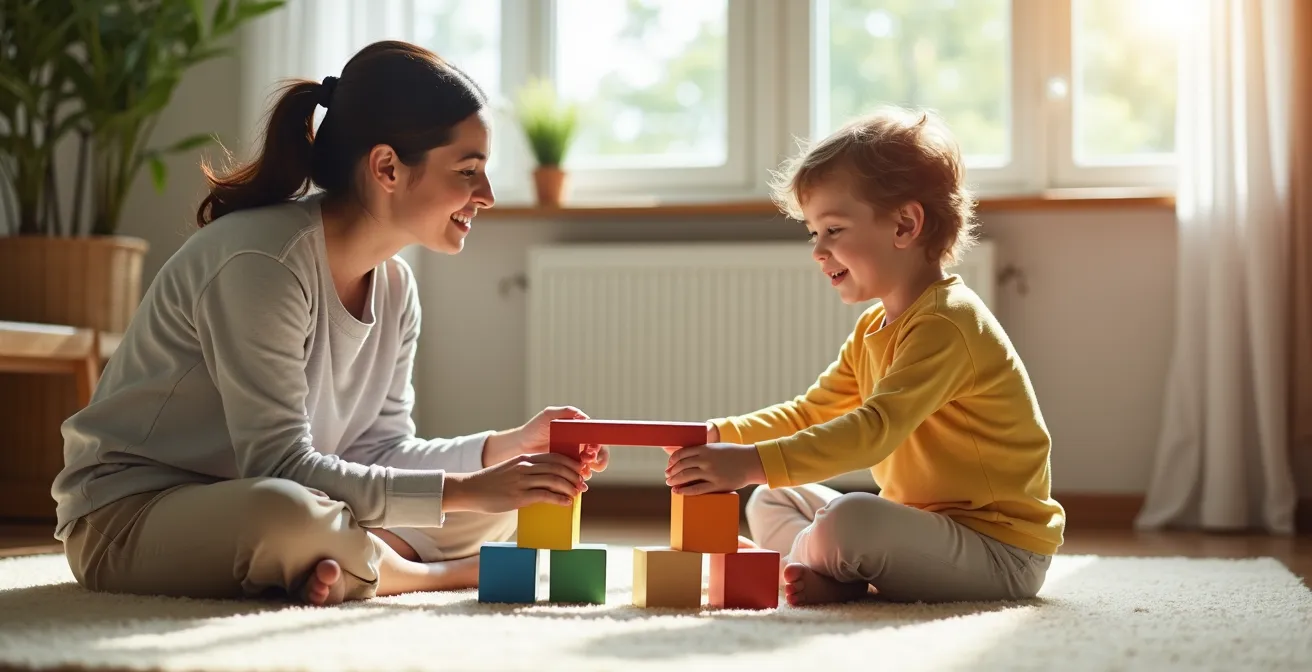
Only after this reconnection, when everyone is calm, can a brief debrief be effective. This isn’t a lecture, but a simple, collaborative process of repair.
- Step 1 – Reconnect: Start with non-verbal connection. Offer a hug, a snack, or suggest a quiet activity. Your primary goal is to re-establish a feeling of safety and togetherness.
- Step 2 – Recount: Once calm, briefly and neutrally narrate what happened without blame. “That was so hard when the tower fell down. You felt really big anger in your body.”
- Step 3 – Repair/Re-do: Brainstorm solutions for next time, together. “When we feel that frustrated again, what’s something we could do with that energy? Maybe we could stomp our feet or push the wall.”
By respecting the brain’s state during and after a meltdown, you create a predictable cycle of rupture and repair that builds deep trust and long-term emotional resilience.
How to Use Self-Hypnosis to Manage Contractions Without Medication?
While the title mentions contractions, the underlying principle of self-hypnosis is a powerful tool for any overwhelming physical or emotional sensation, including those experienced by a child during a meltdown. At its core, this practice is about creating a powerful mental anchor of safety that can be accessed when the outside world feels too intense. For a child, this isn’t about complex hypnotic scripts but about co-creating a vivid “safe place” in their imagination that they can “visit” to calm their nervous system.
This “safe place” becomes a portable regulator. It’s a resource built during calm times that can be deployed during a storm. The key is to make it a rich, multi-sensory experience. It’s not just a place they see in their mind, but one they can hear, smell, and feel. Is it a cozy, soft nest? A sunny beach with the sound of waves? A quiet forest with the smell of pine? By engaging multiple senses, you make the anchor more robust and easier for their brain to lock onto when stressed.
The process of creating and using this anchor is a foundational co-regulation practice. It must be established when the child is already calm, happy, and connected with you. Trying to introduce it for the first time during a meltdown will fail because their “upstairs brain” is not available for creative imagination. Daily, playful practice is what strengthens the neural pathway, making it an automatic reflex over time. You can even pair the mental image with a physical cue, like gently squeezing a finger, which acts as a shortcut to trigger the feeling of calm.
Here is a step-by-step guide to building this powerful internal resource with your child:
- Choose a Calm Moment: Introduce the idea when you are both relaxed and connected, perhaps at bedtime or during quiet playtime.
- Imagine the Place: Ask your child to think of their favorite, most peaceful place in the whole world, real or imaginary.
- Add Sensory Details: Guide them with questions. “What colors do you see? What sounds can you hear? Is it warm or cool? What does the air smell like?”
- Practice Daily: Spend just a minute or two “visiting” this place every day to make the mental anchor strong.
- Create a Physical Cue: While in the safe place, decide on a simple physical touch, like touching the thumb to the pointer finger, that will be your secret signal.
- Use the Anchor: During an overwhelming moment, use a calm voice and the physical cue to gently guide them back: “Let’s go to our cozy forest. Can you feel the soft moss under your feet?”
By proactively building this internal sanctuary, you’re not just managing a moment of distress; you’re teaching them a lifelong skill of self-regulation.
Why Spinning and Swinging Are Essential for Regulating a Meltdown?
Have you ever wondered why children seem to have an endless desire to spin, swing, and hang upside down? This isn’t just play; it’s a deep biological drive to develop and regulate their nervous system. These activities provide powerful vestibular input, which refers to the sense of movement and gravity, processed by our inner ear. The vestibular system is a master regulator; it tells our brain where our body is in space, helping us feel balanced and coordinated. For a child, this input is as crucial as food and water, especially in the early years when, as research shows, the brain forms over 1 million neural connections per second.
During a meltdown, the world can feel chaotic and disorienting. Rhythmic, predictable vestibular input, like gentle rocking or slow swinging, can have a profoundly organizing effect. It works directly on the brainstem, a core part of the “downstairs brain,” sending calming and organizing signals throughout the nervous system. This is why rocking a baby to sleep is so effective—it’s pure vestibular regulation. Fast, unpredictable spinning can be alerting, but slow, rhythmic motion is almost universally calming.
Conversely, some children who are already in a high state of arousal may seek out intense spinning to “reset” their system. A few short, controlled bursts of spinning can sometimes help a dysregulated child’s brain “reboot” and organize the flood of sensory information it’s receiving. The key is to be led by your child and to ensure safety. For most calming purposes, however, slow and steady is the goal. You don’t need a playground to provide this essential input. Many simple activities can be done at home with no equipment.
- Blanket “Burrito”: Roll your child up snugly in a blanket and gently rock them from side to side.
- Slow Bouncing: Sit with your child on an exercise ball or your lap and bounce in a slow, predictable rhythm.
- Hammock Sway: Use a sturdy blanket held by two adults to create a makeshift hammock and swing your child gently.
- Log Rolling: Encourage your child to roll across the carpet or a soft patch of grass.
- Office Chair Spins: For a child who seeks more intense input, provide controlled, short spins (5-10 seconds at a time) in an office chair, always checking in to see how they feel.
By understanding and providing these movement-based needs, you offer a powerful, non-verbal pathway back to calm and help your child build a more resilient and integrated sensory system.
Key Takeaways
- Co-regulation is a biological process, not a behavioral tactic. It uses your calm nervous system to regulate your child’s.
- Body-based tools like deep breathing (long exhales), heavy work (proprioception), and rocking (vestibular input) are more effective than words during a meltdown.
- Validate the emotion, but set boundaries on the behavior. Commands like “stop crying” increase stress and undermine safety.
Transforming “No” into “Yes”: The Power of Positive Phrasing
Our language is a powerful tool that constantly sends signals of either threat or safety to our child’s nervous system. A brain, especially a young one, is hardwired to react to the word “No.” It often feels like a wall, a conflict, a threat to autonomy. Constant use of “No,” “Don’t,” and “Stop” can inadvertently keep a child’s nervous system in a state of low-grade defense. Transforming your language from negative commands to positive, possibility-oriented phrasing can dramatically shift the dynamic from conflict to cooperation. This isn’t about permissive parenting; it’s about clear and respectful communication that offers a path forward.
The strategy is simple: instead of telling your child what *not* to do, tell them what they *can* do. This approach has several benefits for their nervous system. First, it avoids the confrontational energy of a direct “No.” Second, it provides a clear, actionable instruction for their brain to follow, reducing confusion and frustration. “Walking feet inside” is a much clearer motor plan for the brain than “No running!” Third, it often involves a “Yes, and…” or a “Yes, when…” structure, which acknowledges their desire while upholding a boundary. This validates their impulse while redirecting it, which is the essence of co-regulation. This is especially important for the significant number of children who struggle with emotional regulation.
This shift requires conscious practice, as many of our own automatic phrases are negatively framed. A comparative analysis provided in a guide on co-regulation clearly illustrates this transformation. Having a few of these “re-frames” ready can make a world of difference in the heat of the moment, de-escalating a potential conflict before it even begins.
| Instead of Saying | Try This Positive Alternative | Why It Works |
|---|---|---|
| ‘No running inside!’ | ‘Walking feet inside, AND the backyard is perfect for running’ | Offers an acceptable alternative |
| ‘Stop yelling!’ | ‘Let’s use our inside voice’ or ‘I can hear you better when you speak softly’ | Provides clear expectation without conflict |
| ‘Don’t hit your sister!’ | ‘Gentle touches only’ or ‘Show me gentle hands’ | Models desired behavior |
| ‘No cookies before dinner!’ | ‘Yes, you can have a cookie WHEN we finish dinner’ | Creates anticipation instead of denial |
| ‘Stop making a mess!’ | ‘Let’s keep our toys in this area’ | Gives manageable boundaries |
By consciously choosing your words, you are not just managing behavior. You are modeling respectful communication, reducing defensive states, and using language itself as a powerful tool to co-regulate and build connection.