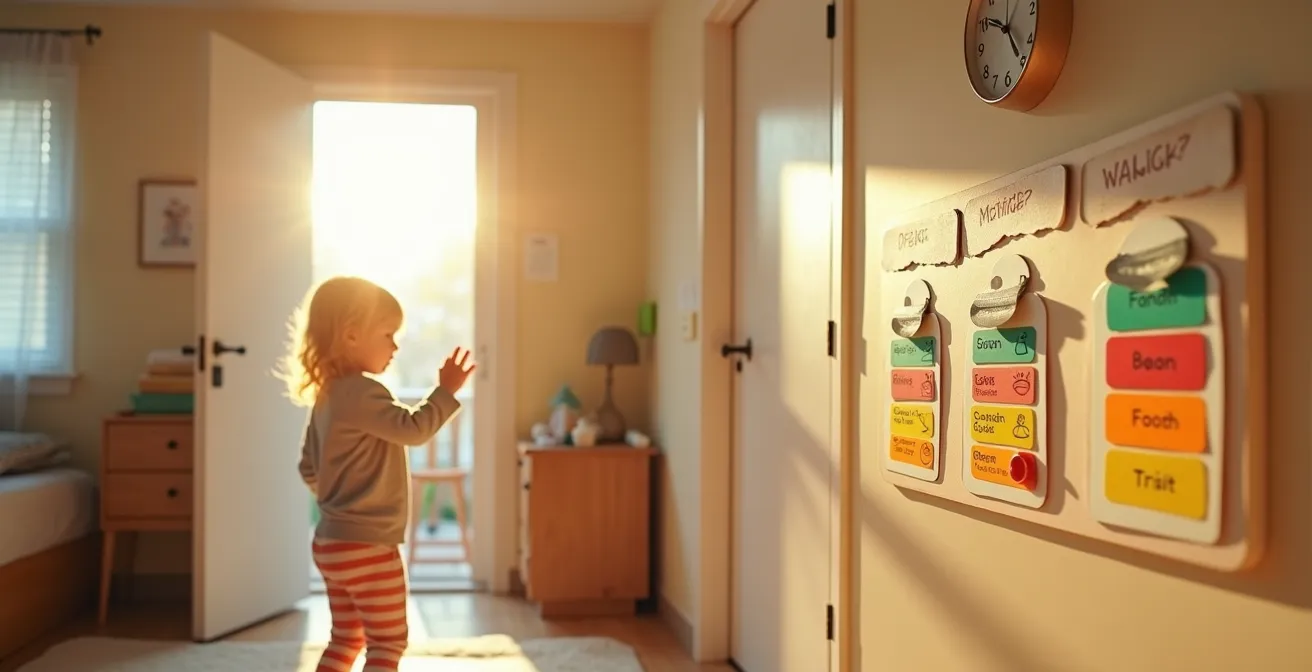
In summary:
- Your child’s brain isn’t wired to understand “we’re late”; they need visual, concrete steps, not abstract time concepts.
- A customizable velcro routine chart transforms the dynamic, making your child the “CEO of their morning” instead of you being the taskmaster.
- Teaching independence through “scaffolding” (doing it with them, then gradually fading out) is a faster long-term strategy than just doing it for them.
- Linking the evening routine to morning prep (the “Morning Launchpad”) is the secret to a truly seamless start to the day.
That familiar morning screech of “Put your shoes on!” for the tenth time. The frantic search for a matching sock. The spilled milk on a freshly ironed school uniform. It’s a scene played out in households everywhere, turning the first hours of the day from a time of connection into a battlefield of frustration. Many parents try the usual tactics: setting alarms earlier, laying out clothes, or offering rewards. But these are often just band-aids on a much deeper issue.
The constant reminders and power struggles aren’t a sign of a “naughty” child or a failing parent. They’re a symptom of a systems problem. We often expect our children to operate with the same sense of urgency and executive function as an adult, but their brains are simply not built for it yet. What if the key wasn’t to manage your child harder, but to fundamentally change the game? The real secret lies in shifting the responsibility from your brain to a visual, tangible system that your child can own.
This article will deconstruct the chaos and provide a step-by-step blueprint for building that system. We’ll explore the neuroscience behind why your child struggles with time, show you how to create a routine chart they’ll actually want to use, and reveal the small but powerful shifts in your approach that will cultivate true, lasting independence. Get ready to trade the morning mayhem for a predictable, peaceful, and empowering start to every day.
For those who prefer a visual walkthrough, the following video provides a fantastic look at creating a DIY visual schedule that complements the strategies we’re about to explore. It’s a great way to see the core tool in action.
In this guide, we’ve structured the journey from understanding the problem to implementing a complete solution. Each section builds upon the last, creating a comprehensive system for transforming your family’s mornings. Here’s what you can expect.
Summary: A Complete Guide to a Visual Routine System for Calm Mornings
- Why Your 6-Year-Old Has No Concept of “We Are Late”?
- How to Make a Velcro Routine Chart That Kids Actually Want to Use?
- Alarm Clock vs Gro-Clock: Which Helps Toddlers Stay in Bed?
- The “I’ll Just Do It” Mistake That Kills Independence Skills
- How to Serve “Grab and Go” Breakfasts That Are High Protein?
- The Helicoparenting Mistake That Stifles a Child’s Independence by Age 10
- When to Serve Protein: The Breakfast Switch That Improves Focus at School?
- Designing a 20-Minute Bedtime Routine That Actually Works for Toddlers
Why Your 6-Year-Old Has No Concept of “We Are Late”?
It’s one of the most maddening parts of parenting: you’re frantically trying to get out the door, while your child is calmly inspecting a dust bunny as if time doesn’t exist. The truth is, for them, it barely does. This isn’t defiance; it’s developmental reality. The part of the brain responsible for planning, time management, and understanding consequences—the prefrontal cortex—is the last to develop. In fact, neuroscience research confirms it takes nearly 25 years for the prefrontal cortex to fully mature.
When you say “we’re going to be late,” you’re using an abstract concept that their brain can’t yet process. They live in a concrete, “right now” world. They understand “put on shoes,” but the “why” (to avoid being late for school, which means the teacher will be waiting, etc.) is a complex sequence of future events that is simply beyond their grasp. Between the ages of 3 and 5, this part of the brain is in a critical period of making connections, but it’s far from the efficient, organized hub it will be in adulthood.
This is why verbal reminders and threats are so ineffective. You’re speaking a different cognitive language. To them, your urgency is just stressful noise. The solution isn’t to talk louder or faster; it’s to provide a concrete, visual roadmap that translates the abstract concept of “getting ready” into a simple, followable sequence of events. This is the foundation of the visual routine system: it stops taxing a part of their brain that isn’t ready and instead plays to their strengths—visual learning and concrete tasks. This is the first step in brain offloading for both you and your child.
How to Make a Velcro Routine Chart That Kids Actually Want to Use?
The secret to a successful routine chart isn’t just listing tasks; it’s creating an interactive experience that gives your child a sense of control and accomplishment. A velcro chart is the perfect tool for this, turning a list of chores into a satisfying game. The physical act of moving a task from the “To Do” column to the “Done” column provides immediate, tangible feedback that their brain craves. It makes progress visible and celebrated.
Here’s how to create one that isn’t just another piece of wall clutter:
- Co-create and Customize: The most crucial step is involving your child from the very beginning. Let them choose the theme (dinosaurs, space, fairies) and help pick colors or stickers. Use a simple tool like Canva to customize a printable template with their name on it. This creates instant buy-in; it’s *their* chart, not yours.
- Use Pictures, Not Words: For young children, use clear, simple pictures for each task (a toothbrush, a bowl of cereal, a pair of shoes). This makes the chart an executive function trainer, allowing them to “read” the routine without needing you to interpret it.
- Get the Tactile Feel Right: Laminated picture cards feel professional and durable. When attaching the velcro, put the soft, fuzzy side on the main chart and the rough, scratchy side on the back of the cards. This small detail makes the “rip and stick” motion more satisfying.
- Establish the ‘Done’ Zone: The magic is in the destination. Having a clearly marked “Done” or “Finished” column gives a sense of finality and accomplishment. Watching that column fill up is a powerful motivator.
- Hold Weekly ‘Team Meetings’: Check in with your child once a week for just five minutes. Ask, “How is your morning chart working?” or “Is there anything we should change?” This reinforces their ownership and allows you to tweak the system together as they grow.
The close-up below shows the magic moment: the tangible connection between the child’s action and the task’s completion. This visual and tactile feedback is what makes the system work so effectively.

By following these steps, you’re not just making a chore chart. You’re designing an interactive tool that builds autonomy, provides predictability, and makes your child the proud CEO of their morning.
Alarm Clock vs Gro-Clock: Which Helps Toddlers Stay in Bed?
For many parents, the morning chaos begins before they’re even out of bed, with a toddler bursting into the room at 5 a.m. declaring it’s time to play. This is where a specific type of clock can be a true game-changer. But a traditional, blaring alarm clock is often the worst choice for a young child. It’s startling, anxiety-inducing, and teaches them to react to an external command rather than internalizing a sense of time.
Kids love pictures, and a chart gives them a clear visual guide of what comes next. With the chart, kids can follow along and complete tasks on their own. Knowing what to expect helps everyone stay calm and on track.
– 7 Days of Play Parenting Experts, How to Make a Kid-Friendly Morning Routine Chart
This principle extends beyond charts to time itself. Visual “sleep-trainer” clocks, like the popular Gro-Clock, operate on a different philosophy. Instead of just marking an endpoint, they visually communicate the *passage* of time in a way a child can understand. They answer the constant question, “Is it time yet?” without the child needing to ask. A blue, sleeping star might slowly transition to a yellow, smiling sun when it’s okay to get up. This provides predictability scaffolding, giving them a sense of control and reducing the anxiety of waiting.
This comparative analysis shows why a visual clock is a superior tool for teaching toddlers and young children about wake-up times.
| Feature | Visual/Gro-Clock | Traditional Alarm |
|---|---|---|
| Teaching Method | Shows ‘not yet/now’ concept visually | Triggers immediate action |
| Anxiety Reduction | Answers ‘Is it time?’ constantly | Creates startling awakening |
| Child Control | Gives sense of predictability | External command only |
| Long-term Use | Scaffold tool, phase out gradually | Permanent solution |
Ultimately, a visual clock is a temporary teaching tool. Its goal is to help your child internalize the rhythm of the morning, providing a gentle and empowering way to understand when the day begins. It transforms the wake-up call from a jarring interruption into a calm, predictable event they can anticipate and understand.
The “I’ll Just Do It” Mistake That Kills Independence Skills
In the heat of the morning rush, it feels so much faster to just tie your child’s shoes, button their shirt, or spread the butter on their toast yourself. This is the “I’ll Just Do It” trap. It solves the immediate problem of being late, but it creates a much bigger long-term problem: it robs your child of the opportunity to learn. Every time you step in, you’re sending a subtle message: “You’re not capable,” or “My time is more important than your learning.”
This habit is incredibly costly in the long run. In fact, parenting efficiency calculations show that investing 3 extra minutes per task to teach independence can save you an estimated 50 hours of work over the next five years. That initial investment of patience pays massive dividends. Resisting the urge to take over is one of the most powerful things you can do to build your child’s confidence and competence.
The key to breaking this cycle is a technique called scaffolding and fading. Instead of expecting them to master a task all at once, you provide just enough support to help them succeed, and then gradually remove that support as they become more proficient. It’s about being their coach, not their concierge.
Your Action Plan: The Scaffolding and Fading Technique
- Week 1: Demonstrate and Narrate. You perform the entire task (e.g., making toast) while your child watches. You narrate every step out loud: “First, we get the bread. Next, we put it in the toaster…”
- Week 2: Child Starts, Parent Finishes. Your child does the very first, easiest step (e.g., getting the bread out), and you complete the rest of the task. Praise their contribution enthusiastically.
- Weeks 3-4: Gradual Handover. Your child now does the first two or three steps independently. You are on standby to help only if they get stuck, offering verbal prompts before physical help.
- Weeks 5-6: Assistant Role. Your child completes almost the entire task. You only step in for the most challenging part (e.g., getting the hot toast out of the toaster).
- Week 7+: Verbal Encouragement Only. Your child now performs the entire task from start to finish. Your role is simply to be a cheerleader, offering encouragement and celebrating their independence.
This methodical approach turns overwhelming tasks into manageable steps. It respects the child’s pace, builds mastery, and systematically transfers responsibility from you to them, creating a foundation for lifelong self-reliance.
How to Serve “Grab and Go” Breakfasts That Are High Protein?
Once the dressing and teeth-brushing are done, breakfast can be the final hurdle that sends your smooth morning off the rails. The solution is to create an “Independence Station” for breakfast—a system of pre-prepped, kid-accessible options that are high in protein to keep them full and focused. This isn’t about sugary cereal bars; it’s about smart, make-ahead meals that empower your child to serve themselves.
A little prep on Sunday can transform your entire week. The goal is to have several nutritious choices ready to go in a low drawer or shelf in the fridge that your child can easily reach. This eliminates decision fatigue for you and gives them a powerful sense of autonomy. Nutritional analysis shows, for example, that just 1 cup of cottage cheese contains about 25 grams of protein, making it a powerhouse ingredient for many of these ideas.
Here’s a sample Sunday workflow to stock your Independence Station:
- Batch-cook egg bites: In a muffin tin, whisk eggs with cottage cheese or Greek yogurt, and let your child add mix-ins like cheese, spinach, or diced ham. Bake and store in the fridge.
- Prepare overnight chia pudding jars: Mix chia seeds, milk (or a milk alternative), and a touch of maple syrup or honey in small jars. They’ll be ready to grab in the morning.
- Assemble yogurt parfaits: Layer Greek yogurt, berries, and granola in clear containers. The colorful layers make them visually appealing.
- Make and freeze protein pancakes: Make a large batch of your favorite protein pancakes or waffles on the weekend. Freeze them in individual portions that can be quickly toasted.
- Set up the station: The most important step! Place these items in clear, easy-to-open containers on a low, accessible shelf in the fridge. You’re creating a mini-buffet that your child is in charge of.
This system does more than save time. It teaches portioning, decision-making, and self-care. It’s another powerful piece of the brain offloading puzzle, removing “What’s for breakfast?” from your morning mental load.
The Helicoparenting Mistake That Stifles a Child’s Independence by Age 10
The “I’ll Just Do It” mistake, when repeated over years, evolves into a broader pattern known as helicopter parenting. It’s the well-intentioned impulse to hover, protect, and manage every aspect of a child’s life to prevent them from struggling or failing. While it comes from a place of love, its long-term effects can be profoundly damaging to a child’s developing sense of self. It systematically undermines their ability to develop resilience, problem-solving skills, and self-confidence.
The neuroscience is clear: a child’s brain develops in response to its environment. When a child is consistently shielded from challenges, their prefrontal cortex doesn’t get the “reps” it needs to build strong pathways for executive functions. As researchers noted in a landmark study published in PNAS, environmental events and social experiences are not optional extras; they are critical architects of the developing brain. The study states, ” When the PFC is exposed to different environmental events during development…the developing PFC may develop in different ways.”
By age 10, a child who has been consistently “helicoptered” may exhibit several concerning traits:
- Low Frustration Tolerance: They may give up easily at the first sign of difficulty because they haven’t built the mental muscle for perseverance.
- Anxiety and Indecisiveness: Lacking practice in making their own choices, they may feel overwhelmed when faced with decisions, big or small.
- Poor Problem-Solving Skills: They look to an adult for the solution to every problem, from a tangled shoelace to a disagreement with a friend.
- A Diminished Sense of Competence: Deep down, they may internalize the message that they are not capable of handling things on their own.
Fostering independence in small, manageable ways—like letting your child dress themselves or pour their own cereal, even if it’s messy—is not just about making your mornings easier. It’s a critical investment in building a capable, resilient, and confident human being. It’s about letting them experience the small struggles that lead to big growth.
When to Serve Protein: The Breakfast Switch That Improves Focus at School?
You’ve successfully created a grab-and-go breakfast station, but *what* your child chooses to grab can have a significant impact that lasts long after they’ve left the house. Many traditional breakfast foods (cereal, toast with jam, pastries) are high in simple carbohydrates. While they provide a quick burst of energy, they often lead to a blood sugar spike followed by a crash, leaving kids feeling sluggish, irritable, and unable to focus just an hour or two into the school day.
The simple but powerful switch is to prioritize protein at breakfast. Protein is digested more slowly, providing a steady, sustained release of energy. This helps stabilize blood sugar and provides the essential amino acids the brain needs to produce neurotransmitters responsible for focus and alertness. The impact is so significant that a George Washington University study found that children who ate high-protein breakfasts showed improved attention spans and fewer behavior problems, a finding particularly crucial for children with attention-related challenges.
The breakfast spread below isn’t just about convenience; it’s a visual representation of fueling a child’s brain for optimal learning and emotional regulation throughout the day.

Think of it as front-loading their day for success. The egg bites, Greek yogurt parfaits, and chia puddings from your Independence Station aren’t just convenient; they are brain fuel. By making these the easiest and most appealing options, you’re not just solving a morning logistics problem—you’re directly contributing to their ability to learn and thrive in the classroom. This simple nutritional strategy is a cornerstone of a truly holistic morning system.
Key takeaways
- A child’s inability to grasp “being late” is a brain development issue, not a behavior issue. Visuals work where words fail.
- Involve your child in creating and customizing their routine chart to ensure they feel ownership over the system.
- Teaching independence via “scaffolding” is a long-term time-saver that builds your child’s confidence and skills.
Designing a 20-Minute Bedtime Routine That Actually Works for Toddlers
The secret to a calm, independent morning doesn’t actually start at 7 a.m. It starts the night before. A consistent, predictable bedtime routine is the foundation upon which a successful morning is built. Research has consistently shown that children with a regular bedtime routine not only fall asleep faster and sleep better, but these benefits in self-regulation and security last well into adulthood. It provides a crucial sense of safety and predictability that calms the nervous system and prepares the brain for rest.
But a truly strategic bedtime routine goes one step further. It includes a “Morning Launchpad” component—a set of tasks designed specifically to eliminate morning friction points. By integrating morning prep into the evening wind-down, you’re offloading tasks from the most stressful time of day to the calmest. This is the ultimate system thinking approach, connecting the end of one day to the beginning of the next.
Here’s what a 20-minute routine incorporating a Morning Launchpad might look like:
- 7:30 PM – Wind-Down & Prep: After bath and pajamas, it’s time for the Morning Launchpad. This is a calm, collaborative activity. You might check the weather app together and let your child lay out their clothes for the next day.
- 7:40 PM – Pack and Place: Pack the backpack together—is the homework in? The library book? The water bottle? Then, place the backpack and the chosen shoes right by the front door. This single step eliminates the frantic last-minute search.
- 7:45 PM – Connection Time: With the “work” of the morning done, the last 15 minutes are purely for connection. Read a story, sing a song, or just cuddle and talk about the day.
- 8:00 PM – Lights Out: A consistent sleep cue (like a specific phrase or song) signals that it’s time for sleep, closing the loop on a predictable and secure evening.
This approach reframes “getting ready for tomorrow” from a chore into a calm, connecting ritual. It completes the circle of independence, giving your child agency over not just their morning, but the flow of their entire day.
By shifting your perspective from managing behavior to building systems, you can transform your mornings. Start today by choosing one small piece of this system—whether it’s co-creating a chart or setting up a Morning Launchpad—and begin the journey from chaos to calm.