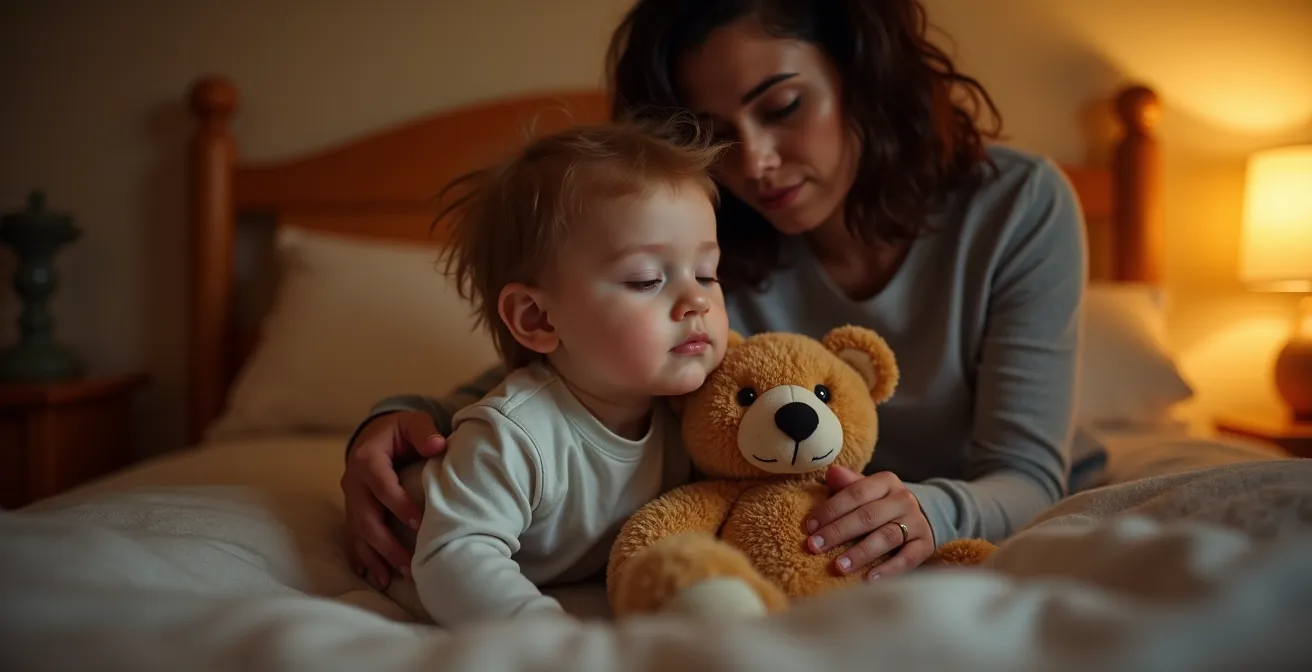
The nightly 2-hour struggle with your toddler isn’t a discipline problem; it’s a biological one, caused by a routine that fails to send the right sleep signals to their brain.
- A successful routine is a sequence of predictable behavioral cues that systematically calm the nervous system.
- The transition between activities (like bath to pajamas) is more critical than the activities themselves, requiring a planned “sensory downgrade.”
- Dedicated facial interaction and emotional connection just before bed are non-negotiable to fill a child’s “attachment cup” and prevent separation anxiety.
Recommendation: Stop focusing on just the activities. Instead, master the order, timing, and emotional tone of your routine to biologically prime your child for sleep, making resistance and tantrums far less likely.
The clock ticks past 8:30 PM, and you’re entering the second hour of what you hoped would be a simple bedtime process. Every request is met with a “no,” every transition sparks a meltdown, and the peaceful evening you envisioned has dissolved into a wrestling match of wills. If this scene feels painfully familiar, you’re not alone. Many parents try all the standard advice—a warm bath, a quiet story, a soft lullaby—only to find themselves locked in a nightly battle.
The common approach treats a bedtime routine as a checklist of calming activities. But this misses the fundamental point. Your toddler isn’t consciously deciding to fight sleep; their brain and body simply haven’t received the right signals to power down. The fighting isn’t a behavioral issue; it’s a biological one. The secret to transforming this nightly struggle into a peaceful 20-minute ritual lies not in what you do, but in how and when you do it. It’s about understanding the science of sleep cues.
The true purpose of a bedtime routine is to function as a powerful, non-verbal communication tool with your child’s nervous system. It’s a predictable sequence that triggers the physiological processes of sleep, most importantly the release of melatonin. This guide will move beyond the generic advice and function as your behavioral strategy map. We will deconstruct the routine into its critical components, explaining the “why” behind each step, so you can build a system so effective and predictable that your toddler’s brain learns to anticipate sleep, not fight it.
To help you master this approach, we will explore the precise mechanics of a successful routine, from the biological triggers of consistency to the critical role of emotional connection. This structured guide will provide the insights and tools you need to reclaim your evenings.
Summary: How to Build a Science-Backed Toddler Bedtime Routine
- Why Doing Things in the Same Order Triggers Melatonin Release?
- How to Transition from Bathtub to Pajamas Without a Tantrum?
- Lovey vs Blanket: Which Comfort Object Is Safer for Crib Sleep?
- The Babysitter Error That Undoes a Week of Sleep Training
- White Noise vs Lullabies: Which One Sustains Sleep Through the Night?
- When to Start Bedtime: Calculating the Perfect Window Based on Age?
- Why Lack of Facial Interaction Is More Stressful Than Physical Separation?
- When to Turn Off Wi-Fi: Why 90 Minutes Before Bed Is the Magic Number?
Why Doing Things in the Same Order Triggers Melatonin Release?
A toddler’s brain thrives on predictability. When a sequence of events happens in the exact same order every single night, it becomes a powerful behavioral cue. This isn’t just about comfort; it’s about conditioning a biological response. Each step—bath, pajamas, story, song—acts as a signal to the brain, telling it what comes next. As the final step approaches, the brain anticipates sleep and begins the crucial process of releasing melatonin, the hormone that governs the sleep-wake cycle. This is why consistency is the non-negotiable foundation of any successful sleep strategy. An unpredictable routine sends confusing signals, keeping the brain alert and on guard.
The power of this sequencing is not just theoretical. As sleep consultant Taking Cara Babies highlights, research consistently shows that “Bedtime routines are shown to lead to longer, less disrupted nighttime sleep.” It’s the repetition that builds the association. Think of it as a cognitive off-ramp for your toddler. Their busy, exploratory daytime brain needs a clear, guided path to the quiet state required for sleep. A consistent routine provides that path, reducing the mental effort required to wind down and making the transition to sleep a subconscious, automatic process.
This principle was demonstrated effectively in a study with parents and young children. According to research highlighted by Happiest Baby, a simple, consistent three-step routine can produce dramatic results. Philadelphia researchers found that parents who started a 3-step bedtime routine (bath, massage, and quiet cuddling or singing) saw success within just two weeks. Their children, aged 7 to 36 months, not only fell asleep faster but also slept longer, proving that the predictability of the routine itself is a potent sleep aid. This is your goal: to make the sequence so ingrained that the body’s sleep mechanisms activate long before your child’s head hits the pillow.
Ultimately, doing things in the same order removes uncertainty and anxiety for your child. They know what’s coming, feel secure in that knowledge, and their body responds accordingly. This is the first and most critical element in ending bedtime battles.
How to Transition from Bathtub to Pajamas Without a Tantrum?
The transition from the warm, free-flowing environment of the bathtub to the more restrictive task of getting dressed is a common flashpoint for tantrums. This isn’t defiance; it’s a sensory shock. Your toddler goes from a warm, weightless, and playful state to a cool, dry, and task-oriented one. The key to preventing a meltdown is to manage this transition with a deliberate “sensory downgrade” and a dose of predictability.
This is where micro-rituals become invaluable. Instead of an abrupt end, signal the shift. Give a five-minute warning before the bath is over. Have a special, ultra-soft hooded towel waiting, turning the act of drying off into an immediate, comforting cocoon rather than a chilly exposure. This focus on a positive sensory experience can transform the entire dynamic. The goal is to make the next step feel just as good, if not better, than the last.

As you can see, wrapping the child immediately in a warm, plush towel minimizes the sensory jolt from water to air. You can further ease this transition by injecting playfulness and control into the process. Create a game like a “Pajama Power-Up” with silly sounds as you dress them. Offer a simple choice: “Do you want the star pajamas or the dinosaur pajamas?” This small act of granting autonomy can be incredibly powerful for a toddler, giving them a sense of control over a process that is otherwise dictated to them. Maintaining a warm bathroom and bedroom temperature is also critical to minimize the physical shock that can trigger emotional distress.
By treating this step not as a chore but as a carefully choreographed part of the routine, you replace the potential for conflict with connection and play, setting a positive tone for the rest of the evening.
Lovey vs Blanket: Which Comfort Object Is Safer for Crib Sleep?
Once your child is over 12 months old and the risk of SIDS from soft bedding decreases, introducing a comfort object can be a game-changer for sleep. It serves as a transitional object, a proxy for you that provides security and reassurance during the night. However, the choice between a small “lovey” (a small, breathable piece of fabric, often with an animal head) and a blanket involves considering both safety and psychological function. For many toddlers who struggle with sleep, research shows that as many as 20 to 30% of babies and toddlers have trouble sleeping, often linked to separation anxiety, making this choice important.
A lovey is often the superior choice for a few key reasons. Its small size inherently reduces the risk of suffocation compared to a larger blanket. It’s also highly portable, meaning you can bring that piece of “home” and consistency with you to daycare, on vacation, or to a grandparent’s house. Critically, a lovey is a perfect vehicle for “scent-loading.” You can sleep with it for a night or two to imbue it with your unique scent, making it an even more powerful tool for soothing your child when you’re not there. It becomes a tangible piece of your presence.
The following table, based on information from sleep experts, breaks down the key differences to help guide your decision. A blanket offers physical warmth, but a lovey offers targeted psychological comfort and fosters emotional independence.
| Factor | Lovey | Blanket |
|---|---|---|
| Psychological Function | Proxy for parent, fosters emotional independence | Primarily physical comfort |
| Breathability | Small size reduces suffocation risk | Larger surface area, choose lightweight |
| Attachment Potential | High – becomes specific transitional object | Moderate – more replaceable |
| Scent-Loading Capability | Excellent – small, easy for parent to sleep with | Good but bulkier to prepare |
| Portability | Very portable for consistency away from home | Less convenient for travel |
While a lightweight, breathable blanket can be perfectly safe for a toddler, the high attachment potential and portability of a lovey make it a more strategic tool for sleep training and building independent sleep skills.
The Babysitter Error That Undoes a Week of Sleep Training
You’ve spent weeks meticulously crafting the perfect, predictable bedtime routine. Your toddler is finally falling asleep peacefully. Then comes date night. You return to find the babysitter broke the routine—offering an extra drink, reading five stories instead of two, or letting them get out of bed—and just like that, a week of progress is undone. This isn’t the babysitter’s fault; it’s a failure to transfer the “magic” of the routine. The single biggest error is assuming another caregiver will intuitively understand the precise, non-verbal cues your child now relies on.
Consistency is the bedrock of sleep training, and it must be maintained by every caregiver. As experts in the field confirm, numerous studies have shown that implementing a consistent bedtime routine can improve sleep quality and duration in young children. When that consistency is broken, it reintroduces uncertainty and anxiety for your toddler, signaling that the rules are negotiable. This is why you must create a “babysitter-proof” system that is impossible to misinterpret. Your routine is a script, and every actor needs to know their lines.
This means going beyond verbal instructions. You need to create a physical and visual guide that makes the routine foolproof. This includes preparing all items in advance and scripting the key phrases and actions that signal safety and predictability to your child. The goal is to make it easier for the sitter to follow your routine than to invent their own.
Action Plan: Creating a Babysitter-Proof Bedtime Script
- Create a Visual Chart: Design a simple chart with pictures or icons for each step (e.g., a picture of a bathtub, pajamas, a book). Your toddler can follow along, and the sitter has a clear visual guide.
- Prepare a “Routine-in-a-Box”: Place the specific pajamas, the two pre-approved books, the lovey, and the white noise machine in a single box or basket. This eliminates unwanted negotiation or variation.
- Write a One-Page Script: Detail the key “magic phrases” your child expects to hear (e.g., “See you in the morning, I love you”). Include timings for non-verbal cues, like when to dim the lights.
- List the “Don’ts”: Clearly state the one or two things the sitter must NOT do (e.g., “Do not offer an extra drink after the story,” or “Do not engage in conversation after they are in the crib”).
- Brief in Advance: Have a 5-minute briefing with the sitter before your child is present. This avoids creating anxiety for your toddler and allows the sitter to ask questions privately.
By externalizing the routine into a clear, tangible system, you empower any caregiver to execute it with the same precision you do, protecting your investment in your child’s healthy sleep habits.
White Noise vs Lullabies: Which One Sustains Sleep Through the Night?
The sound environment of your toddler’s room plays a crucial role in both falling asleep and, more importantly, staying asleep. Parents often debate between lullabies and white noise, but from a behavioral and biological standpoint, they serve very different functions. Lullabies are part of the wind-down routine; their melodic and verbal nature is engaging and serves as a wonderful connection point. However, that same engaging quality makes them less effective for sustaining sleep throughout the night.
White noise, on the other hand, is the superior tool for sleep sustainment. Its power lies in its monotony. It provides a consistent, boring, and predictable “wall of sound” that masks abrupt environmental noises—a dog barking, a siren, a door closing—that can startle a child out of a light sleep cycle. A lullaby, with its variable pitches and cadences, can actually become the source of a sleep disruption if it ends abruptly or if the child becomes conditioned to need a specific song to fall back asleep. Continuous white noise, played throughout the entire sleep period, creates a stable auditory environment, much like the constant sounds they heard in the womb.

The goal is to create a sensory cocoon that remains unchanged for the entire 10-12 hours of night sleep. This auditory consistency helps toddlers transition between sleep cycles without fully waking. If you use a sound machine, ensure it plays continuously and doesn’t have an automatic shut-off timer. The sound should be no louder than a soft shower (around 50 decibels) and placed several feet away from the crib. While a lullaby is a beautiful part of the “emotional refueling” portion of the routine, think of white noise as the invisible, protective bubble that helps maintain that peaceful state all night long.
In short: use lullabies to connect and calm your child while they are awake, but switch to continuous white, pink, or brown noise once they are in the crib to help them stay asleep.
When to Start Bedtime: Calculating the Perfect Window Based on Age?
One of the most common mistakes parents make is starting the bedtime routine too late. By the time a toddler is visibly exhausted—rubbing their eyes, yawning excessively, or becoming clumsy—they are often already overtired. An overtired brain is flooded with cortisol, a stress hormone that acts like adrenaline. It gives them a “second wind” of frantic, hyperactive energy, making it nearly impossible for them to wind down. Trying to put an overtired toddler to bed is like trying to stop a moving train. You’ve missed the station.
The key is to identify your child’s subtle, early “sleepy cues” and initiate the 20-minute routine at that exact moment. This “perfect window” is when their body is biologically ready for sleep, but before the cortisol rush begins. For most toddlers, this window aligns with their natural circadian rhythm, which is why several studies have found that a bedtime before 9:00 pm leads to better toddler sleep, with the optimal time often falling between 7:00 and 8:00 PM. However, every child is different, so becoming a “sleepy cue detective” is essential.
For three consecutive days, become a meticulous observer. Forget the clock and watch your child. Note the exact time of their first sleepy cue. This isn’t the dramatic yawn; it’s the subtle sign that comes before it. Look for the “thousand-yard stare” where they zone out, a sudden increase in clumsiness, or a decreased interest in play. Once you have this data for three days, you can calculate their average sleepy cue time and start your routine right then. For example, if you notice the stare happens around 7:10 PM on average, your 20-minute routine should begin at 7:10 PM, aiming for them to be in bed by 7:30 PM. This proactive approach works with their biology, not against it.
By catching their natural sleep wave instead of fighting the overtired tide, you transform bedtime from a battle into a gentle, collaborative process.
Why Lack of Facial Interaction Is More Stressful Than Physical Separation?
For a toddler, the separation of bedtime is one of the most significant emotional events of their day. We often focus on physical comfort—hugs, cuddles, a cozy bed—but we neglect the most powerful tool for emotional regulation: our face. A lack of responsive, engaged facial interaction can be more stressful for a young child than actual physical distance. This was powerfully demonstrated in Dr. Edward Tronick’s famous “Still Face Experiment.”
In the experiment, a mother who was previously engaged with her infant suddenly adopts an expressionless, unresponsive face. The baby’s reaction is immediate and profound. As a report from The Gottman Institute on the experiment describes, the infant “rapidly sobers and grows wary. He makes repeated attempts to get the interaction into its usual reciprocal pattern.” When those attempts fail, the baby becomes distressed and dysregulated. This shows that a child’s sense of safety is deeply tied to the responsive feedback they get from their caregiver’s face. An unexpressive or distracted face is a profound sign of disconnection.
This is why the 20-minute bedtime routine must be a zone of undivided attention. This is your moment for “emotional refueling.” Put your phone away completely. During story time, make sustained eye contact. When they tell you something, mirror their facial expressions to show attunement. Use a warm, responsive voice. This focused connection fills their “attachment cup,” giving them the emotional security they need to handle the separation of sleep. As Dr. Edward Tronick’s work implies, a parent who is physically present but emotionally checked-out (looking at a phone) can be more distressing than a parent who has already said goodnight and left the room.
rapidly sobers and grows wary. He makes repeated attempts to get the interaction into its usual reciprocal pattern
– Dr. Edward Tronick, The Still Face Experiment (1975)
By providing this intense burst of connection right before separation, you are giving your child the emotional resources they need to feel safe and secure enough to let go and fall asleep on their own.
Key Takeaways
- Consistency is Biological: A predictable routine isn’t just comforting; it’s a series of cues that biologically triggers the release of melatonin, the sleep hormone.
- Master the Transitions: Preventing tantrums often comes down to managing the sensory shifts between activities, like from a warm bath to cool air, with planned micro-rituals.
- Connection Before Separation: The 20 minutes before bed must be a period of intense, focused facial interaction to “refuel” your child’s emotional security, making the separation for sleep manageable.
When to Turn Off Wi-Fi: Why 90 Minutes Before Bed Is the Magic Number?
In our hyper-connected world, the final step of the “sensory downgrade” before sleep involves managing our digital environment. The common advice to “avoid screens before bed” is correct, but understanding the specific mechanism and timing makes it far more powerful. The issue isn’t the screen itself, but the type of light it emits. Blue light, prevalent in LEDs, smartphones, and tablets, is particularly disruptive to our circadian rhythm. It effectively tells our brain that it’s still midday, actively halting the production of melatonin.
The recommendation to power down devices—and by extension, the Wi-Fi that feeds them—at least 90 minutes before bedtime is rooted in our natural sleep cycles. As a 2014 study suggested, exposure to artificial light at night suppresses the body’s melatonin levels. This suppression doesn’t just make it harder to fall asleep; it can even shorten the brain’s perception of how long the night is, leading to earlier waking and more fragmented sleep. Giving the brain a full 90-minute buffer without this stimulating light allows melatonin levels to rise naturally, preparing the body for deep, restorative rest.
For a toddler, whose brain is even more sensitive to these cues, this rule is paramount. This means the entire household environment should shift. Dim the overhead lights, switch to warm-toned lamps, and ensure there are no glowing screens in their field of vision during the entire bedtime routine. Turning off the Wi-Fi can be a helpful, definitive “off switch” for the whole family, signaling that the day’s stimulating digital activities are officially over and the wind-down period has begun for everyone. This creates an environment that supports, rather than sabotages, the biological processes you are trying to encourage.
Start tonight by making the 90-minute screen-free window a non-negotiable part of your family’s evening. By protecting your toddler’s brain from confusing light signals, you give them the final, crucial key to unlocking a peaceful night’s sleep.