
The nightly fight over phones is a battle you are losing because you are using the wrong weapons; it is a biological problem, not a disciplinary one.
- Teenage brains are biologically hyper-sensitive to the melatonin-suppressing effects of blue light from screens.
- A screen-free bedroom is achieved not through inconsistent rules, but by systematically re-engineering your home’s environment and routines.
Recommendation: Implement a non-negotiable 90-minute “Digital Decommissioning” protocol for the entire family, starting tonight.
The scene is familiar in countless homes: it’s past bedtime, the house is quiet, but a pale blue light emanates from under your teenager’s door. You know they are scrolling, watching, or gaming, and you feel a surge of frustration. You have had the conversation, set the rules, and yet the nightly battle over screens continues. This struggle is not a failure of your parenting, but a misunderstanding of the enemy. The allure of the screen is a potent biological force, particularly for the developing adolescent brain. The constant exposure to content is one issue, but the more insidious problem is the light itself, which actively sabotages the body’s natural sleep mechanisms.
Most parental strategies rely on willpower and negotiation—tactics that are doomed to fail against the powerful neurochemical rewards of screen time. The common advice to “just take the phone away” ignores the ensuing arguments, the claims of “needing it for an alarm,” and the simple fact that teenagers are adept at finding workarounds. To truly win this war, you must stop fighting battles and instead change the entire landscape. This requires a shift in thinking: from enforcing rules to engineering an environment. The solution is not a single action but a comprehensive, biologically-informed system that re-anchors your family’s internal clocks away from digital dependency and toward natural, restorative sleep.
This guide will not offer gentle suggestions. It provides a strict, structured framework for reclaiming the bedroom as a sanctuary for sleep. We will dismantle the problem piece by piece, from the science of blue light to the psychology of parental hypocrisy, and provide a concrete, actionable system to implement in your home. This is not about being popular; it is about protecting your child’s and your own physical and mental health.
To navigate this system effectively, this article is structured to build your strategy from the ground up. The following sections outline the science, the environmental changes, the psychological tactics, and the precise protocols needed to create a truly screen-free sleep environment.
Summary: A System for Screen-Free Sleep
- Why Blue Light Suppresses Melatonin More in Children Than Adults?
- How to Build a Family Charging Station in the Kitchen?
- “Do as I Say, Not as I Do”: Why Your Phone Habit Undermines the Rules?
- The Weekend Loophole Mistake That Makes Weekdays Harder
- When to Turn Off Wi-Fi: Why 90 Minutes Before Bed Is the Magic Number?
- Why Morning Sunlight Is the Most Powerful Sleep Tool You Own?
- How to Create a “No-Phone Zone” at Dinner Without Causing a Rebellion?
- Regulating Circadian Rhythms in Infants for Better Night Sleep
Why Blue Light Suppresses Melatonin More in Children Than Adults?
The first step in our system is understanding the biological adversary. Not all light is created equal, and the blue light emitted from phones, tablets, and computers is a particularly potent sleep disruptor. This light directly inhibits the brain’s production of melatonin, the hormone that signals to your body that it is time to sleep. While this affects everyone, the impact is far more severe in children and adolescents. In fact, research has found that evening light exposure suppresses melatonin twice as much in children compared to adults. Their developing eyes have larger pupils and clearer lenses, allowing more of this disruptive light to penetrate and send a powerful “daytime” signal to the brain, even late at night.
This is not a minor sensitivity; it is a profound biological vulnerability. Further scientific inquiry confirms this heightened response. A study published in the Journal of Clinical Endocrinology & Metabolism compared the effects of different light temperatures on melatonin suppression. It found that melatonin suppression in children was significantly greater than in adults under both standard (3000K) and cool, blue-rich (6200K) LED light. The effect was so pronounced that under the 6200K light, children’s subjective sleepiness was significantly lower, meaning they not only produced less melatonin but also *felt* more awake. Your teen isn’t just being defiant when they say they aren’t tired after an hour of scrolling in the dark; their brain chemistry has been actively manipulated by the light from their device.
Understanding this disproportionate impact is critical. It reframes the “no phones in the bedroom” rule from a matter of discipline to a non-negotiable health imperative, akin to childproofing a home. You are not just removing a distraction; you are removing a potent, biological saboteur from the sleep environment.
How to Build a Family Charging Station in the Kitchen?
Knowing that screens are biologically toxic to sleep is the “why.” Now we move to the “how,” starting with environmental engineering. If a device is physically in the bedroom, it will be used. The single most effective strategy to prevent this is to create a centralized, public “docking” area for all family electronics. This is not a suggestion; it is the architectural foundation of your screen-free system. The kitchen is the ideal location: it’s a high-traffic, neutral territory that is typically unoccupied late at night, removing the temptation for a final “check-in.”
This “Family Charging Station” must be both functional and mandatory. It should have enough ports for every device—phones, tablets, and smartwatches. Invest in a multi-device organizer to keep cables tidy and create a sense of formal procedure. This is not a junk drawer; it is a designated home. The act of walking to the kitchen and physically docking a device creates a clear, ritualistic end to the digital day. This also solves the common “I need my phone for an alarm” excuse. The solution is simple and non-digital: a basic, single-function alarm clock. They are inexpensive and remove the primary justification for keeping a phone by the bedside.
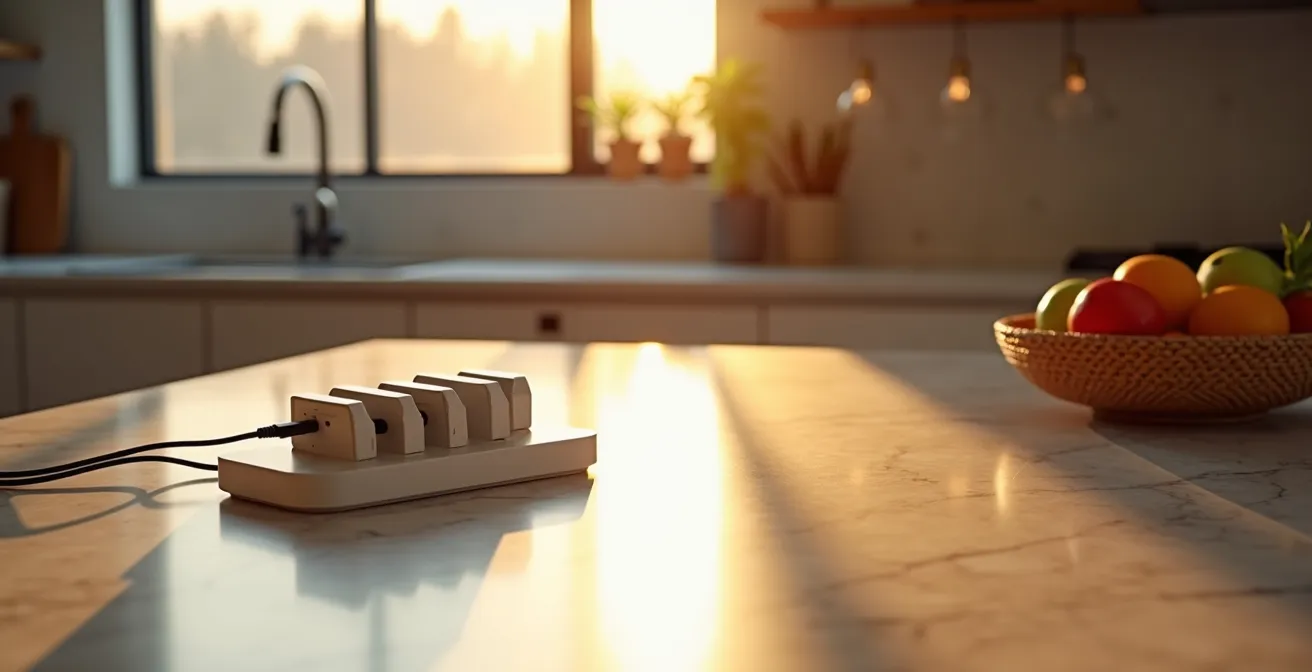
The visual of all family devices charging together overnight reinforces the message that this is a collective commitment. It is not a punishment directed at the teenager but a household policy for better health. The station becomes a physical manifestation of your family’s digital boundaries. In the evening, the devices go to their “bed” in the kitchen, allowing the humans to go to their beds—in their screen-free, sleep-optimized bedrooms.
“Do as I Say, Not as I Do”: Why Your Phone Habit Undermines the Rules?
You can create the most sophisticated charging station and quote sleep science verbatim, but if you are scrolling in bed yourself, the entire system will collapse. This is the “Hypocrisy Gap,” and it is the fastest way to lose all credibility and authority. Teenagers have an acute sense of fairness and are experts at spotting double standards. If they see you tapping away on your phone after you’ve told them to dock theirs, your rules become meaningless. The message they receive is not “screens are bad for sleep,” but “this is a rule for you, not for me.”
Parental modeling is not a “nice-to-have”; it is a prerequisite for success. The principle is simple: your actions must align with your words. When establishing screen-free zones, the rules must apply to everyone. This is often the most difficult step for parents, who justify their own screen use as “work” or “important.” While some digital tasks are unavoidable, health experts emphasize that parental modeling is a powerful predictor of a child’s own habits. You are the primary role model for a healthy relationship with technology.
To close the Hypocrisy Gap, the family must agree on what constitutes “legitimate use” versus “mindless scrolling” in the evening. This requires honest conversation and clear boundaries, not just for the kids, but for you. A framework can help differentiate necessary tasks from habitual browsing.
| Legitimate Evening Use | Mindless Scrolling | Family Agreement |
|---|---|---|
| Emergency work call | Social media browsing | Announce purpose out loud |
| Checking weather for tomorrow | News feed scrolling | Time limit: 2 minutes |
| Setting morning alarm | YouTube autoplay | Do it at charging station |
| Responding to family text | Online shopping browsing | Share the message content |
By defining these terms as a family and adhering to them publicly, you transform the rule from a top-down decree into a shared cultural value. Your commitment is the glue that holds the entire system together. When you dock your phone at the charging station alongside theirs, you are not just following a rule; you are leading by example.
The Weekend Loophole Mistake That Makes Weekdays Harder
One of the most common points of failure in any new routine is the “weekend loophole.” The thinking is that after a disciplined week, it is acceptable to relax the rules on Friday and Saturday nights. This might mean later bedtimes, extended screen use, and sleeping in. While it feels like a harmless reward, it is a form of circadian chaos. This inconsistency creates a state of “social jetlag,” where your body’s internal clock is shifted by several hours, much like when you travel across time zones. The consequence is that Sunday night becomes a struggle to fall asleep, and Monday morning is met with grogginess, irritability, and a profound sense of exhaustion.
Your body’s circadian rhythm thrives on consistency. The brain’s master clock, the suprachiasmatic nucleus, does not know the difference between a Tuesday and a Saturday. When you drastically alter sleep and wake times, you desynchronize the intricate hormonal cascade that governs alertness and sleepiness. Letting your teen stay up late scrolling on a Friday night before letting them sleep until noon on Saturday is the equivalent of flying them two time zones west and expecting them to be sharp and ready for school on Monday morning. It makes the weekdays an uphill battle against their own biology.

The solution is rhythmic consistency. This does not mean a military-like schedule, but it does mean keeping bedtimes and, more importantly, wake-up times within a tight 60-minute window, even on weekends. Instead of rewarding with late-night screens, shift the reward to a special weekend breakfast or an engaging morning activity. The goal is to anchor the circadian rhythm every single day, creating a stable foundation for sleep that makes the transition from weekend to weekday seamless, not jarring.
When to Turn Off Wi-Fi: Why 90 Minutes Before Bed Is the Magic Number?
We have established the need to remove screens from the bedroom. Now, we must define the timeline. Simply docking the phone moments before climbing into bed is not enough. The brain needs a “cool-down” period to transition from the high-stimulation state of digital engagement to a calm, pre-sleep state. While many sleep experts recommend that screens be avoided for at least one hour before bedtime, the gold standard for a robust system is 90 minutes. This duration is not arbitrary; it provides a structured, three-stage shutdown that systematically prepares the mind and body for rest.
This 90-minute window is the “Digital Decommissioning Protocol.” It is a non-negotiable part of the evening routine. For extreme cases or to enforce compliance, some families find it effective to shut off the home’s Wi-Fi router on a timer set to the 90-minute mark. This removes the source of temptation and sends a clear, indisputable signal that the digital day is over. The protocol itself should be structured to guide your child (and you) from a state of active engagement to passive calm. It is a gradual ramp-down, not an abrupt stop.
Implementing a clear, multi-stage protocol removes ambiguity and provides a predictable structure that becomes second nature over time. This is not about willpower; it is about process. The following checklist outlines the three essential stages of this crucial 90-minute period.
Your 90-Minute Digital Decommissioning Protocol
- Stage 1 (90-60 min before bed): Digital Finalization. This is the final window for all digital tasks. Complete any remaining homework, send the last text messages, and save all work. Announce that you are entering the final digital phase.
- Stage 2 (60-30 min before bed): Analog Transition. All devices are now walked to the family charging station and docked for the night. This phase is for preparing for the next day: packing bags, laying out clothes, and completing personal hygiene routines.
- Stage 3 (30-0 min before bed): Pre-Sleep Calm. This final phase is completely screen-free and dedicated to calming activities. This includes reading a physical book (not on a tablet), journaling, gentle stretching, or having a quiet, low-key conversation.
Why Morning Sunlight Is the Most Powerful Sleep Tool You Own?
Our system has so far focused on the negative inputs to remove at night: blue light and screens. But an equally powerful strategy is to add a positive input in the morning. The most potent, effective, and free tool for regulating your sleep-wake cycle is morning sunlight. Getting direct sun exposure shortly after waking is the primary signal that sets your body’s 24-hour master clock, anchoring your entire circadian rhythm for the day. This is not a wellness trend; it is fundamental human biology.
The mechanism is elegant and powerful. Light, specifically the spectrum found in morning sun, strikes the retina and sends a direct signal to the suprachiasmatic nucleus (SCN) in your brain. This tells the SCN to halt melatonin production and, in its place, trigger the release of cortisol and other hormones that promote wakefulness and alertness. As the experts at the Sleep Foundation explain:
Seeing sunlight (or any bright light) shortly after waking up lets your brain know it’s time to slow its melatonin production and start getting ready for daytime.
– Sleep Foundation experts, Sleep Foundation Guidelines 2025
Crucially, this morning light exposure also starts a countdown timer for melatonin release in the evening. By getting a strong “on” signal in the morning, you are pre-programming your brain to release melatonin at the appropriate time approximately 14-16 hours later. A teenager who gets 10-15 minutes of sunlight exposure before 9 a.m. will have a much more robust and timely melatonin surge that evening, making it biologically easier to fall asleep. This proactive morning habit is the perfect antidote to the disruptive effects of evening screen time.
How to Create a “No-Phone Zone” at Dinner Without Causing a Rebellion?
The principles of environmental engineering and digital boundaries should not be confined to the bedroom. Another critical battleground is the dinner table, which should be a sanctuary for connection, not a sea of screens. Establishing a “no-phone zone” during meals serves a dual purpose: it carves out vital time for family conversation and it further normalizes the practice of being disconnected from devices. However, this is often met with resistance, from claims of boredom to fears of missing something important.
Implementing this rule requires a strategic, phased approach rather than a sudden, absolute ban, which can feel punitive and spark rebellion. The goal is to gradually replace the habit of digital distraction with the habit of personal connection. Start small and build on success. Explain the “why” behind the rule—that the goal is to reconnect as a family—and then introduce a clear, manageable plan that everyone can adapt to. This shows that you respect the difficulty of the change while remaining firm on the objective.
The following phased implementation plan is a practical roadmap for reclaiming your dinner table. It slowly increases the screen-free duration while simultaneously introducing tools to make the transition easier and more engaging.
| Week | Duration | Focus |
|---|---|---|
| Week 1-2 | First 10 minutes | Everyone shares one highlight from their day |
| Week 3-4 | Half of mealtime | Add conversation starters or games |
| Week 5+ | Entire meal | Natural conversation flows without prompts |
This gradual process minimizes resistance and allows the family to build the “muscle” of conversation. By providing alternatives like conversation jars, you address the fear of “having nothing to talk about” and actively foster a more engaging and connected mealtime environment for everyone.
Key Takeaways
- The Biological Imperative: Teenage brains are twice as sensitive to the melatonin-suppressing effects of blue light, making screen time before bed a potent sleep saboteur.
- Environmental Engineering is Key: Success comes from changing the physical environment—not just making rules. A mandatory, central charging station outside the bedroom is non-negotiable.
- The System is the Solution: A consistent, 90-minute “Digital Decommissioning” protocol, adherence to the rules by parents, and maintaining a regular sleep rhythm even on weekends are the pillars of a successful strategy.
Regulating Circadian Rhythms in Infants for Better Night Sleep
To fully appreciate the circadian disruption happening in our teenagers, it is instructive to look at how these rhythms are first established. The principles of sleep regulation are universal, and the foundation is laid in the first months of life. An infant is not born with a 24-hour clock; they develop it through exposure to consistent environmental cues. Understanding this foundational process highlights exactly what is being broken by the erratic schedules and artificial light of modern adolescent life.
From day one, the key to building a healthy circadian rhythm is consistency. This involves creating strong “anchor events”—predictable, recurring activities that signal to the baby’s developing brain the difference between day and night. These anchors are not complex; they are simple, sensory experiences tied to a regular schedule. Consistent bedtime routines can help children fall asleep faster, sleep longer, and wake up less during the night, and this principle holds true across all ages. The routine itself is a powerful cue for the brain to begin preparing for sleep.
The non-screen anchor events used to establish an infant’s sleep rhythm provide a perfect blueprint for the types of activities we must reintroduce into our teenagers’ lives. These are simple, powerful, and biologically attuned cues:
- Morning Light: Take baby outside within 30 minutes of waking for natural light exposure to set their clock.
- Consistent Activity: Engage in consistent tummy time or sensory play at the same time daily to structure the day.
- Afternoon Cues: A regular walk in a stroller in the afternoon helps regulate daytime alertness.
- Evening Wind-Down: A warm bath with a consistent scent and a predictable lullaby sequence signals that sleep is approaching.
- Bedtime Ritual: The same gentle rocking motion every night becomes the final, powerful cue for sleep.
This blueprint—morning light, predictable daytime activity, and a multi-sensory evening wind-down—is the natural formula for sleep that we are born to follow. The system outlined in this article for your teenager is not a new invention; it is a deliberate reconstruction of this fundamental biological process, adapted for an age of digital distraction. It is about removing the artificial signals that break the rhythm and reintroducing the natural ones that have guided human sleep for millennia.
Stop negotiating. Stop making exceptions. The health of your family’s sleep is not a democracy. The evidence is clear, and the stakes—from mood regulation and academic performance to long-term physical health—are too high. Use this system as your blueprint and begin implementing it tonight. Your family’s well-being depends on it.
Frequently Asked Questions About Reclaiming the Bedroom
What if we have nothing to talk about without phones?
Start with a conversation jar filled with fun questions that anyone can pull from. Topics can range from ‘What superpower would you choose?’ to ‘What was the best part of your day?’
How do we handle resistance from teenagers?
Begin with a gradual approach – start with just the first 10 minutes phone-free, then extend gradually as the family adjusts to connecting without devices.
What about emergency calls during dinner?
Designate one adult phone on silent but visible for true emergencies only, with the agreement that non-urgent calls wait until after the meal.