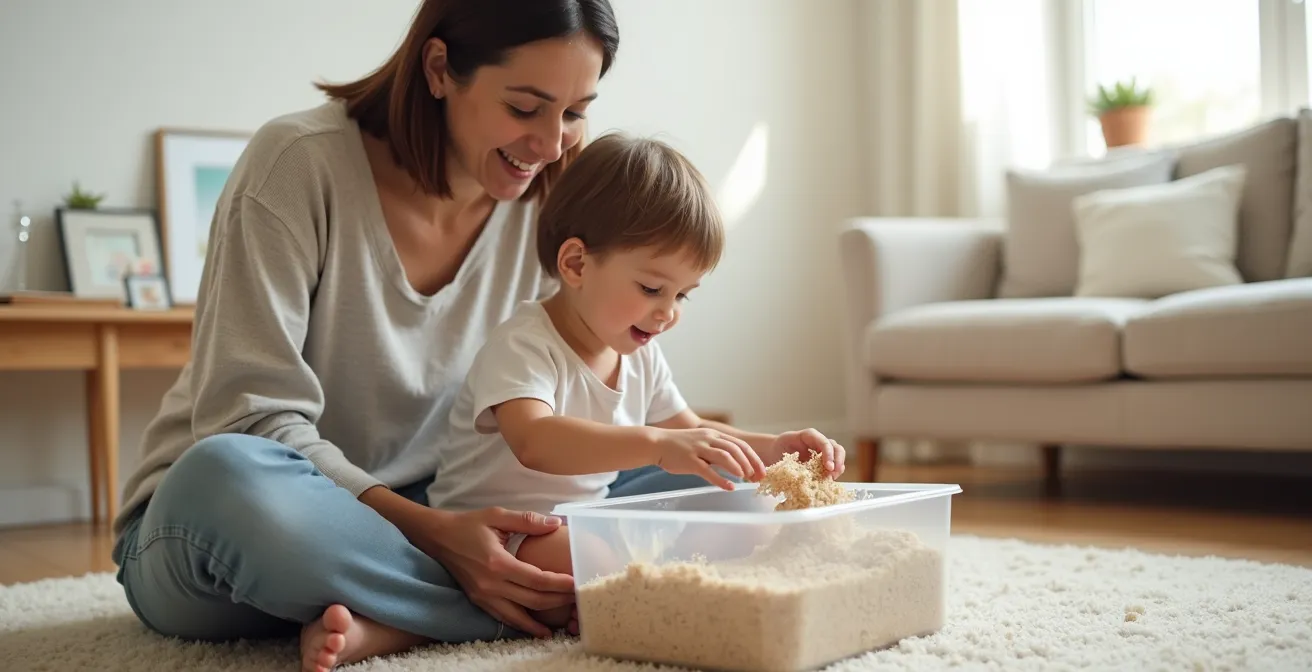
Your child’s challenging behaviors aren’t defiance; they are signals from a dysregulated nervous system.
- Forcing exposure to textures often backfires by reinforcing the brain’s association of that sensation with danger.
- The true goal is to build “neurological safety” through co-regulation and predictable sensory input, not to force compliance.
Recommendation: Focus on regulating the nervous system first, using tools like heavy work and vestibular input, before expecting behavioral change at the dinner table or in the dressing room.
The morning routine becomes a battleground over a sock seam. The dinner table is a source of nightly tension, where a single pea touching a piece of chicken can trigger a full-blown meltdown. As a parent, you’ve likely asked yourself: “Is my child just being difficult? Is this extreme pickiness, or is it something more?” You’ve probably been advised to “just keep offering the food” or to “make it fun,” yet these well-intentioned strategies often seem to make things worse, increasing everyone’s stress levels.
These common approaches often fail because they address the behavior, not the root cause. They operate on the assumption that the child’s reaction is a choice. But what if it isn’t? What if the frantic struggle to take off a shirt or the gagging reaction to yogurt is an involuntary, physiological response to sensory information their brain cannot process correctly? This is the reality for children with Sensory Processing Disorder (SPD), where the nervous system interprets everyday sensations as overwhelming, confusing, or even dangerous. Research shows that sensory processing difficulties are more common than many realize, affecting up to 1 in 6 children in some form.
This article shifts the focus from managing behavior to supporting the nervous system. As an occupational therapist, I want to provide you with a new lens—one that helps you see these reactions not as defiance, but as communication. We will move beyond the “what” (the behavior) and delve into the “why” (the neurological underpinnings). You will learn not just what to do, but why specific strategies work to create the neurological safety your child needs to feel secure, regulated, and ready to explore their world.
We’ll explore the fundamental sensory inputs that organize the brain, provide concrete methods for making sensory exploration safe and manageable, and reframe daily challenges like dressing and eating. This guide is designed to equip you with the understanding and tools to become your child’s most effective co-regulator.
Contents: A Guide to Understanding Your Child’s Sensory World
- Why Spinning and Swinging Are Essential for Regulating a Meltdown?
- How to Create Sensory Bins That Don’t Ruin Your Floors in 5 Minutes?
- Wet vs Dry Mess: Which Texture Should You Introduce First to a Sensitive Child?
- The “Just Touch It” Mistake That Increases Sensory Aversion
- How to Remove Tags and Seams to Stop Morning Dressing Battles?
- How to Use “Heavy Work” Like Pushing Walls to Ground an Anxious Child?
- Catering vs One Meal: Which Approach Reduces Table Stress?
- Co-Regulation Strategies: Calming Your Child’s Nervous System When They Can’t
Why Spinning and Swinging Are Essential for Regulating a Meltdown?
When a child is in the throes of a sensory meltdown, their nervous system is in a state of chaos. Their “fight-or-flight” response is activated, and logical reasoning is offline. In these moments, trying to talk them down is often futile. The most effective intervention is not verbal, but physical, targeting the very system that governs balance and spatial orientation: the vestibular system. Located in the inner ear, this system is the brain’s traffic controller for sensory information. Providing the right kind of vestibular input can have a profoundly organizing and calming effect.
Spinning and swinging are not just play; they are powerful neurological tools. Slow, rhythmic, linear movements (like gentle swinging back and forth or side-to-side) are incredibly calming. This predictable motion tells the brain that everything is okay, helping to down-regulate an over-aroused nervous system. Think of rocking a baby to sleep—it’s the same principle. In contrast, fast, erratic, or rotational spinning can be disorganizing and should be used with caution, as it can be overstimulating for an already sensitive child.
Incorporating these movements proactively, not just reactively, can help fill a child’s “sensory budget” and prevent meltdowns from happening in the first place. These “movement snacks” are deposits into their regulatory bank account. The key is to observe your child’s response. Do they seem calmer and more focused after swinging? Do they seek out spinning? Their behavior is the best guide to what their nervous system needs. Providing these inputs helps the brain learn to process sensory information more efficiently, building a stronger foundation for regulation over time.
For a child whose inner world feels chaotic, vestibular input provides a powerful anchor. Here are some ways to provide this regulating input:
- Slow, linear swinging in a therapy swing, playground swing, or hammock for calming input.
- Gentle rocking in a rocking chair to help organize the nervous system.
- Slow, controlled bouncing on an exercise ball for regulated alerting and focus.
How to Create Sensory Bins That Don’t Ruin Your Floors in 5 Minutes?
Sensory bins are a cornerstone of occupational therapy, offering a controlled way for children to explore textures. However, for parents, the vision of rice, beans, or sand scattered across the living room can be a major deterrent. The fear of mess shouldn’t prevent this vital exploration. The key is not to avoid the mess, but to contain it brilliantly. With a few simple “hacks,” you can create a low-stress sensory play zone in minutes, allowing your child to get the tactile input they need without creating a massive cleanup job for you.
The goal is to establish a clear, contained play space. This not only saves your floors but also provides a predictable boundary for your child, which in itself is regulating. An old shower curtain liner or a cheap tarp is your best friend. Spread it on the floor as a designated “mess-friendly zone.” For even better containment, a small, inflatable kiddie pool can be used indoors as a perfect sensory arena. Another creative solution is to turn a coffee table upside down and stretch a fitted sheet over the legs, creating a fabric “box” to hold the bin and any spills.
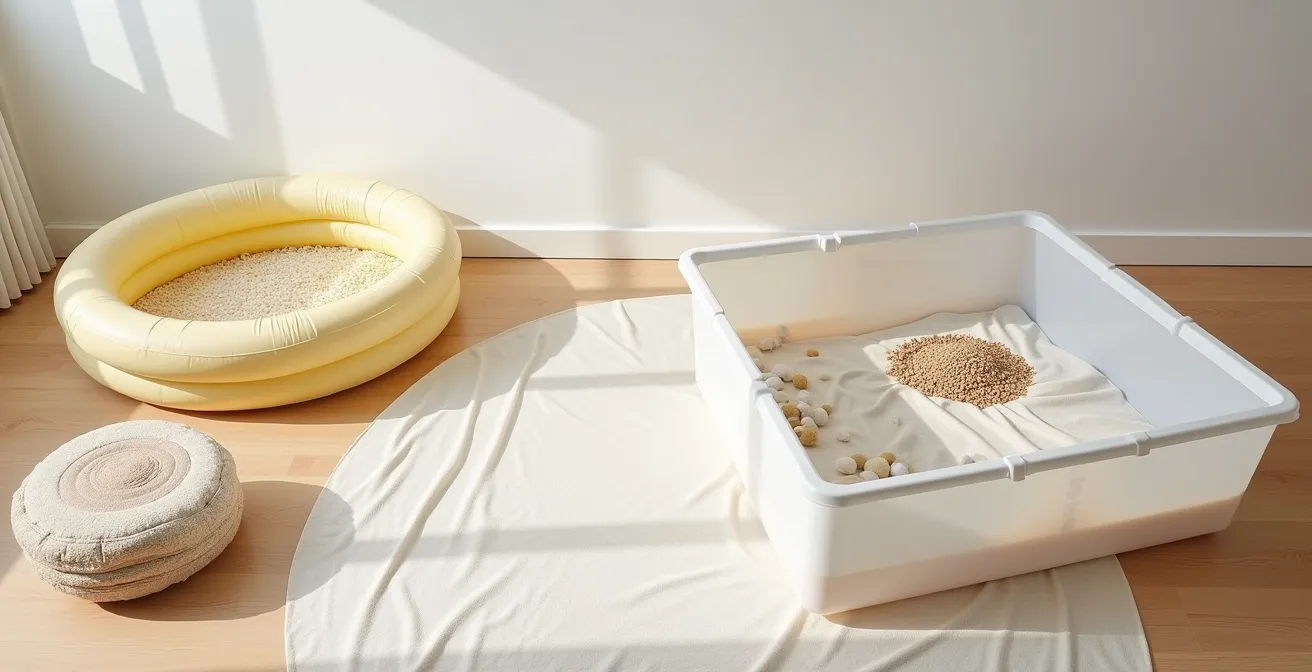
As the image shows, creating different stations can make containment part of the fun. Once the containment is set, the focus shifts to the experience. For children who are highly sensitive or averse to touch, don’t expect them to dive their hands in immediately. Start by providing tools—scoops, funnels, shovels, or toy trucks. These tools act as a bridge, allowing the child to interact with the texture without direct skin contact, building that crucial feeling of neurological safety. This indirect interaction is a critical first step towards tolerance.
Your 5-Minute Mess-Proof Sensory Bin Plan
- Designate the Zone: Place a cheap shower curtain liner or a large, old towel on the floor. This visually and physically defines the play area.
- Choose Your Container: Use a shallow plastic bin, a small inflatable kiddie pool, or turn a coffee table upside down with a fitted sheet over the legs to create a contained space.
- Start with Tools: Always provide scoops, funnels, or small toys. This allows tactile-averse children to engage without direct hand contact, respecting their boundaries.
- Match Filler to Need: Choose a single, dry texture to start (e.g., rice, dried beans). For an overstimulated child, consider quiet fillers like cotton balls or fabric scraps.
- Set One Clear Rule: The only rule is “Keep the fun in the bin/on the mat.” This teaches boundaries in a positive way, focusing on the “do” instead of the “don’t.”
Wet vs Dry Mess: Which Texture Should You Introduce First to a Sensitive Child?
For a child with tactile sensitivity, not all textures are created equal. The difference between touching dry rice and plunging a hand into gooey slime is immense. The reason lies in predictability. Dry, uniform textures are predictable—they feel the same way every time. Wet, mixed, or “goopy” textures are unpredictable, changing shape and feel with every touch. This unpredictability can send a sensitive nervous system into high alert. Therefore, the cardinal rule of texture introduction is to start with the predictable.
This principle applies to both sensory play and food. Children who are hypersensitive have increased sensitivity to sensory inputs, and as an analysis of sensory issues explains, these sensations can be bothersome and overwhelming. Always begin with a single, dry texture. Think uncooked rice, dry pasta, sand, or dried beans. Allow the child to explore this one texture with tools, then hands, until they are comfortable and it no longer elicits a stress response. Only then should you move up the ladder, perhaps by introducing two separate dry textures in different bowls before ever mixing them.
Wet textures come much later. Start with the most predictable wet texture: water. Simple water play is a fantastic, low-threat introduction. From there, you can progress to something with a bit more substance but a consistent feel, like simple, one-color playdough. The most challenging textures are the mixed ones—like slime, oobleck (cornstarch and water), or foods like yogurt with fruit chunks or chunky casseroles. These are at the very top of the texture hierarchy because they are the most unpredictable. Rushing to these can create significant sensory aversion and set back progress.
The following “Predictability Ladder,” based on principles used by occupational therapists, provides a clear roadmap for this gradual process. As a report from therapists at Children’s Hospital Colorado would support, this progression respects the child’s nervous system.
| Stage | Texture Type | Examples | Predictability Level |
|---|---|---|---|
| Stage 1 | One dry texture | Rice, sand, dry beans | Highly predictable |
| Stage 2 | Two separate dry textures | Rice and pasta in different containers | Predictable |
| Stage 3 | One predictable wet texture | Water, simple playdough | Moderately predictable |
| Stage 4 | Mixed textures | Slime, oobleck, yogurt with fruit | Unpredictable |
The “Just Touch It” Mistake That Increases Sensory Aversion
It’s a tempting and common parental response. Your child recoils from the texture of a new food or a messy craft, and in an effort to show them it’s safe, you say, “It’s fine, just touch it.” While the intention is to encourage, the impact is often the opposite. For a child with sensory hypersensitivity, being pressured or forced to touch an aversive texture is not a learning experience; it’s a neurological threat. This action can trigger a full-blown fight-or-flight response, cementing the brain’s association between that texture and feelings of danger and panic.
This approach fundamentally misunderstands the nature of sensory aversion. It’s not a behavioral choice that can be overcome with willpower; it’s a physiological alarm. As one expert powerfully states, this tactic is counterproductive.
Forcing contact with an aversive texture triggers a fight-or-flight response. This doesn’t teach tolerance; it neurologically reinforces the brain’s association of that texture with danger and fear, making the aversion worse.
– Amy Lowell, MS, OTR/L, Sensory Integration Specialist at Children’s Hospital Colorado
Instead of forcing interaction, the therapeutic goal is to create an environment of absolute safety and control for the child. Success is redefined. It’s not about the child touching the slime; it’s about the child being able to stay calm and regulated in the same room as the slime. This is a huge win. The most powerful tool a parent has is their own regulated nervous system. By calmly interacting with the texture yourself, without any expectation for your child to join in, you are modeling safety. This is called “parallel play with textures.” Your calm engagement sends powerful non-verbal cues to your child’s brain via mirror neurons, saying, “This is not a threat. I am safe, and so are you.”
True progress is built on trust, not force. The alternative approaches focus on respecting the child’s boundaries while gently expanding their window of tolerance. Some effective strategies include:
- Practicing ‘Parallel Play with Textures’: The parent models safe, calm interaction while the child observes from a comfortable distance.
- Describing Textures Neutrally: Use objective language like, “This playdough feels cool and soft,” avoiding loaded words like “yucky” or “fun.”
- Redefining Success: Celebrate the child staying calm and regulated near the texture, even without touching it. This is a massive step.
- Focusing on Regulation: Prioritize the child’s nervous system state over any behavioral goal. If they start to get agitated, remove the stimulus and help them regulate.
How to Remove Tags and Seams to Stop Morning Dressing Battles?
For many children with tactile sensitivity, getting dressed can feel like a daily ordeal. A seemingly insignificant clothing tag, a bulky seam on a sock, or the stiff fabric of new jeans can feel like sandpaper or tiny needles against their highly sensitive skin. These are not complaints to be dismissed; they are legitimate sensory assaults. The first step to winning the morning dressing battle is to become a sensory detective, hunting down and neutralizing these hidden irritants. Eliminating these triggers removes a significant source of daily dysregulation.
The most obvious culprit is the clothing tag. A “Good” solution is to simply cut it out with scissors, but this often leaves a small, scratchy stubble that can be just as irritating. A “Better” solution is to use a seam ripper, a small tool available at any craft store. It allows you to carefully remove the entire tag and all its threads, leaving a completely smooth surface. The “Best” solution, however, is to proactively buy tagless clothing. Many brands now cater to sensory needs with printed labels and seamless designs.

Beyond tags, look for other hidden irritants. Thick seams, especially in socks and underwear, can be a major issue. Look for seamless options or try turning socks inside out so the seam is on the outside. The texture of printed graphics on t-shirts can be stiff and uncomfortable on the inside. Stiff new jeans can also be problematic; you can soften them by washing them a few times with a cup of vinegar or baking soda before the first wear. Even laundry detergent with strong scents can be an olfactory irritant that adds to a child’s sensory load.
A final strategy to reduce morning friction is “Outfit Rehearsal.” The night before, have your child try on the next day’s chosen outfit for just 5-10 minutes in a low-stress context. This allows their system to acclimate to the feel of the clothes without the time pressure of the morning rush. It gives you a chance to identify any surprise irritants and makes the morning dressing process feel more predictable and safe for your child.
How to Use “Heavy Work” Like Pushing Walls to Ground an Anxious Child?
When a child is anxious, overwhelmed, or “bouncing off the walls,” their body is seeking input to help it feel organized and grounded. This is where “heavy work” comes in. Heavy work refers to any activity that involves pushing, pulling, or carrying heavy objects, providing deep pressure input to the muscles and joints. This input is called proprioception, and it is one of the most powerful and efficient ways to regulate the nervous system. It essentially tells the brain exactly where the body is in space, which has an immediate calming and organizing effect.
Unlike the vestibular system, which can be disorganizing if used incorrectly, proprioceptive input is almost always calming. It’s a safe and reliable tool in your sensory toolkit. When you see your child becoming anxious or hyperactive, you can proactively suggest a heavy work activity. One of the simplest and most accessible is “wall pushes.” Have the child stand a foot or two from a wall and push against it with all their might for a count of ten. This provides intense, grounding input without any special equipment.
As confirmed by a report on proprioceptive input from occupational therapists, these activities are effective for grounding. The key is to integrate these activities naturally throughout the day, both as a preventative measure and an in-the-moment strategy. This isn’t about adding another task to your day; it’s about reframing existing chores and play as therapeutic opportunities.
Heavy work is a language the body understands. It meets the nervous system’s need for input in a safe, structured way, helping an anxious or hyperactive child feel more in control of their body and their environment. Here is a breakdown of different types of heavy work and when to use them:
| Category | Activities | When to Use | Effect |
|---|---|---|---|
| Push/Pull | Pushing walls, pulling a wagon, pushing a shopping cart | Before transitions | Grounding |
| Carry | Carrying books, groceries, a laundry basket | Throughout the day | Organizing |
| Body Squeeze | Tight hugs (if tolerated), being rolled in a blanket (“burrito”), using a weighted vest | During overwhelm | Calming |
Catering vs One Meal: Which Approach Reduces Table Stress?
Mealtimes are a common battleground for parents of children with sensory sensitivities. The parent’s goal is nutrition; the child’s goal is to avoid what feels like a sensory assault. This often leads to two equally stressful scenarios: either the parent becomes a short-order cook, making a separate “special” meal, or the parent insists the child eat the same meal as everyone else, leading to power struggles. There is a third way, a therapeutic approach that removes the battle and reduces stress for everyone: the Division of Responsibility combined with a deconstructed meal.
This model, developed by feeding specialist Ellyn Satter, is both simple and profound. It clearly defines the roles at the dinner table, and in doing so, eliminates the power struggle.
The parent decides what, when, and where food is served. The child decides if they eat and how much they eat from what is offered. This single concept removes the power struggle and honors the child’s bodily autonomy.
– Ellyn Satter, Division of Responsibility in Feeding Model
This doesn’t mean you let the child dictate a menu of only chicken nuggets. It means you, the parent, provide a balanced meal, but you do so in a way that gives the child a sense of control and safety. This is where the “deconstructed meal” comes in. Instead of serving a mixed dish like a casserole or spaghetti bolognese, you serve all the components separately. For example: a bowl of plain pasta, a bowl of sauce, a bowl of grated cheese, and a side of steamed broccoli. This approach allows the child to see each ingredient clearly and choose the components that feel safe to them.
Crucially, every meal should include at least one “safe food”—something you know your child will almost always eat, like bread, plain rice, or a specific fruit. This takes the pressure off entirely. The child knows there is something on the table they can eat, so they don’t go hungry. The other foods become “learning foods.” There is no pressure to eat them, only to be exposed to them on the table. This low-pressure exposure is the foundation for eventually trying new things when their nervous system is ready. Mealtimes become about family connection and positive exposure, not about the quantity of food consumed.
Key Takeaways
- Regulation Before Expectation: Always prioritize calming your child’s nervous system with tools like heavy work or swinging before asking them to face a sensory challenge.
- Redefine Success: Progress isn’t forcing a child to eat a new food or wear an itchy sweater. It’s about them staying regulated and calm in the presence of that challenge.
- Predictability is Safety: Introduce new textures and experiences in a slow, graded manner, always starting with what is most predictable (dry, uniform textures) to build neurological trust.
Co-Regulation Strategies: Calming Your Child’s Nervous System When They Can’t
Self-regulation—the ability to manage one’s own emotions and behaviors—is a skill that develops over time. Children, especially those with sensory processing challenges, often haven’t developed this skill yet. When they are overwhelmed, their nervous system becomes dysregulated, and they are incapable of calming themselves down. In these moments, they rely on co-regulation: the process of using a caregiver’s calm nervous system as an external anchor to help their own system find its way back to a state of balance.
This is a biological process, not just an emotional one. A dysregulated brain subconsciously scans its environment for safety signals. A calm, steady presence from a trusted adult is the most powerful safety signal there is. Your slow breathing, low voice tone, and relaxed facial expression are sending direct biological messages to your child’s brain via their mirror neuron system. As detailed in research cited by the Child Mind Institute, this system helps the child’s brain “mirror” or sync up with your regulated state. You are literally lending them your calm.
The most important principle of co-regulation is the “Parent-First Principle.” You cannot give away calm that you do not have. Before you do anything to help your child, you must first regulate yourself. Take one deep breath. Feel your feet flat on the floor. Consciously lower the pitch of your voice. This small act of self-regulation makes you a more effective co-regulator. Often, the most powerful strategy is to simply sit quietly nearby without making demands. Your silent, steady presence can be more calming than any words.
For a child who is sensitive to touch, co-regulation doesn’t require physical contact. There are many “without contact” strategies that can be highly effective. Humming a low, monotonous tune provides regulating auditory input. Softly narrating in a rhythmic voice, “I am right here. You are safe. I will help you,” provides predictability and reassurance. The goal is not to stop the meltdown, but to be a safe harbor for your child while the storm passes, showing them that you can handle their biggest feelings and that they will get through it.
Begin by observing your child’s sensory needs not as a problem to be fixed, but as a language to be understood. Your next step is to introduce one small moment of co-regulation or heavy work today, focusing on connection and neurological safety above all else.