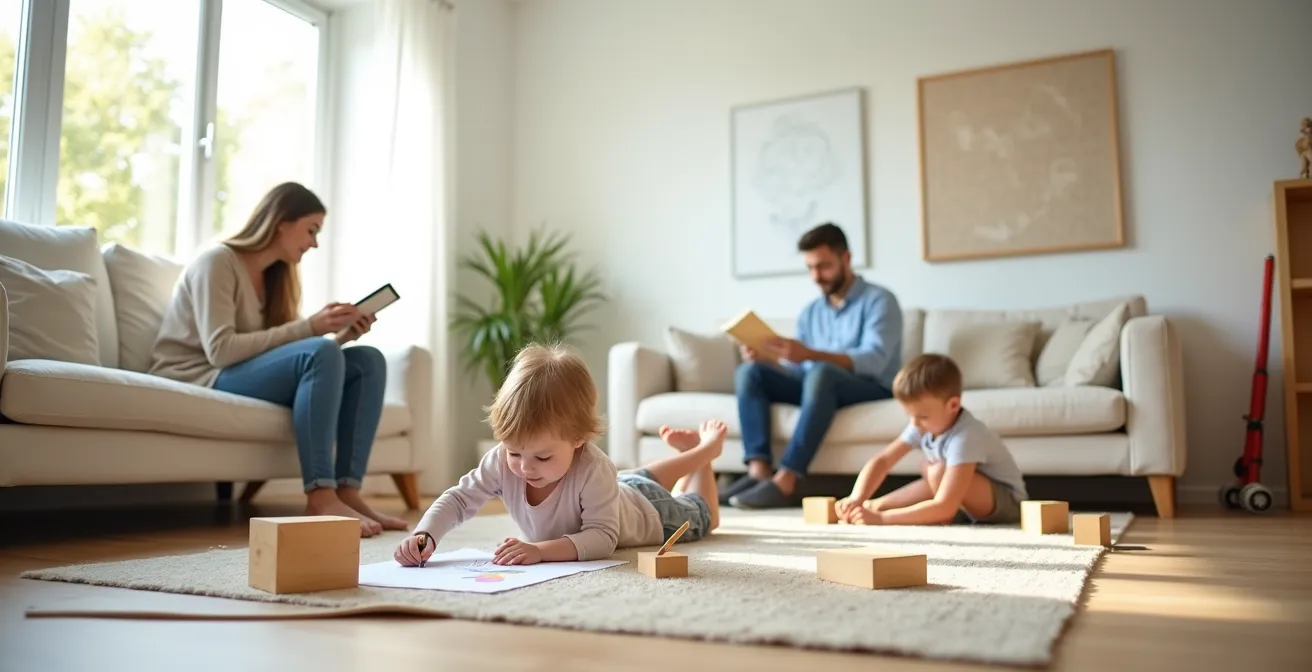
The solution to your family’s burnout isn’t a better calendar—it’s a braver one.
- Research shows unstructured downtime, even boredom, is what truly fuels creativity, not another structured class.
- The real cost of any activity includes a hidden ‘time tax’ from commutes, preparation, and mental recovery that we often ignore.
Recommendation: Start with a family schedule audit to identify one activity or commitment you can radically cut this month.
The evening scramble is a familiar story for countless parents. Soccer practice ends at 6:00, music lessons start at 6:45, and somewhere in that sliver of time, a meal needs to happen. You’ve become a logistics manager, a chauffeur, and a scheduler, all in the name of giving your children the best opportunities. The prevailing wisdom tells us to optimize, to color-code calendars, and to find the perfect balance of sports, arts, and academics. We’re told that a busy child is a successful child, and that free time is wasted time.
But what if this entire framework is flawed? What if the relentless pursuit of enrichment is the very thing robbing our children of a rich childhood? This isn’t another guide about finding a better planner or meal-prepping more efficiently. This is a permission slip to do less. It’s an argument for a radical shift in perspective: from viewing your family’s schedule as a product to be optimized, to seeing it as a space to be protected. We will explore why the voids in the calendar are just as valuable, if not more so, than the commitments that fill it.
This guide will give you the framework to question the “cult of busyness” and reclaim a more spacious, connected family life. We will dismantle the myths that keep us running, provide practical tools to audit your real-time commitments, and empower you to make choices that serve your family’s well-being over the pressure to perform.
For those who prefer a condensed format, the following video offers a powerful summary of the core issues surrounding the overscheduled child, perfectly complementing the deeper dive in this guide.
To navigate this radical rethinking of your family’s time, we have structured this article to guide you step by step. From understanding the science of boredom to practical strategies for reclaiming your weekends, each section builds on the last to create a complete roadmap for change.
Summary: A Guide to Resisting the Cult of Family Busyness
- Why Boredom Is the Precursor to Creativity in Children?
- How to Conduct a Family Schedule Audit to Find Hidden Free Time?
- Team Sports vs Solo Hobbies: Which Fits Your Introverted Child?
- The Commute Calculation Error That Makes Your Evening Impossible
- When to Start Activities: Why Under 5s Don’t Need Organized Sports?
- How to Reclaim Your Weekends: Turning Chores into Quality Time
- When to Keep Your Child Home from School for Mental Health Reasons?
- Beyond Team Sports: Finding Physical Activities for “Non-Athletic” Kids
Why Boredom Is the Precursor to Creativity in Children?
The complaint “I’m bored” often sends parents scrambling for a solution: a new toy, a screen, a structured activity. We have been conditioned to see boredom as a problem to be solved, a void to be filled. But this is a profound misunderstanding. Boredom isn’t a failure of parenting; it is a feature of a healthy, developing mind. It is the fertile ground where creativity, self-reliance, and problem-solving take root. When a child’s mind isn’t being fed constant external stimuli, it is forced to turn inward.
This internal exploration is not empty time. As confirmed by neuroscience research on the brain’s default mode network (DMN), this is when our minds are surprisingly active. The DMN is responsible for daydreaming, imagination, and reflecting on past experiences to make new connections. Activating this network through unstructured downtime gives children the mental space to process their world, develop a stronger sense of self, and invent their own forms of entertainment. A child who can tolerate boredom is a child who is learning to think for themselves, a skill far more valuable than any single extracurricular activity.
Resisting the urge to “cure” boredom is a radical act of trust. It is trusting that your child has the inner resources to navigate their own mental landscape. By creating a spacious childhood with built-in, unstructured time, you are giving them the gift of self-discovery. This downtime allows them to explore their own interests without the pressure of performance or adult supervision, fostering the kind of intrinsic motivation that lasts a lifetime.
How to Conduct a Family Schedule Audit to Find Hidden Free Time?
Before you can reclaim your time, you must understand where it truly goes. Most families operate on an idealized version of their schedule, underestimating the hidden time sinks that drain their energy. A family schedule audit is not about finding new ways to cram more in; it’s a radical diagnostic tool to identify what you can mercilessly cut. The goal is to create space, not to optimize clutter. It is a powerful first step in moving from a life of frantic activity to one of intentional connection.
The process is simple but revealing. Take a large calendar or a whiteboard and, for one week, map out everything. Not just the activities themselves, but the entire ecosystem around them: the 30-minute commute to hockey, the 15 minutes it takes to find shin guards, the 20 minutes of wind-down time needed after a stimulating practice. This is the “Activity Tax” in action. What looks like a 60-minute class is often a 2-hour commitment draining your family’s resources. This aligns with findings from Federal Reserve research that shows enrichment activities comprise only 3% of a child’s time, while passive leisure like TV consumes a much larger chunk, often because everyone is too exhausted for anything else.
Once you visualize the week, you can start making brave decisions. The color-coded calendar below illustrates this concept, showing how activities can create high-stress “red zones” that dominate evenings and weekends, leaving little room for the restorative “green zones” of free time.

Seeing your time laid out this way removes the emotion and turns it into data. You can clearly identify the activities with the highest ‘tax’ and ask the radical question: “What is the real value we are getting from this, and is it worth the cost?” This audit gives you the evidence you need to justify saying no and begin the process of radical un-scheduling.
Your 5-Step Family Schedule Audit Plan
- Map the Time Tax: For one week, list every activity and add its “hidden” time: prep, commute, and recovery. This is your true time cost.
- Collect the Energy Data: Beside each time block, rate the energy level for the family (e.g., on a 1-5 scale) before and after the activity. Is it energizing or draining?
- Confront the ‘Why’: For each commitment, ask: “Whose need does this activity meet? Is it my child’s genuine passion, or is it my own anxiety about them ‘keeping up’?”
- Identify the ‘Red Zones’: Circle the parts of your week that are consistently stressful, chaotic, and joyless. These are your primary targets for elimination.
- Make One Brave Cut: Based on your audit, choose ONE activity or commitment to eliminate entirely for the next month. Observe the space it creates.
Team Sports vs Solo Hobbies: Which Fits Your Introverted Child?
In our society, team sports are often seen as a childhood rite of passage, essential for learning cooperation, sportsmanship, and grit. For many children, this is true. But for an introverted child, the high-stimulation, socially demanding environment of a competitive team can be a source of profound anxiety and exhaustion rather than joy. Pushing an introvert into a role that clashes with their innate temperament isn’t building character; it’s depleting their limited social energy and teaching them that their natural way of being is wrong.
The key is to give them permission to be who they are. This means expanding our definition of “activity” beyond the soccer field or basketball court. Introverted children often thrive in environments that allow for “parallel play”—being part of a group while focusing on individual progress. This lowers the social stakes while still providing a sense of community. They can enjoy the process of skill mastery without the constant pressure of direct interaction or team-based competition.
Case Study: Parallel Play in Martial Arts
Activities like martial arts, climbing gyms, and maker spaces are excellent examples. In a dojo, for instance, children learn and practice moves together, but their focus is internal. As noted by experts on introverted children, while martial arts have a social element, classes often involve more parallel engagement than direct collaboration. The journey of progressing through different belt levels is a personal one, appealing to the introvert’s desire for individual achievement and self-mastery over group victory.
If you’re unsure where your child falls, consider their “social battery.” Do they need significant quiet time to recharge after a playdate? Do they prefer deep one-on-one conversations to chaotic group settings? Do they seem more interested in the process of learning a skill than in winning a game? Answering yes to these questions is a strong indicator that solo or parallel hobbies like swimming, archery, coding, art classes, or hiking might be a much better fit. It’s about finding an activity that fills their cup instead of draining it.
The Commute Calculation Error That Makes Your Evening Impossible
We’ve been taught to measure our children’s activities in neat, 60-minute blocks on a calendar. Dance class from 5 to 6 p.m. seems manageable. But this is a dangerous illusion. The single biggest mistake we make in scheduling our lives is ignoring the Activity Tax—the significant, invisible time and energy costs that surround every single commitment. This miscalculation is the primary reason our evenings feel so chaotic and impossible, even with a seemingly “balanced” schedule.
The Activity Tax has three components. First, there’s the prep time: finding the uniform, packing the snack, the last-minute bathroom trip. Second, there’s the commute time: the drive there and back, which is often unpredictable due to traffic. Finally, and most overlooked, is the transition and recovery time: the mental and physical energy it takes for a child to decompress from a high-stimulation environment and switch gears to homework or bedtime routines. That “one-hour” class is, in reality, a two-hour black hole in your family’s evening.
This is where the parent-as-chauffeur trap snaps shut. You spend a significant portion of your evening in the car, waiting in parking lots, feeling your own energy drain away. The exhaustion is palpable, a direct result of underestimating the true cost of these commitments. The image below is a familiar one for any parent caught in this cycle: the quiet exhaustion behind the wheel while life happens somewhere else.

Acknowledging this hidden tax is liberating. It allows you to assess activities not by their advertised duration, but by their total impact on your family’s well-being. When you see that a single activity is consuming a three-hour chunk of your precious evening, you are empowered to ask a radical question: “Is it worth it?” Often, the answer is a resounding no. This realization is a critical step towards radically un-scheduling and reclaiming your evenings for rest and connection.
When to Start Activities: Why Under 5s Don’t Need Organized Sports?
The pressure to give our children a “head start” begins earlier than ever. We see toddlers in soccer jerseys and preschoolers in ballet tutus, and a quiet anxiety creeps in: “Is my child falling behind?” This fear drives an industry of organized activities for the under-5 crowd, but it is fundamentally at odds with what we know about early childhood development. For young children, the best preparation for life is not a structured class but unstructured, self-directed play.
Child development experts are clear on this point. Forcing academic or athletic skills too early can be counterproductive, leading to burnout and a dislike for the very activity you hoped they would love. Before the age of 6 or 7, a child’s primary “work” is to learn about the world through exploration, imagination, and physical play on their own terms. This is how they build the foundational skills that organized sports will one day require.
Organized activities before age 6 or 7 are not developmentally appropriate. Prior to this age, children should be encouraged to discover their own interests through self-directed play and exploration.
– Child Development Experts, Imagination Playground Research on Overscheduled Children
Instead of enrolling your four-year-old in a competitive league, you can foster these “pre-sport” skills in far more natural and joyful ways. A family dance party develops rhythm and body awareness. Navigating a playground obstacle course builds balance and spatial awareness. Playing with balls of different sizes develops hand-eye coordination. Building a fort out of cushions teaches problem-solving and engineering basics. These playful activities are not just “fun”; they are the developmental building blocks for future athletic and academic success, and they happen naturally when a child is given a spacious, un-scheduled environment to explore.
How to Reclaim Your Weekends: Turning Chores into Quality Time
For many overscheduled families, weekends are not a time of rest but a frantic catch-up session. They become a blur of errands, laundry, and yard work, leaving everyone feeling just as depleted as they were on Friday. The conventional approach is to try and get the chores done as quickly as possible to “make room” for fun. But the slow living, radical approach is to reframe the work itself. What if chores weren’t an obstacle to connection, but an opportunity for it?
This is the concept of “Family Contribution.” By shifting the language from “chores” (a burden) to “contribution” (a shared responsibility), you change the entire dynamic. It’s no longer about individuals ticking off tasks in isolation; it’s about the family working together as a team to maintain its shared home. This reframing opens the door to “connection pairing”—the intentional merging of a household task with a bonding activity.
The possibilities are endless and can be tailored to your family’s interests. Fold laundry while listening to an audiobook or a shared podcast. Prepare meals for the week together while having a meaningful conversation or a family dance party in the kitchen. Wash the car as a team, ending in an inevitable water fight. By weaving connection into the fabric of these necessary tasks, you are not just getting things done; you are creating rituals and memories. You are modeling for your children that work and joy are not mutually exclusive.
This approach requires a small-scale planning system. A weekly, five-minute “All-Hands Meeting” for “Family, Inc.” can be a fun way to divvy up the contributions. Some families create a “chore draft” where members can pick their tasks for the week. The key is to instill a sense of shared ownership and to celebrate the completion together, perhaps with a family movie night or a special dessert. This transforms the weekend from a source of stress into a time of genuine, productive connection.
Key Takeaways
- Boredom is a necessary feature, not a bug, in childhood development, activating the brain’s creative networks.
- The true cost of any activity is the ‘Activity Tax’: the combined time for prep, commute, and recovery, which is often double the activity’s duration.
- A “mental health day” is a valid and proactive tool for preventing burnout, not a sign of weakness.
When to Keep Your Child Home from School for Mental Health Reasons?
We are well-practiced in recognizing the signs of physical illness that warrant a day off from school: the fever, the cough, the sore throat. But we are far less comfortable acknowledging the signs of mental and emotional exhaustion. In our productivity-obsessed culture, taking a day off for mental health can feel like an indulgence or a failure. It is time to radically reframe this. A “mental health day” is not about avoiding responsibility; it is a proactive and necessary tool for preventing burnout and promoting long-term resilience.
The chronic stress of an overscheduled life takes a real, physiological toll on children. Pediatricians like Dr. Deb Lonzer have noted that kids whose time is overly organized often struggle with sleep, nutrition, and forming friendships, setting them up for future depression and anxiety. The data backs this up. A stark analysis by University of Georgia economists found that the ‘last hour’ of scheduled activities in a day often does more harm than good, actively increasing a child’s risk of anxiety and depression.
So, when is it time to make the call? Look for changes in behavior: unusual irritability, a persistent lack of enthusiasm for things they once enjoyed, trouble sleeping, or frequent, vague physical complaints like stomachaches or headaches. These are often the body’s way of signaling that the mind is overwhelmed. Keeping your child home in these instances is not “giving in.” It is a powerful act of validation. It tells your child: “I see you are struggling, and your well-being is more important than perfect attendance.” A restorative day should be just that—restorative. It’s not a day for catching up on homework, but for low-stimulation activities like reading, drawing, or simply resting, as shown below.

By strategically implementing “Scheduled Unscheduled Days” or responding to your child’s cues with a proactive mental health day, you teach them a vital life skill: how to recognize their own limits and prioritize their well-being. This is a lesson far more valuable than anything they might miss in a single day of school.
Beyond Team Sports: Finding Physical Activities for “Non-Athletic” Kids
The term “non-athletic” is a damaging label we often apply to children who don’t fit the traditional mold of a team sports player. It suggests a deficiency, a lack of ability. The radical truth is that there is no such thing as a “non-athletic” child. There are only children who haven’t yet found the form of movement that resonates with their body and temperament. Our job as parents is to stop trying to force them into a box and instead help them explore the vast world of physical activity that exists beyond the competitive field.
As sports psychology experts argue, every child is ‘athletic’ when the activity matches their interests—whether it’s the exploration of geocaching, the creativity of dance, or the precision of archery. The goal is not to create a star athlete but to foster a lifelong, joyful relationship with movement. For a child who shies away from the direct competition and social pressure of team sports, this means looking for purposeful movement. This is activity that has a goal beyond winning or scoring points.
Consider the child who loves animals. Walking dogs at a local shelter combines physical activity with service and connection. Or the child who loves nature. Geocaching or orienteering turns a hike into a treasure hunt, focusing on exploration and problem-solving. For the creative child, activities like skateboarding, parkour, or dance offer a way to express themselves physically. Even contributing to a community garden provides functional physical activity—digging, lifting, and carrying—with a tangible, rewarding outcome.
By expanding our definition of what “counts” as physical activity, we give every child a chance to succeed. We give them permission to connect with their bodies in a way that feels authentic and empowering. This approach shifts the focus from performance to participation, from competition to well-being. It’s a more inclusive and sustainable way to ensure all children grow up feeling capable and confident in their physical selves, a principle at the heart of the philosophy of finding the right solo sport.
Your first step in this journey is not to reorganize, but to eliminate. Choose one thing to cut from your family’s schedule this week and fiercely protect the space it creates. You have permission to begin.