
Toy rotation is not a tidying hack but an environmental design strategy that dramatically improves a child’s focus and creativity by intentionally limiting choices.
- Fewer toys counteracts “cognitive shutdown,” leading to longer, deeper, and more imaginative play sessions.
- Observing your child’s natural “play schemas” (like throwing or lining up) allows you to provide the right toys at the right time.
Recommendation: Shift your goal from managing toy clutter to curating a space that respects your child’s developmental stage. Start by removing 50% of the toys and observing the immediate increase in engagement.
Your home is overflowing with toys. Bins are full, shelves are crowded, and yet, your child wanders the room, proclaiming, “I’m bored.” This paradox is exhausting for parents who feel trapped in a cycle of buying, organizing, and cleaning, only to find their children are overstimulated and disengaged. The common advice is to tidy up or get better storage, but this only addresses the symptom, not the cause. The constant presence of too many options overwhelms a young mind, making it impossible to settle into the deep, creative play that is so crucial for development.
What if the solution wasn’t about better organization, but about intentional scarcity? What if the key to unlocking your child’s creativity and focus wasn’t adding more, but strategically taking away? This is the core principle of toy rotation, a method that goes far beyond a simple cleaning schedule. It’s about becoming the thoughtful architect of your child’s play environment. It’s a shift from managing clutter to engineering focus. By understanding the science behind visual clutter and a child’s developmental needs, you can transform a chaotic playroom into a serene space that invites curiosity and sustained engagement.
This guide will walk you through a liberating, step-by-step process. We will explore how to identify your child’s innate play patterns, purge toys without tears, and create a system that fosters independence. You will learn not just the ‘how’ of toy rotation, but the profound ‘why’ that makes it one of the most powerful tools in a minimalist parent’s toolkit. Prepare to trade toy-induced stress for peaceful, imaginative, and deeply fulfilling playtime.
This article breaks down the entire process into actionable steps, from understanding child psychology to creating a practical, sustainable system. Explore the topics below to master the art of intentional play.
Summary: Toy Rotation: How to Foster Deep Play With Fewer Items
- Why Your Child Keeps Throwing Things: It’s a Schema, Not Naughtiness
- How to Purge 50% of Your Toys Without Causing a Meltdown?
- Magnetic Tiles vs Wooden Blocks: Which Offers More Creative Possibilities?
- The Visual Clutter Mistake That Kills Creativity Instantly
- How to Label Bins So a 3-Year-Old Can Clean Up Independently?
- How to Set Up a Custodial Account That Compounds Tax-Free?
- When to Rotate Toys: The Sign That Your Baby Is Bored with the Selection?
- Creating a Montessori-Inspired Environment for Infants Under 6 Months
Why Your Child Keeps Throwing Things: It’s a Schema, Not Naughtiness
When a toddler repeatedly throws their toys, our first instinct is often to see it as misbehavior. But what if it’s not defiance, but development? This repetitive action is likely a “play schema,” a natural and instinctive urge that helps children understand the world. The trajectory schema, for instance, is a child’s way of exploring physics—learning about gravity, distance, and cause and effect. Other schemas include transporting (carrying things from place to place), enclosing (building fences), and positioning (lining things up perfectly).
Instead of fighting these urges, a toy rotation strategy allows you to lean into them. By observing which schema your child is currently exploring, you can provide a small, curated set of toys that satisfies that specific developmental need. If they are in a trajectory phase, a basket with soft balls and beanbags becomes a perfect tool, not a mess. This alignment of toys with innate interest is why toddlers with 4 toys played 2x longer than those with 16; the toys are more relevant to their current cognitive task. Recognizing schemas transforms you from a disciplinarian into a facilitator of learning.
By providing the right tools for their “work,” you validate their exploration and channel their energy productively. The key is to see the pattern behind the action and rotate in toys that support it, making play more engaging and your home more peaceful.
Your Action Plan: Schema-Based Toy Rotation
- Trajectory Phase: Create a ‘throwing basket’ with soft balls, bean bags, and silk scarves. Designate a safe area for this exploration.
- Transporting Phase: Provide tools for moving items, such as small bags, buckets, wheelbarrows, and various small containers.
- Positioning Phase: Offer sorting trays, stacking toys, and materials like stones or blocks that encourage lining up and pattern-making.
- Enclosing Phase: Include boxes, play-silks for making tents, fences for animal figures, and nesting toys.
- Rotation Signal: When your child starts spreading all the toys without deep engagement, it’s a strong sign they have likely mastered the current schema and are ready for a new set of challenges.
How to Purge 50% of Your Toys Without Causing a Meltdown?
The thought of getting rid of half your child’s toys can feel daunting, sparking fears of tantrums and regret. The secret is to reframe the process from one of loss to one of empowerment and control. Instead of you making unilateral decisions, involve your child in a way that respects their feelings and teaches valuable life skills. A gamified approach can turn a stressful chore into a positive family activity.
One of the most effective, low-conflict methods is the “toy purgatory” or “maybe box” system. Rather than immediately donating toys, you place them in a holding area out of sight for 30-60 days. This removes the immediate pressure of a final decision. If the child doesn’t ask for a specific toy during that time, it’s a clear sign they haven’t missed it, making the choice to donate it much easier for everyone. This method provides a safety net and builds trust.
A family who implemented this system successfully reduced their collection from over 90 toys to just 10-12 items on display. They reported a massive shift in play quality and a 75% reduction in daily cleanup time. For older children, you can position them as a “Toy Librarian,” deciding which toys to “lend out” to other children who might need them, fostering empathy. The goal is to make the process a collaboration, not a confrontation, liberating your home from clutter while empowering your child.
Magnetic Tiles vs Wooden Blocks: Which Offers More Creative Possibilities?
In the world of open-ended toys, wooden blocks and magnetic tiles are giants. Both are celebrated for fostering creativity, but they offer different developmental pathways. The choice isn’t about which is “better” overall, but which is better for a specific age and stage. Wooden blocks are masters of teaching real-world physics: gravity, balance, and structural integrity are non-negotiable concepts when building a tower that won’t fall. They provide a tangible, grounded experience in cause and effect.
Magnetic tiles, on the other hand, defy gravity. They introduce children to the magic of geometry and 2D-to-3D transitions. Their magnetic pull allows for constructions that would be impossible with blocks, opening up a different kind of architectural and imaginative thinking. While toddlers may struggle with the polarity of magnets, preschoolers can create complex, colorful structures, exploring symmetry and design in a way blocks don’t allow.
The true creative explosion, however, happens when they are combined. The image below showcases how wooden blocks can become the sturdy foundations for elaborate buildings, while magnetic tiles form the shimmering walls and roofs. This synergy allows children to integrate the physical laws of blocks with the geometric freedom of tiles.
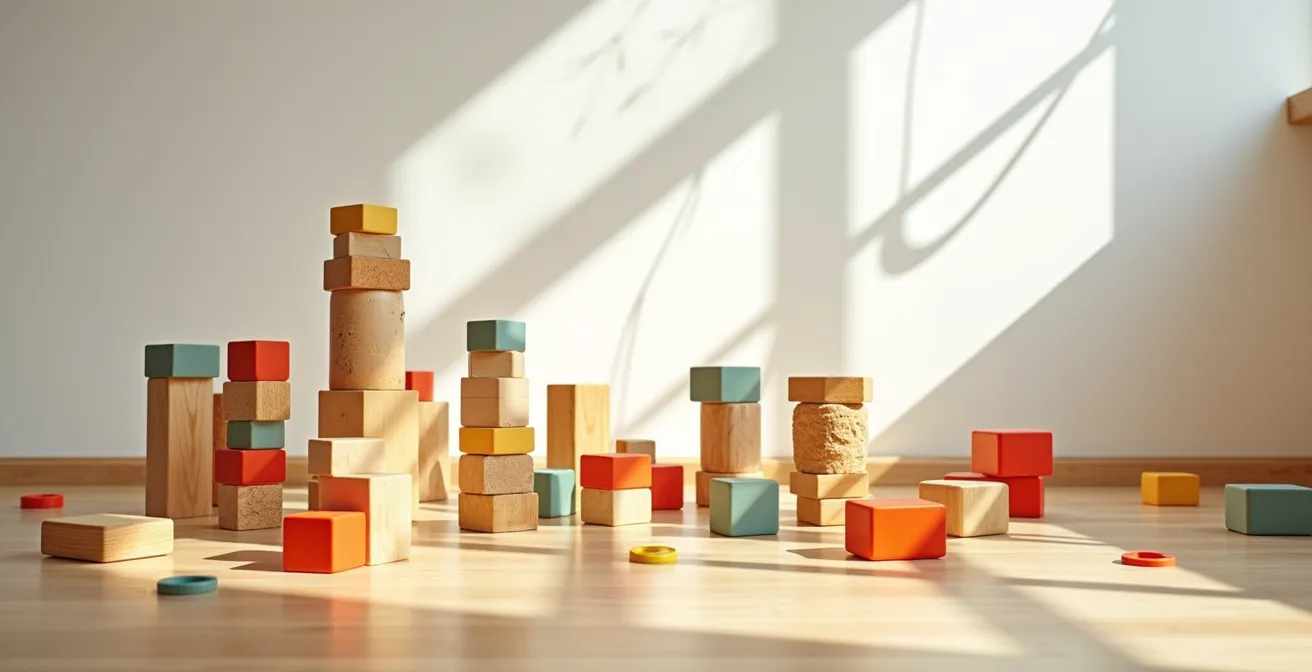
As you can see, using both materials together elevates play to a new level, encouraging integrated problem-solving. By understanding their distinct benefits, you can rotate them in and out to target specific skills or offer them together for maximum creative potential. The following table breaks down their strengths by age.
| Age/Stage | Wooden Blocks | Magnetic Tiles | Combined Use |
|---|---|---|---|
| 12-24 months | Superior for gravity exploration, stacking, knocking down | Too complex for this age | Blocks only recommended |
| 2-3 years | Balance, weight distribution, cause-effect learning | Beginning 2D patterns on floor | Blocks as primary, tiles as supplement |
| 3-5 years | Foundation building, structural physics | 2D to 3D transitions, geometric understanding | Use blocks as bases for tile structures |
The Visual Clutter Mistake That Kills Creativity Instantly
The most common mistake parents make is believing that more choice equals more creativity. The opposite is true. A room filled with dozens of toys doesn’t inspire a child; it paralyzes them. This isn’t a matter of opinion but of cognitive science. Faced with too much stimulus, a child’s brain experiences what researchers call “cognitive shutdown.” Unable to decide where to focus, the child flits from one toy to the next, touching everything but engaging with nothing. Or, they default to the easiest, most passive option available, like asking for a screen.
The numbers are stark. While the average home has around 90 toys for a toddler, child development experts recommend that 3 to 5 toys are optimal for focused play at any given time for infants and toddlers. This intentional scarcity creates mental space. When a child has only a few well-chosen items available, they are compelled to explore them more deeply, invent new ways to use them, and sustain their attention for longer periods. The visual “noise” of a cluttered playroom is a direct enemy of this deep engagement.
As Dr. Carly Dauch noted in her landmark study on the subject, this overload is a primary killer of creativity. In her research for the University of Toledo Infant Behavior Study, she observed this phenomenon directly:
Too many toys can lead to cognitive shutdown, causing children to flit between toys without engaging deeply or simply default to screen time.
– Dr. Carly Dauch, University of Toledo Infant Behavior Study
Liberating your child’s creativity starts with liberating their environment from this visual and mental clutter. A clean, organized space with just a handful of toys is not a punishment; it’s a gift of focus.
How to Label Bins So a 3-Year-Old Can Clean Up Independently?
Fostering independence in cleanup is a primary goal for many parents, and the right labeling system is the key. For a pre-reading three-year-old, text labels are meaningless. The secret is to create a system that is visual, tactile, and intuitive. Instead of relying on words, you make the bin itself communicate its contents in a way a young child can instantly understand. This turns tidying from a chore they need help with into a matching game they can master on their own.
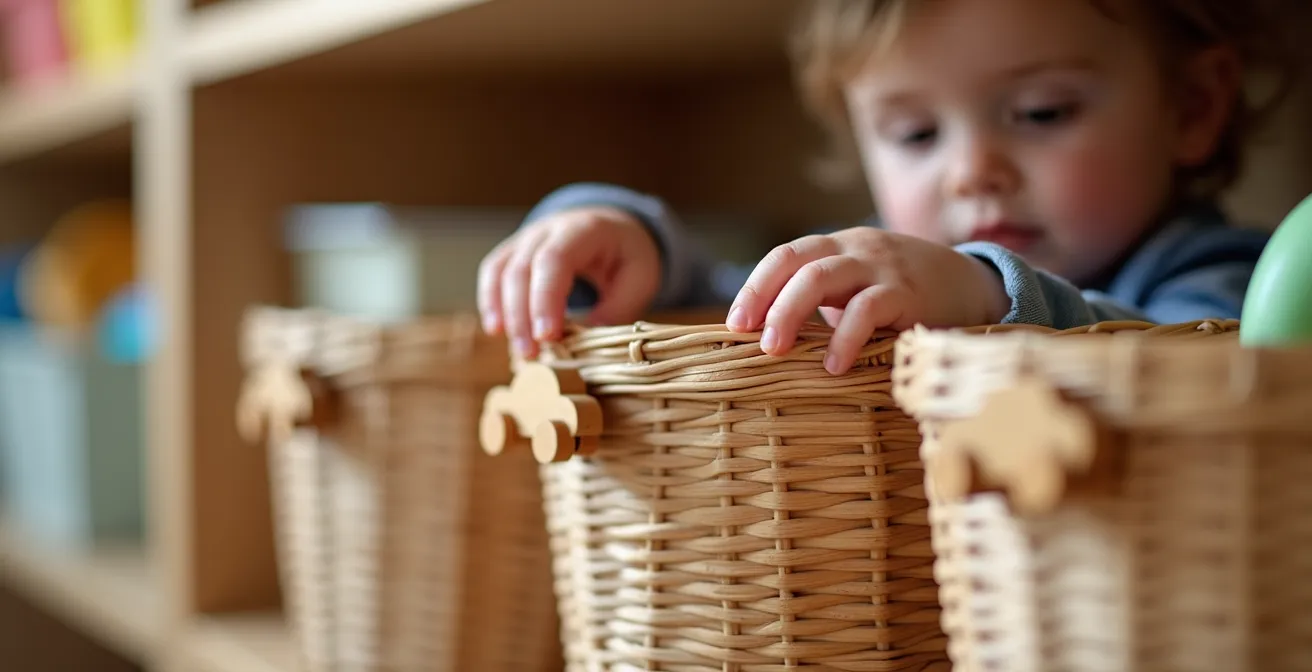
The most effective method is to use a real object as the label. By gluing an actual LEGO brick to the outside of the LEGO bin or a small plastic animal to the animal bin, you create an unambiguous, three-dimensional cue. The child doesn’t need to decipher a picture; they simply match the object in their hand to the identical object on the container. This one-to-one correspondence is the foundation of early categorization skills.
The image below demonstrates this powerful yet simple concept in action. The child’s hands are naturally drawn to match the toy car to its designated home, guided by the tactile label.
To further enhance this system, you can use clear containers so the contents are always visible, reinforcing the connection. Another powerful technique is to color-code the shelf space where the bin belongs, so the red bin always returns to the red-marked spot. Finally, you can transform cleanup into a “transporting game,” where the child’s “job” is to drive the cars back to their garage or bring the animals back to their farm. This playful approach, combined with a clear visual system, empowers your child to take ownership of their space.
How to Set Up a Custodial Account That Compounds Tax-Free?
The philosophy of toy rotation and minimalism isn’t just about creating a calmer home; it’s about a fundamental shift in values from consumption to intentionality. And this shift can have a profound financial impact. By consciously reducing toy purchases, you free up significant funds that can be redirected toward your child’s long-term future. Consider the scale: in the UK alone, over $3.3 billion is spent on toys annually. Redirecting even a fraction of that spending can build substantial wealth for your child.
Instead of another plastic toy destined for the clutter pile, that money could be seeding a custodial account, such as a 529 plan (in the US) or a similar tax-advantaged education savings vehicle. These accounts allow investments to grow tax-free, harnessing the power of compound interest over nearly two decades. The “toy” you’re giving them is the gift of future opportunity and financial security.
One family’s “Anti-Toy Fund” provides a powerful case study. By redirecting 50% of their annual $2,000 toy budget into a 529 plan, they invested an extra $1,000 each year. Their projections showed this simple shift could grow into a college fund of over $35,000 in 18 years. To make this abstract concept tangible for the family, they created a visual “growth thermometer” on the wall, coloring in a new section each time they chose to invest instead of purchase. This beautifully connects the act of saying “no” to a fleeting want with the “yes” of a growing future, making compound interest a visible and exciting family project.
Key Takeaways
- Toy rotation is a developmental tool, not a cleaning system. Its goal is to match toys to a child’s current cognitive needs (schemas).
- Visual clutter causes “cognitive shutdown,” which is why fewer toys on display lead to longer, more focused play.
- The best time to rotate toys is not on a fixed schedule, but when you observe your child has achieved “mastery” of the current items.
When to Rotate Toys: The Sign That Your Baby Is Bored with the Selection?
One of the biggest questions parents have is “how often should I rotate toys?” The common advice of “every two weeks” is arbitrary and misses the point. The cue for rotation isn’t the calendar; it’s your child’s behavior. The true signal isn’t boredom, but its opposite: mastery. When your child can consistently and easily achieve the primary purpose of a toy—all the rings are on the stacker, the puzzle is solved without hesitation—their brain is signaling that it has extracted the learning from that challenge and is ready for a new one.
This idea is a cornerstone of Montessori-inspired parenting. It requires a shift from scheduling to observing. You become a scientist of your child’s play, watching for subtle cues. Is their engagement deep or shallow? Are they exploring a toy for several minutes (engagement) or just briefly touching it before moving on (interaction)? A consistent drop in the duration of play with individual items is a strong indicator that the challenge is gone.
As Montessori educator Kylie from the How We Montessori Blog puts it, this distinction is crucial:
The true sign for rotation isn’t boredom, but mastery. When a baby can consistently achieve the toy’s primary purpose, their brain is ready for a new challenge.
– Kylie, How We Montessori Blog
Another telltale sign is “toy spreading”—when a child takes everything off the shelf and scatters it without actually playing. This is often a cry for a new, more appropriate challenge. Before swapping everything out, it’s wise to observe these patterns for a few days to confirm it’s a true developmental shift and not just a passing mood. This child-led approach ensures that the environment is always perfectly calibrated to their learning journey.
Creating a Montessori-Inspired Environment for Infants Under 6 Months
For infants, the world is their playroom, and a Montessori-inspired environment is designed to be safe, engaging, and respectful of their developing abilities. The principles of toy rotation apply even to the youngest babies, but the focus is less on “toys” and more on “purposeful materials.” The goal is to create a simple, uncluttered space that supports motor skills, sensory development, and concentration from day one. Montessori practitioners often recommend a total collection of 8 to 16 quality toys for this age group, with only 6 to 8 available at any one time.
An effective setup for an infant involves creating distinct activity stations that can be rotated. A movement area, typically with a soft mat and a low-hanging wall mirror, is a constant. It allows the infant to observe their own movements and build body awareness. A visual area might feature a simple wooden play gym from which high-contrast mobiles are hung and rotated weekly to match their developing eyesight (e.g., progressing from the black-and-white Munari mobile to the colorful Gobbi). Finally, a tactile area could be a “treasure basket” filled with a few safe, natural objects (a wooden spoon, a large smooth stone, a silk scarf) that are changed every couple of weeks to offer new textures and shapes to explore.
One educator who implemented this system for a 4-month-old reported that the infant was engaging in independent, focused “work” for 20-30 minute periods by 5 months old—a significant increase from the typical 5-10 minute engagement span. This demonstrates that even at this early age, a thoughtfully curated and rotated environment respects the infant’s capacity for concentration and prevents the overstimulation that leads to fussiness.
Your journey toward a calmer, more creative home begins not with a massive cleanup, but with a simple act of observation. Watch your child, understand their play, and intentionally curate their world. Start today by choosing just one area to simplify and witness the profound impact it has on their focus and joy.