
If your baby screams during tummy time, the solution isn’t to force it; it’s to understand and address the root cause of their discomfort.
- Discomfort from reflux can be eased with inclined positions, like using a yoga ball.
- Weak core muscles or a disengaging environment can be overcome with strategic play and positioning.
Recommendation: Shift your mindset from ‘enduring’ tummy time to becoming a ‘developmental detective,’ finding the positions and environments where your baby can thrive.
It’s a sound many new parents know all too well: the instant, frustrated wail that begins the moment your baby’s belly touches the play mat. You’ve heard the advice from everyone—your pediatrician, fellow parents, countless articles. “Tummy time is crucial!” they say. You feel the pressure, knowing it’s key to building strength and preventing a flat head, but the daily battle leaves you feeling stressed and defeated.
The common advice is to try for short periods or use distracting toys. But what if that doesn’t work? What if the crying continues, turning what should be a developmental activity into a source of anxiety for both you and your baby? The truth is, your baby isn’t being difficult; they are communicating. They are telling you that something about the standard floor position isn’t working for their body right now.
But here’s the secret that can change everything: what if the key isn’t to force your baby to endure tummy time, but to solve it like a developmental puzzle? As a pediatric physical therapist, I want to shift your perspective. This isn’t a battle of wills. It’s an opportunity to understand your baby’s unique needs—be it reflux discomfort, visual preference, or the need for more support—and adapt the “work” to fit them. Tummy time doesn’t just have to happen on the floor.
This guide will walk you through why your baby might be resisting and introduce you to a world of effective, gentle alternatives. We’ll explore how to use simple tools like a yoga ball, redesign your play space into a “Yes Environment,” and leverage your own body as the ultimate playground. It’s time to transform tummy time from a daily struggle into a moment of connection and progress.
To help you navigate these solutions, this article breaks down the most common challenges and provides practical, therapist-approved alternatives. You’ll find a clear path to making this essential activity a positive experience for everyone.
Summary: A Practical Guide to Overcoming Tummy Time Tears
- Why Skipping Tummy Time Leads to Flat Head Syndrome (Plagiocephaly)?
- How to Use a Yoga Ball to Make Tummy Time Bearable for Reflux Babies?
- Chest-to-Chest vs Floor Mirror: Which Position Is Easier for Beginners?
- The Pillow Prop Mistake That Can cause Suffocation Risks
- When to Do Tummy Time: Why Doing It After a Feed Is a Recipe for Disaster?
- The “Bumbo Seat” Mistake That Weakens Core Muscle Development
- How to Keep Your Pelvis Mobile Even After You Can’t Feel Your Legs?
- Designing a “Yes Environment” to Accelerate Gross Motor Skills Safely
Why Skipping Tummy Time Leads to Flat Head Syndrome (Plagiocephaly)?
The “Back to Sleep” campaign, initiated in 1992, was a monumental success in reducing the risk of Sudden Infant Death Syndrome (SIDS). It taught parents the vital importance of placing babies on their backs to sleep. However, this essential safety guideline had an unintended consequence: a significant increase in positional plagiocephaly, or “flat head syndrome.” Because babies now spend so much time on their backs in cribs, car seats, and swings, the constant pressure on one part of their soft, pliable skull can cause it to flatten.
The numbers are telling. Since the campaign began, studies show the incidence of positional plagiocephaly has risen from 2-5% to as high as 20-46%. This isn’t just a cosmetic issue; severe plagiocephaly can sometimes be associated with developmental challenges, as it may restrict the baby’s ability to turn their head equally in both directions, impacting motor skills and visual tracking.
Tummy time is the primary counterbalance to all that time spent on the back. It relieves pressure on the back of the head and, more importantly, it’s the fundamental workout for your baby. During these sessions, they are strengthening their neck, shoulder, back, and arm muscles. This neuromuscular development is what gives them the strength to lift and turn their head freely, which naturally varies the pressure points on their skull throughout the day.
Skipping this “workout” means those muscles remain weak, making it harder for the baby to reposition their own head. They may develop a preference for turning to one side (torticollis), which exacerbates the flattening. Therefore, viewing tummy time not as an optional activity but as a crucial developmental and preventative tool is the first step toward understanding its importance.
Ultimately, consistent practice, even in alternative forms, is the best defense against flat head syndrome and the cornerstone of healthy motor development.
How to Use a Yoga Ball to Make Tummy Time Bearable for Reflux Babies?
For many babies, the hatred of tummy time isn’t stubbornness—it’s genuine discomfort, often caused by gastroesophageal reflux (GER). When a baby with reflux lies flat on their stomach, gravity works against them, allowing stomach acid to travel back up the esophagus. This causes a painful burning sensation, and naturally, the baby protests. Forcing them to “push through” this pain is counterproductive and can create a lasting negative association with the position.
This is where a yoga or exercise ball becomes a game-changing tool. By placing your baby tummy-down on the ball, you can create an inclined surface where their head is slightly higher than their stomach. This simple adjustment uses gravity to your advantage, helping to keep stomach contents down and significantly reducing reflux-related discomfort. It transforms the experience from painful to tolerable, and even enjoyable.
To do this safely, kneel on the floor and place the ball in front of you. Drape your baby over the top, keeping a firm, secure grip on their trunk and hips at all times. You can gently roll the ball forward and backward or side to side. This movement is not only soothing but also stimulates their vestibular system, which is crucial for balance and spatial awareness. The unstable surface of the ball gently challenges their core muscles to engage in a way that the flat floor does not, promoting postural activation without the associated pain.
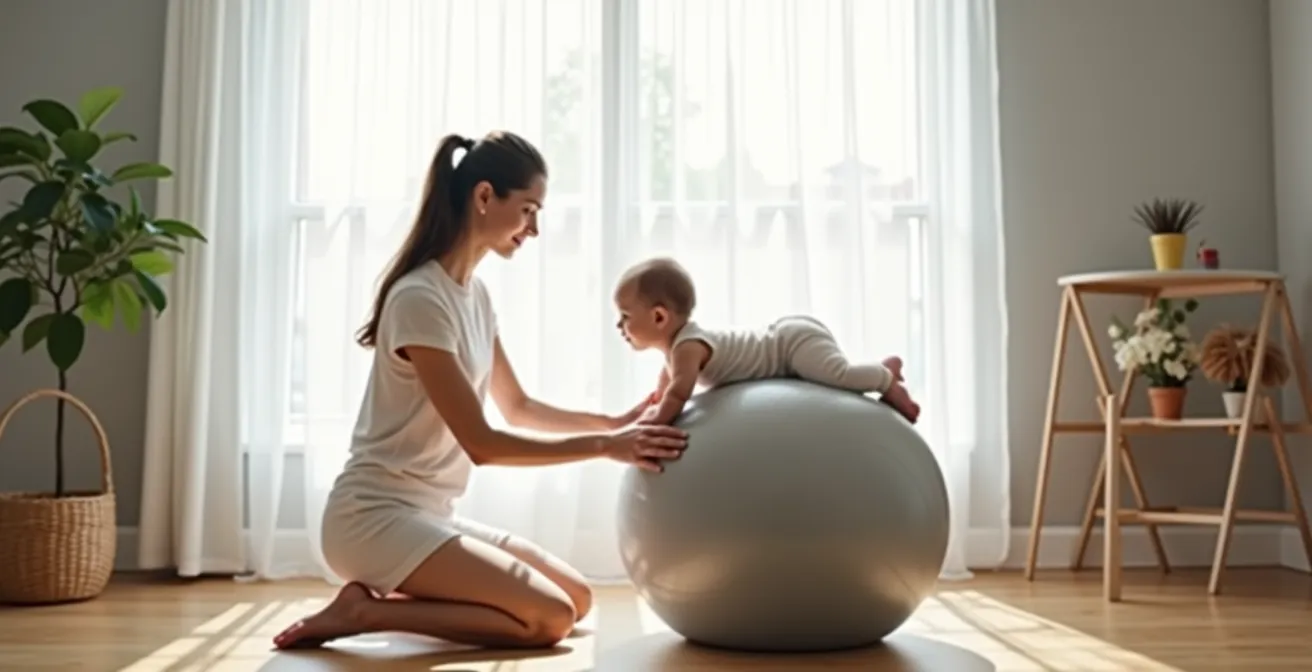
As the image demonstrates, your hands should always be providing support and stability. For added benefit, physical therapists often recommend positioning the baby so they are lying slightly on their left side on the ball. This takes advantage of the stomach’s natural J-shape, further using gravity to prevent spit-up. This technique is a perfect example of solving the developmental puzzle: identifying the root problem (reflux pain) and using a simple tool to change the environment.
By making this one change, you meet your baby where they are, building trust and turning a dreaded activity into a positive, skill-building exercise.
Chest-to-Chest vs Floor Mirror: Which Position Is Easier for Beginners?
Before a baby is ready to tackle long sessions on the floor, they need to build foundational strength and confidence. Two of the best starting positions are chest-to-chest (or “tummy-to-tummy”) and using a floor mirror. While both are excellent, they serve slightly different purposes and are ideal for different stages of early development. Understanding which to use and when can make all the difference for a baby who is just starting out.
The chest-to-chest position is the ultimate beginner’s move. To do it, simply recline on a couch or bed, supported by pillows, and lay your baby on your chest. This position is naturally soothing. Your baby can hear your heartbeat, feel your warmth, and see your face up close, which provides immense comfort and security. It’s the least intimidating way to introduce tummy time because the incline makes it easier for them to attempt those first wobbly head lifts. The primary goal here is bonding and gentle, short-bursts of neck muscle activation.
As your baby gets a bit stronger (around 2-4 months), introducing a non-breakable floor mirror can be a powerful motivator. Babies are fascinated by faces, including their own. Placing a mirror in front of them during floor time encourages them to lift and hold their head up for longer periods as they engage with their reflection. This fosters independent play and self-discovery. The goal shifts from comfort and bonding to encouraging longer duration and active visual tracking.
The following table, based on guidance from pediatric experts, breaks down the key differences to help you choose the right approach for your baby’s age and ability.
| Position | Best Age | Key Benefits | Duration |
|---|---|---|---|
| Chest-to-Chest | Newborn-2 months | Soothing, helps practice first head lifts, promotes bonding | 2-5 minutes at a time |
| Floor Mirror | 2-4 months+ | Encourages visual tracking, longer independent sessions, self-discovery | 5-15 minutes as tolerated |
As Huckleberry Pediatric Sleep Consultants note, “Placing your baby chest-to-chest, or ‘tummy to tummy,’ as you recline, is soothing and helps your baby practice those first wobbly head lifts.” It’s the perfect starting point. The mirror then becomes the next logical step to build endurance.
By starting with the easier, more comforting position and progressing as your baby shows readiness, you create a positive learning curve instead of a frustrating wall.
The Pillow Prop Mistake That Can cause Suffocation Risks
In an attempt to make tummy time more comfortable, many well-meaning parents reach for a pillow to prop their baby up. However, this common practice can be extremely dangerous. Using a soft, squishy pillow, like a Boppy or a standard bed pillow, poses a significant suffocation risk. If a baby’s head slumps forward, their face can press into the soft surface, obstructing their airway. Because young infants lack the neck strength to lift and reposition their head, this can quickly become a life-threatening situation. Safe sleep and safe play guidelines are clear: soft bedding and pillows should never be used for unsupervised tummy time.
This doesn’t mean all propping is bad—it just has to be done correctly. The mistake isn’t the idea of providing support, but the tool used. Instead of a soft pillow, pediatric therapists recommend using a much smaller, firmer object, such as a tightly rolled-up towel or a small, firm nursing pillow designed specifically for this purpose. The key is in the placement and the firmness.
The correct technique involves placing the firm roll under your baby’s chest and armpits, with their arms forward over the roll. This position accomplishes two things safely:
- It creates a gentle incline that takes some pressure off the baby’s belly, making the position more comfortable.
- It provides ergonomic support to the shoulder girdle, positioning the arms correctly to begin practicing pushing up.
This placement facilitates proper muscle development and prevents the baby from simply resting their chin on the prop. The roll should never be placed under the abdomen, as this can put undue pressure on their internal organs and hinder the work of the core muscles.
Supervision is always non-negotiable, even with a proper prop. The goal is to provide just enough support to make the activity manageable, allowing the baby to build strength progressively. By swapping a hazardous soft pillow for a firm, strategically placed roll, you eliminate the risk while still providing the helpful assistance your baby needs to succeed.
This simple switch from a soft pillow to a firm roll is a perfect example of how a small, informed adjustment can make an activity both safer and more effective.
When to Do Tummy Time: Why Doing It After a Feed Is a Recipe for Disaster?
You’ve found the perfect position, set up an engaging play area, and your baby seems content. But as soon as you place them on their tummy, they spit up and start to cry. What went wrong? The answer is often not the position, but the timing. Scheduling tummy time immediately after a feeding is one of the most common mistakes parents make, and it’s a guaranteed recipe for discomfort.
When a baby’s stomach is full of milk, lying flat on their belly puts direct pressure on it. This pressure, combined with an immature esophageal sphincter (the muscle that keeps stomach contents down), makes it incredibly easy for milk to come back up. This leads to spit-up at best, and painful reflux at worst. It’s uncomfortable and quickly creates a negative association with the activity. As the pediatric therapists at Pathways.org advise, “Try to do Tummy Time when baby is most happy and avoid Tummy Time immediately after feeding.”
So, when is the best time? The ideal window is when your baby is in a “quiet alert” state. This is the period when they are awake, calm, and observant—often right after they wake up from a nap (and before they are hungry again) or after a diaper change. Integrating a few minutes of tummy time into your diaper change routine is a fantastic strategy for consistency. Since you’re already on the floor with them, it feels like a natural extension of your interaction rather than a separate, scheduled chore.
Remember, the goal is not one long, marathon session. Multiple short bursts throughout the day are far more effective and less overwhelming for a baby. Start with just 2-3 minutes at a time for a newborn and gradually work up. A few minutes on your chest here, a few minutes on the floor after a diaper change there—it all adds up. By the time they are two months old, pediatricians recommend they get a total of 15 to 30 minutes per day.
Your Action Plan: Perfecting Tummy Time Timing
- Identify the ‘Quiet Alert’ Window: Observe your baby’s cues. Find those happy, calm moments after a nap or during play when they are most receptive.
- Integrate into Routines: Make tummy time a standard part of every diaper change. This builds consistency without adding another item to your to-do list.
- Implement the 30-Minute Rule: Wait at least 30 minutes after a feeding before attempting any tummy-down positions to allow for initial digestion.
- Practice in Short Bursts: Aim for 3-5 short sessions (3-5 minutes each) spread throughout the day instead of one long, stressful session.
- Listen to Your Baby: If your baby is tired, fussy, or hungry, it’s not the right time. End the session on a positive note before they become distressed.
By being strategic about when you practice, you set your baby up for success, making tummy time a pleasant and productive part of their day.
The “Bumbo Seat” Mistake That Weakens Core Muscle Development
In the quest to help their babies sit up, many parents turn to supportive seats like the Bumbo. These “container” devices seem like a helpful shortcut, propping a baby into a seated position before they have the strength to do it on their own. However, pediatric physical therapists often caution against their overuse. While convenient, these seats can actually hinder the very muscle development they appear to support.
The problem with a Bumbo-style seat is that it is a form of passive positioning. The molded foam does all the work, holding the baby’s trunk and pelvis in a fixed, slumped posture. The baby isn’t required to activate their own core, back, or neck muscles to stay upright. They are simply being held in place. This can lead to several issues: it promotes a posterior pelvic tilt (a rounded lower back), which is the opposite of the posture needed for healthy sitting, and it prevents the baby from learning to make the small, constant weight shifts and postural adjustments that are essential for developing balance and coordination.
Scientific evidence supports this. Studies using electromyography (EMG) to measure muscle activity have shown that the activation of crucial neck and back muscles is minimal to non-existent when babies are placed in containers like car seats or Bumbos. In contrast, muscle activation is highest when babies are on their tummies on the floor, being held in a parent’s arms, or worn in a carrier. These are all forms of active positioning, where the baby must work against gravity to support themselves.
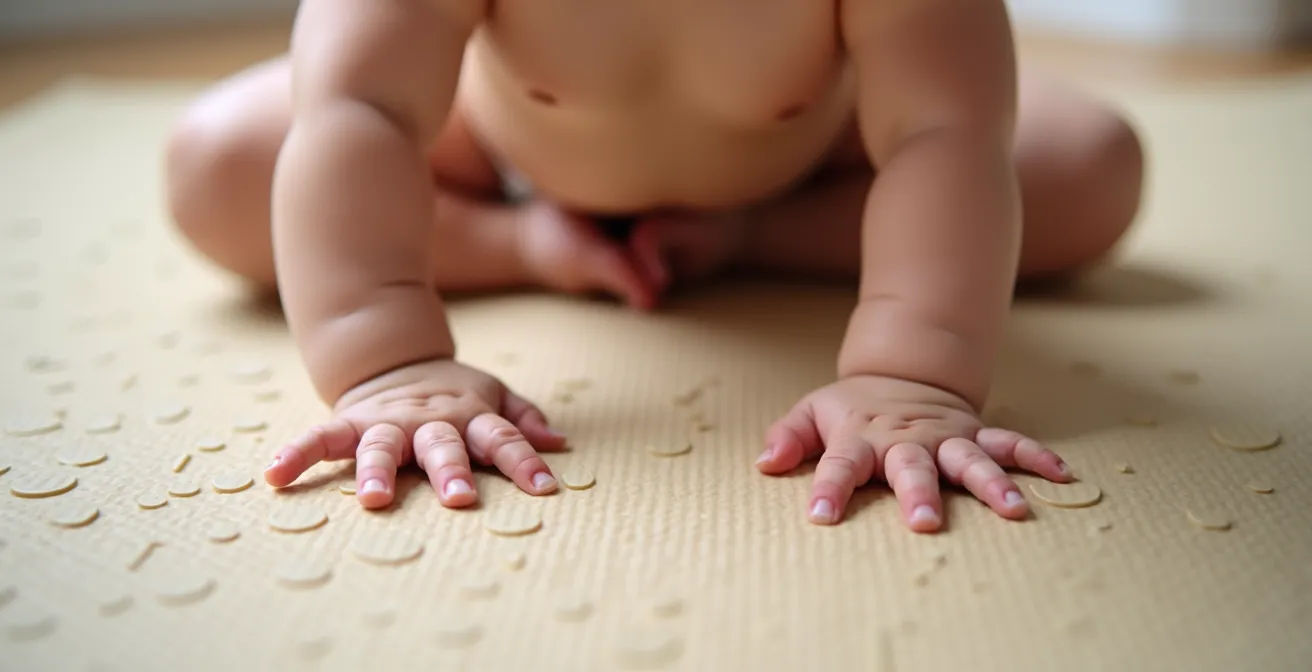
The alternative to passive containers is simple: floor time. The floor is the best gym for a baby. It’s where they can freely move, push up, roll, and eventually learn to get into a sitting position on their own. This process of independent motor exploration is what truly builds a strong, stable core. Instead of propping your baby to sit, encourage the skills that lead to sitting: lots of tummy time, side-lying play, and opportunities to roll.
By prioritizing free movement on the floor over time spent in containers, you give your baby the opportunity to develop the authentic, functional core strength they need for a lifetime of healthy movement.
How to Keep Your Pelvis Mobile Even After You Can’t Feel Your Legs?
Getting down on the floor to play with your baby can be a physical challenge for many parents. Whether you’re recovering from a C-section, dealing with chronic back pain, have a physical disability, or are simply exhausted, the idea of floor-based tummy time can feel daunting or even impossible. This doesn’t mean your baby has to miss out on this crucial developmental activity. In fact, it opens the door to some of the most effective and intimate alternatives.
The most powerful tool you have is your own body. As one pediatric physical therapy guideline suggests, you should “Position the parent’s body as the primary playground.” This empathetic approach transforms the challenge into an opportunity for deeper connection. By using your own chest, lap, and legs, you can provide a comfortable, engaging, and perfectly calibrated surface for your baby’s “workout.”
Instead of getting on the floor, try these floor-free alternatives:
- Lap Time: Sit comfortably in a supportive chair or on the couch. Lay your baby across your thighs, tummy-down. You can position them with their head and arms hanging slightly off one side, encouraging them to look around. This is a great way to practice while you relax.
- The Chest-to-Chest Recline: As mentioned earlier, reclining on the couch or bed and placing your baby on your chest is a fantastic option. It requires no floor work from you and provides immense comfort for your baby.
- The “Airplane” Hold: As you walk around the house, hold your baby facing away from you. Support their trunk with one forearm and use your other hand to support their bottom or legs. Gently tilt their trunk forward so they are parallel to the ground. This hold actively engages their back and neck muscles as they look around.
These positions not only save your back but also offer unique sensory experiences for your baby. They feel your movement, hear your voice, and are engaged in your daily activities. This is far more stimulating than staring at the same spot on a play mat.
By reframing the “problem” of physical limitation, you can create meaningful, movement-rich interactions that benefit both you and your baby.
Key Takeaways
- Solve, Don’t Force: Tummy time resistance is communication. Instead of pushing through tears, become a detective to find and solve the root cause of the discomfort.
- The Environment is a Tool: Your body, a yoga ball, or a simple rolled towel can be more effective than a flat floor. Modify the environment to make the activity manageable and successful.
- All Active Positions Count: Tummy time isn’t just one position. Being held in an “airplane” hold or lying on your chest are powerful ways to build the same essential muscles.
Designing a “Yes Environment” to Accelerate Gross Motor Skills Safely
As your baby becomes more mobile, your role as a parent shifts from initiating movement to facilitating it. The ultimate goal is to create a space where your baby can explore and practice their developing skills safely and independently. This is what’s known as a “Yes Environment”—a space that is so thoroughly baby-proofed and thoughtfully designed that you don’t have to constantly say “no.” It’s an environment that encourages movement, curiosity, and motor skill acquisition.
A Yes Environment removes the obstacles that lead to frustration. Instead of a playpen packed with overwhelming toys, it might be a gated-off area of a living room with a few simple, engaging items. The focus is on giving the baby the freedom to move their body in space. This is where they connect the dots between tummy time strength, rolling, and the beginnings of crawling. The floor becomes their laboratory for movement.
A key part of a Yes Environment is creating a rich sensory landscape. Instead of always using the same soft play mat, vary the textures and surfaces. Let them do tummy time on a fuzzy blanket, a smooth wooden floor, or even outdoors on a soft patch of grass (under close supervision). This sensory input does more than just feel interesting; it provides the brain with crucial information about the body’s position in space (proprioception) and keeps them engaged for longer periods. A baby who is bored on a plain mat might happily spend several more minutes exploring a textured blanket.
This freedom to explore is what helps them meet and exceed developmental guidelines. The World Health Organization, for example, has found that babies who achieve over 30 minutes of tummy time per day by 7 weeks of age show better overall developmental outcomes. Reaching this goal is much easier in an environment that naturally invites and rewards movement, rather than one where activity is confined to short, structured sessions.
By thoughtfully designing your baby’s play space, you move from being the “director” of tummy time to the “facilitator” of a world of movement, empowering them to build strength, coordination, and confidence on their own terms.